
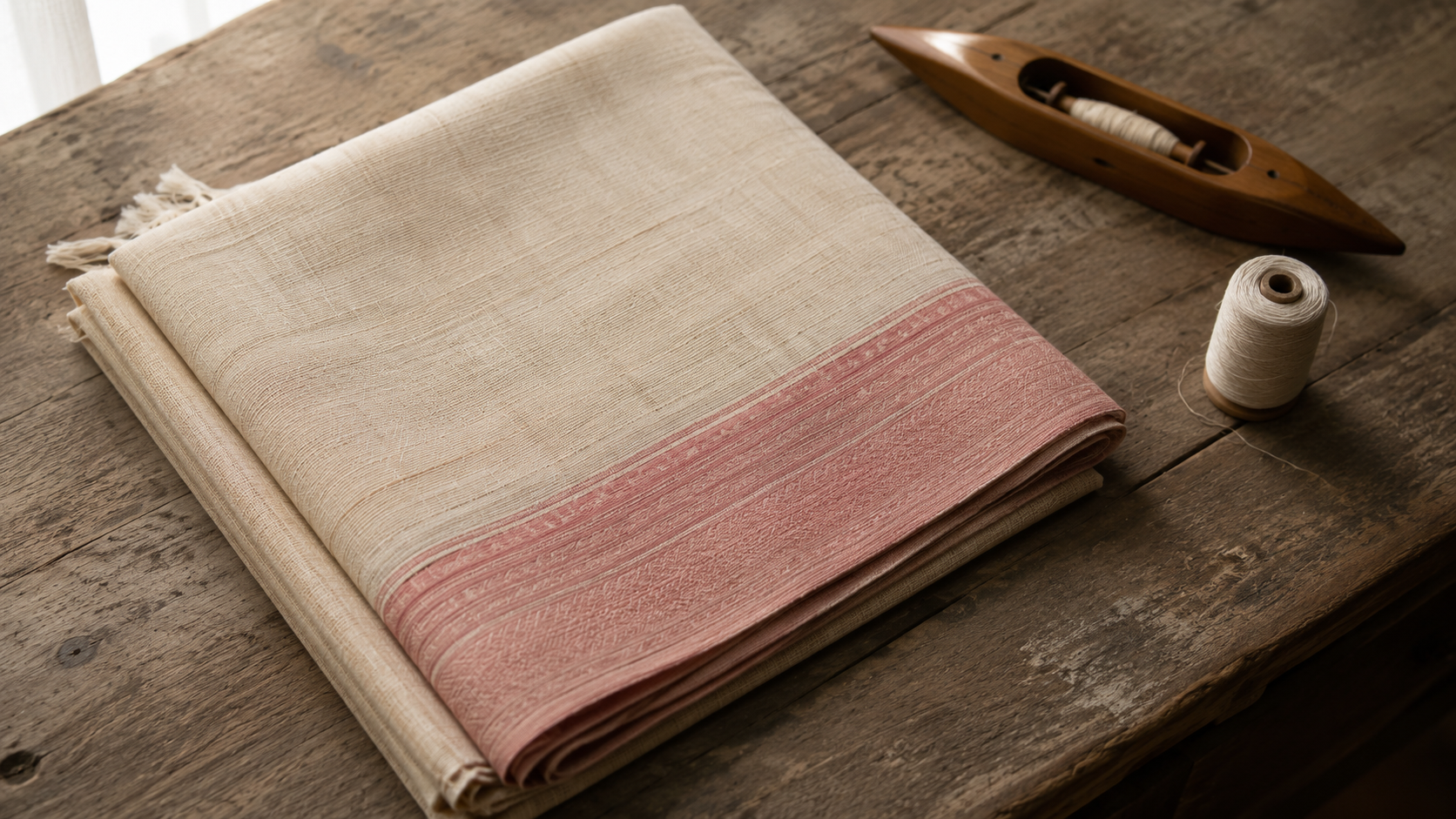
A cotton saree guide should start with a confession: cotton is the most undervalued fabric in the saree world. Silk gets the heritage, brocade gets the wedding photos, organza gets the contemporary fashion press — but cotton is the saree that Indian women have actually worn, every day, for two thousand years. For European wearers building a saree wardrobe, the cotton saree is also the most practical first piece. This cotton saree guide covers what cotton sarees actually are, where they come from, how to spot a real handloom from a powerloom, how to wear and care for one, and why every saree wardrobe should start with cotton. Written from Munich, for European readers.
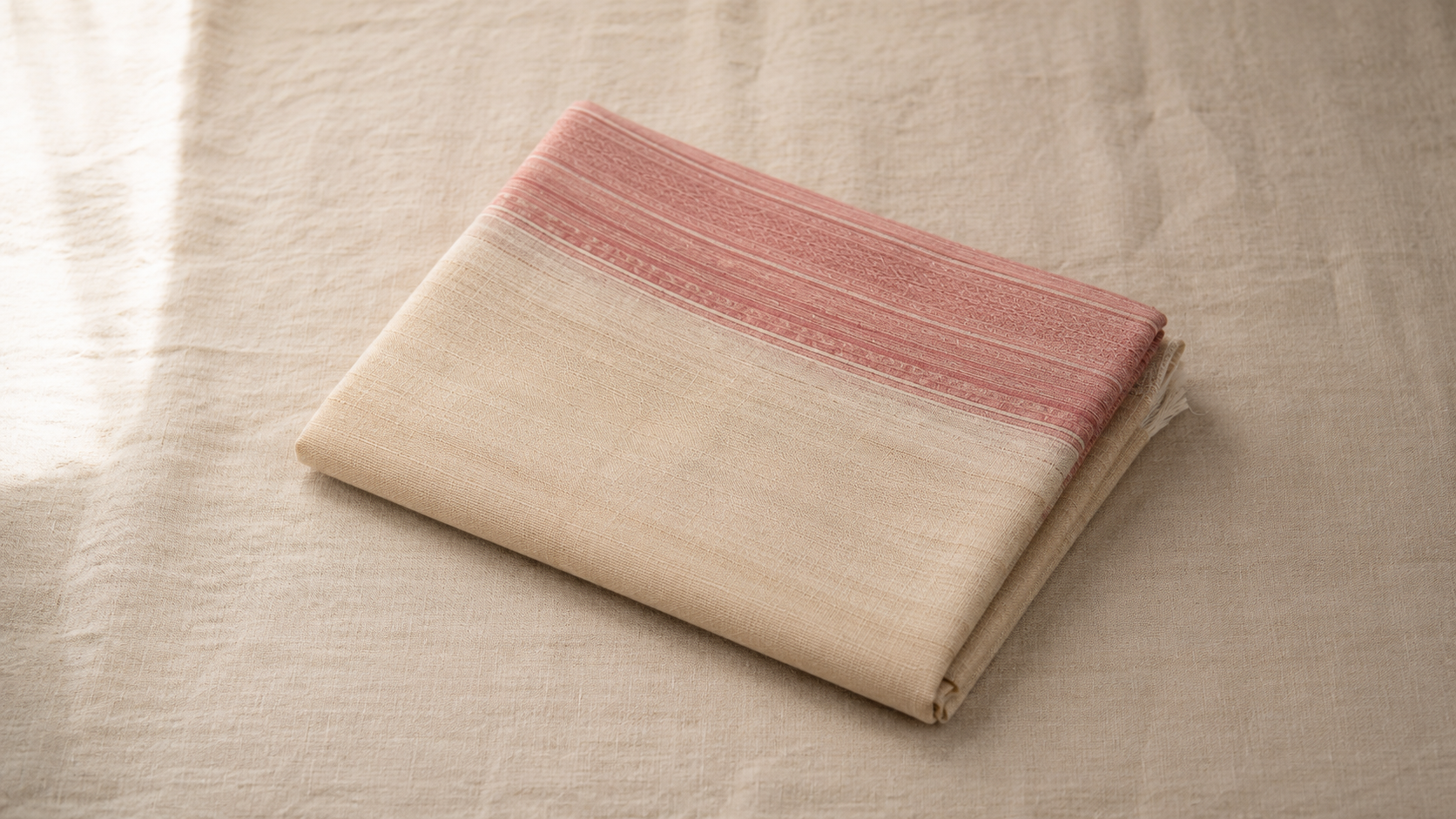
In this cotton saree guide
What makes a cotton saree different
This cotton saree guide is built around handloom cotton specifically. A cotton saree is defined by its fabric — pure cotton, traditionally hand-spun and hand-woven, though much of what is sold today is machine-spun cotton or powerloom-woven. The differences from silk are immediate. Cotton is lighter than silk in weight but stiffer in drape. It absorbs sweat. It breathes. It does not catch on jewellery. It develops character with washing. And it costs a fraction of what a comparable silk costs, which is why any cotton saree guide must put everyday wearability at the centre of the conversation. The cotton saree guide approach we take here always begins with use, then moves to history and provenance.
For this cotton saree guide, we focus mostly on handloom cotton — the version with the most weight, both literal and cultural. Handloom cotton sarees are woven on traditional pit looms by individual weavers, usually within a regional tradition that has continued for generations. The fabric has a slightly uneven, alive texture. The borders and pallu are often woven in contrasting colours or with subtle patterns. Each piece is technically unique, even within the same design. A serious cotton saree guide returns repeatedly to these handloom traditions.
A cotton saree is the workhorse of any Indian wardrobe. In our five-piece starter capsule, cotton is Piece 1 — the everyday, the learning saree, the forgiving foundation. This cotton saree guide explains why.
A short history of cotton in Indian textiles
Cotton in India is older than almost any garment in continuous use anywhere in the world. Cotton was being woven into cloth in the Indus Valley by 3000 BCE. By the time of the Roman Empire, Indian cotton was a major export, prized across the Mediterranean for its fineness and dyeability. Indian cotton fabrics — particularly the famed Dhaka muslin and Bengal calico — clothed European nobility for centuries. The historical depth a cotton saree guide reveals is part of what makes the garment meaningful to wear.
The cotton story turns political in the colonial period. The British East India Company systematically destroyed the Indian handloom industry to make room for British mill-spun cotton sold back to India. Mahatma Gandhi made hand-spun khadi cotton the symbol of Indian independence. Spinning your own cotton thread on a charkha became an act of political resistance. The post-independence Indian government continued to protect handloom cotton through the Handloom Act of 1985, the GI tag system, and continuing subsidies to weaver cooperatives. Any cotton saree guide that skipped this political history would understate what a cotton saree means in India today.
Today, a handloom cotton saree carries this entire history. According to Vogue India, handloom cotton has seen a major contemporary resurgence — younger Indian women, fashion designers, and museums have rediscovered handloom cotton as both a sustainable choice and a cultural touchstone. The cotton saree guide we are writing now sits within that resurgence, and any honest cotton saree guide must acknowledge this political and cultural weight.
The major cotton saree weaves of India
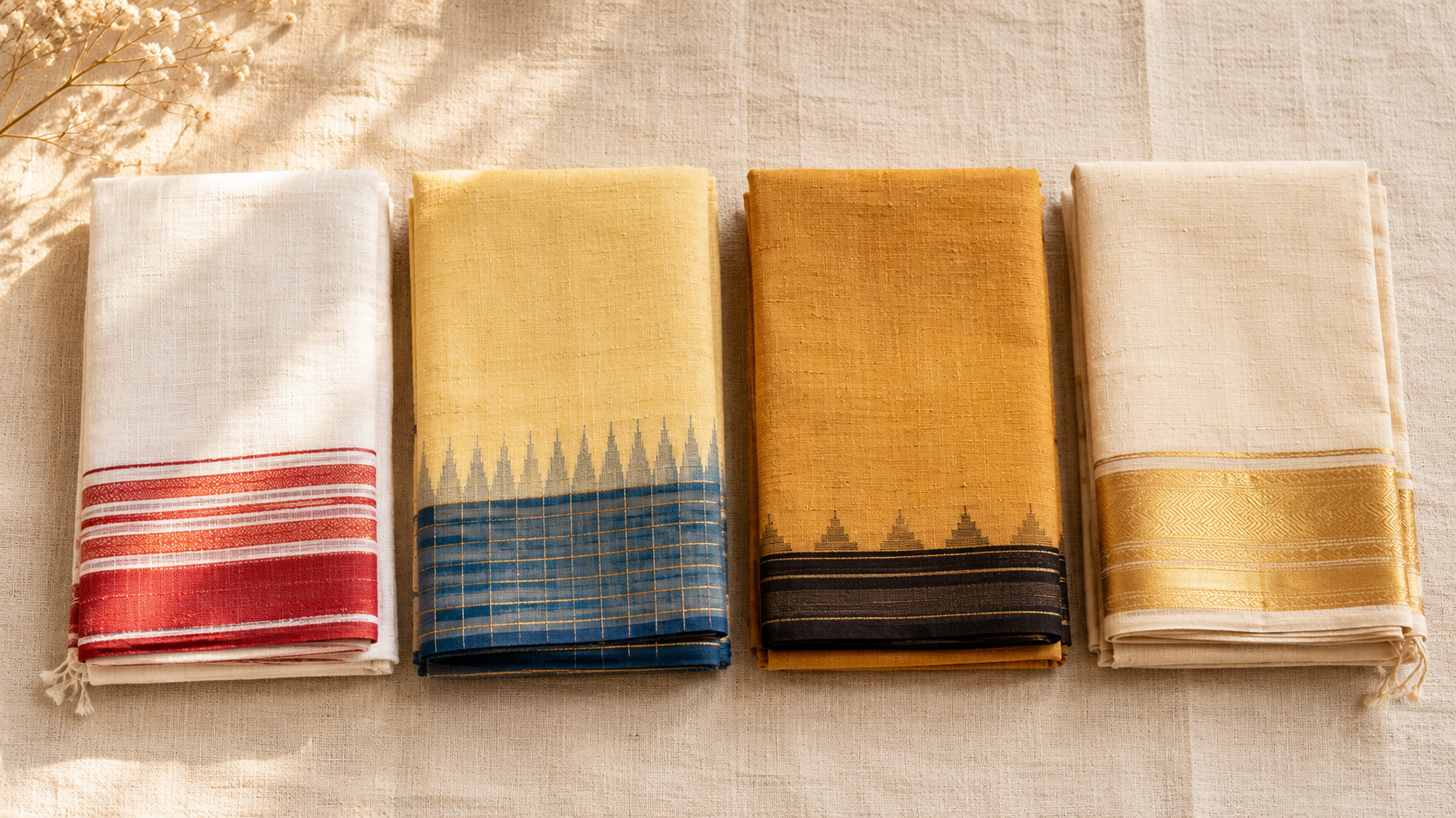
Cotton in India is not one fabric — it is dozens of regional weaves, each with its own history, character, and use. Any complete cotton saree guide must introduce the major traditions. We cover eight here in this cotton saree guide, in rough order of how often a European wearer will encounter them.
Bengal cotton (taant and Dhakai jamdani)
Taant is the everyday cotton saree of Bengal — light, crisp, breathable, traditionally white or pastel with a contrasting border. It is the saree most often worn by Bengali women for office wear, daytime occasions, and Durga Puja. Dhakai jamdani is the dressier Bengali cotton — finer, with intricate floral or geometric patterns woven directly into the fabric. Any cotton saree guide written for Indian readers would put Bengal cotton near the top of the list. Both taant and Dhakai jamdani are GI-tagged and produced by weaver communities concentrated in West Bengal and parts of Bangladesh.
Khadi cotton
Khadi is hand-spun and hand-woven cotton — the most labour-intensive cotton in India, and the most politically loaded. A khadi saree is rough-textured, breathable, and develops a beautiful softness with washing. In this cotton saree guide, khadi gets special weight because of its historical role in Indian independence. Khadi has its own regulatory body in India, and a genuine khadi product carries a Khadi Mark. The fabric is heavier than taant and reads more rustic and earthy.
Mangalagiri cotton
Mangalagiri sarees come from Andhra Pradesh and are recognisable by their woven borders — usually a contrasting colour, often with a striped or checked pattern. The cotton itself is medium-weight, sturdy, and very forgiving for first-time drapers. For most European wearers reading this cotton saree guide, Mangalagiri is the most accessible regional handloom cotton and a good entry point.
Venkatagiri cotton
Also from Andhra Pradesh, Venkatagiri is finer and lighter than Mangalagiri, often described as “translucent.” The fabric has a smooth finish with a slight sheen — almost silk-like at first touch. Borders are often jamdani-style, with small woven motifs running along the edge. In this cotton saree guide we suggest Venkatagiri as a second-purchase rather than a first because the lightness rewards experience.
Kalakshetra cotton
Kalakshetra sarees come from the Kalakshetra Foundation in Chennai, founded by Rukmini Devi Arundale as part of the classical Indian arts revival. The aesthetic is distinctive — earthy natural-dye colours, subtle borders, and a refined minimalist sensibility. Kalakshetra cottons are favoured by classical dancers, academics, and women who prefer understated elegance. A cotton saree guide that ignored Kalakshetra would miss one of the most considered handloom traditions in India.
Kanchipuram cotton
Kanchipuram is famous for silk, but its cotton sarees are also exceptional. The cotton is medium-weight with traditional South Indian temple borders — geometric patterns woven in contrasting colours, sometimes with gold-thread accents. Kanchipuram cottons are dressier than everyday Bengal cottons and work well for daytime weddings. Many readers of this cotton saree guide will end up with a Kanchipuram cotton as their dressier-cotton piece.
Kerala kasavu
Kasavu is the cream-and-gold cotton saree of Kerala, with a distinctive gold-thread border. The body is unbleached cream cotton; the gold border is genuine zari in traditional pieces. Kasavu is worn for Onam, Vishu, and other Kerala festivals, and reads elegant and ceremonial despite being cotton. This cotton saree guide places kasavu in a category of its own — neither everyday nor formal-silk-level, but ceremonial in a quietly distinctive way.
Madurai sungudi
Sungudi is a tie-dye cotton tradition from Madurai in Tamil Nadu — small dots and patterns are created by tying portions of the fabric before dyeing. The result is a playful, summery saree with a strong regional identity. Sungudi has GI protection and is increasingly hard to find as a genuine handloom — a recurring theme in any honest cotton saree guide, as authentic regional handloom traditions face the same powerloom pressure across India.
Handloom vs powerloom cotton — how to tell the difference
One of the most asked questions in any cotton saree guide is how to distinguish a genuine handloom cotton from a powerloom or mill-woven imitation. The differences are real, observable, and worth learning. This section of the cotton saree guide is the most practical buying advice we can offer.
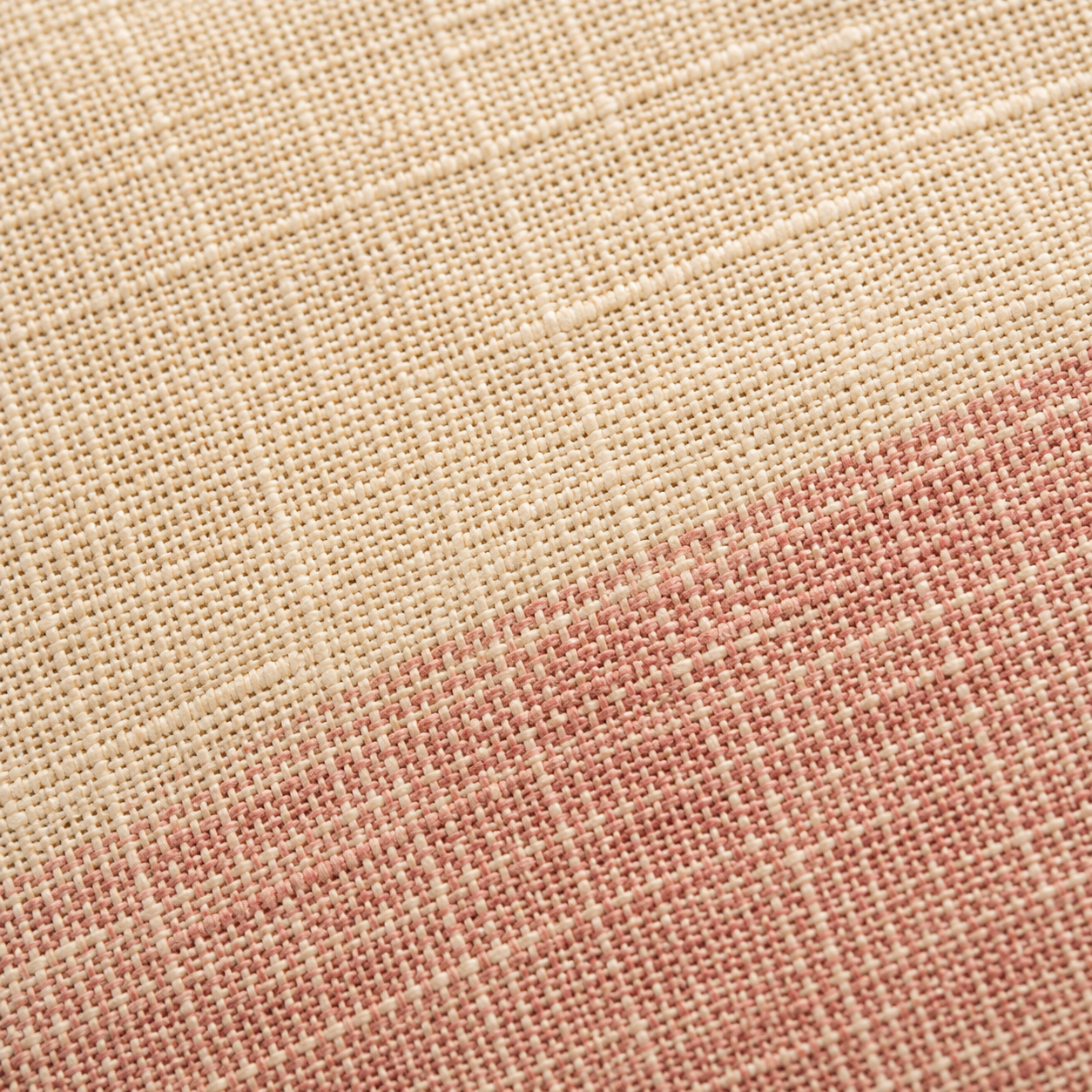
Look at the back of the fabric. A handloom cotton looks similar on front and back — the weave is symmetrical because it was made on a manual loom. A powerloom cotton typically has a more polished front and a rougher, knotted back. This is the first test in any cotton saree guide. Look for irregularities. Handloom cotton has small, charming irregularities — a slightly thicker thread here, a tiny variation in the border there. Powerloom cotton is machine-perfect and reads “too clean.” Check the selvedge. The selvedge edge of a handloom saree often has small loose threads where the weaver tied off rows. Powerloom selvedges are smooth and machine-finished.
Look for the GI mark and Handloom Mark. Authentic handloom cottons from protected regional traditions (Bengal taant, Mangalagiri, Venkatagiri, Madurai sungudi, and others) carry GI tags issued by the Geographical Indication Registry of India. The GI Registry of India maintains the official list of protected handloom traditions. A genuine handloom khadi product carries the Khadi Mark. These marks are not foolproof — counterfeit marks exist — but they are a strong starting signal for any cotton saree guide reader trying to verify authenticity.
Trust the price. A genuine handloom cotton saree from a good regional tradition costs between 80 and 250 euros at source. If a “handloom cotton” saree is being sold for 20 euros, it is almost certainly powerloom. Handloom takes a weaver three to ten days to produce one saree — the labour alone justifies the price floor that this cotton saree guide repeatedly returns to.
How a cotton saree drapes vs a silk
A cotton saree drapes differently from silk, and these differences matter when you wear one. Every cotton saree guide must address the drape question, because cotton’s drape behaviour is part of what makes it the ideal beginner fabric. Cotton is stiffer than silk — the pleats hold their shape better but feel less fluid. Cotton has more friction against the petticoat — once tucked, it stays put without needing pins. Cotton absorbs sweat — which makes it ideal for long-wear days but means it crumples more visibly in warm weather.
For first-time drapers, cotton is the easiest fabric to learn on. Our step-by-step Nivi drape guide recommends a cotton saree for practice. The forgiveness of cotton — the way it holds pleats, the way mistakes can be un-tucked and redone without leaving marks — makes it the right teacher. Once you can drape cotton confidently, the same technique works for silk; silk just demands a little more care at the pleats. The drape advice in this cotton saree guide assumes you are learning on cotton first.
Cotton saree care — washing, ironing, storage
Cotton saree care is straightforward, but with specifics worth knowing. The care section of this cotton saree guide covers the routines that keep a handloom cotton wearable for decades. First wash — a new cotton saree should be soaked in cold salt water for 30 minutes before its first wear. This sets the dye and prevents bleeding in later washes. Regular washing — hand wash in cold water with mild detergent. Avoid wringing; squeeze gently. Machine washing is possible on a delicate cycle for everyday cottons but not recommended for jamdani, kasavu, or any saree with zari work.
Drying — dry flat or on a clothesline, in the shade. Direct sunlight fades natural-dye cottons. Starching — Indian cotton sarees are traditionally starched after washing to restore stiffness. A light rice-water or commercial fabric stiffener applied while damp works well. Many European wearers skip starching; the saree becomes softer with each wash but is still wearable. The starching debate is a perennial cotton saree guide topic. Ironing — medium heat with a little steam works for most cotton sarees. For jamdani and other patterned cottons, iron on the reverse side to protect the weave.
Storage — fold and store in unbleached cotton or muslin, away from direct sunlight. Refold every two months to prevent permanent crease lines. Cotton is less prone to moth damage than silk but still benefits from natural cedar or neem repellents in the storage area. The storage section of this cotton saree guide echoes the storage principles in our broader saree wardrobe guide.
Cotton sarees for European weather
A cotton saree guide for European wearers must address climate. This is where the cotton saree guide for India and the cotton saree guide for Europe diverge. Cotton works year-round in India because Indian winters are mild even in the north. In Europe, the picture is different — cotton is the right fabric for spring and summer occasions, but needs significant adaptation for autumn and winter wear.
For spring and summer in Europe, cotton is ideal. The fabric breathes, layers easily over light underclothes, and stays comfortable through long warm days. A Bengal taant or Mangalagiri cotton works beautifully for a daytime garden wedding, a festival celebration, or an office occasion in June. For autumn and winter, cotton needs the layering approach we cover in our winter saree guide — thermal base layers under the petticoat, long-sleeved blouses, and a wool shawl over the shoulders. The winter case in this cotton saree guide remains the same: cotton-in-winter is possible but never as warm as silk or wool.
For European wearers in cooler northern cities — Stockholm, Helsinki, Edinburgh, Berlin — cotton sarees are best reserved for indoor events from May to September. For southern Europe — Madrid, Rome, Athens — cotton has a much longer season, often March to October. The climate-matching guidance in this cotton saree guide is one of the most asked-about sections for European readers.
How to choose your first cotton saree
The final section of this cotton saree guide is practical. For a European wearer choosing a first cotton saree, four decisions matter most, and any useful cotton saree guide must walk through each one.
Choose a forgiving region. Bengal taant or Mangalagiri are the most accessible handloom cottons — medium-weight, easy to drape, widely available, and reasonably priced. Save Venkatagiri (finer, lighter) and Kalakshetra (more refined aesthetic) for later cotton sarees once you know your preferences. The first-cotton recommendation in this cotton saree guide is always Bengal taant or Mangalagiri for European wearers.
Choose a neutral or earthy colour. Cream, dusty pink, soft maroon, olive green, deep navy, or terracotta will pair with multiple blouses and adapt to many occasions. Avoid pure white for a first cotton saree — it stains easily and shows wear quickly. Avoid bright primary colours for the same reason. The Bengal tradition of white-with-coloured-border is elegant but more demanding to keep pristine, a caveat worth noting in any practical cotton saree guide.
Choose a simple woven border, not embroidery. A genuine handloom border is woven directly into the saree as part of the weaving process. Embroidered borders are added separately and usually indicate powerloom base fabric. For a first cotton saree, look for a clean woven border in a contrasting colour — restrained, not heavy.
Choose the right length. Standard saree length is 5.5 metres; some handloom cottons run shorter at 5 metres. For European wearers, 5.5m is the safer choice — the extra length forgives early draping mistakes. Pair with a fitted blouse following our saree blouse design guide, which sits beside this cotton saree guide as part of the same reading path.
Frequently asked questions
Is a cotton saree appropriate for weddings?
For daytime weddings, garden weddings, mehndi ceremonies, and summer occasions, a dressier cotton saree (Kerala kasavu, Kanchipuram cotton, or a jamdani) is entirely appropriate. For formal evening receptions, cotton reads under-dressed against the silk that most other guests will wear. The cotton saree guide rule of thumb: cotton for daytime weddings, silk for evening.
How much should I pay for a genuine handloom cotton saree?
A genuine handloom cotton from a regional tradition costs between 80 and 250 euros at source in India. Add 30-50 percent for international shipping and import. A Khadi saree typically costs 60-180 euros. Kerala kasavu with genuine zari runs 150-400 euros depending on zari quality. The pricing guidance in this cotton saree guide reflects current source-market pricing — anything dramatically cheaper than these ranges is likely powerloom.
Can I machine-wash a cotton saree?
For everyday cottons like plain Bengal taant or Mangalagiri, a gentle machine wash on a delicate cycle in cold water is acceptable. Avoid machine-washing jamdani, kasavu, Venkatagiri, or any cotton with woven motifs, gold thread, or fine borders — these need hand-washing. The cotton saree guide rule: when in doubt, hand-wash.
Why does my new cotton saree feel stiff?
New cotton sarees come with factory starch that makes the fabric stiff. The first wash removes most of this and the saree becomes significantly softer. Some wearers like the initial stiffness because it holds pleats better; others wash twice before first wear for a softer drape. Both approaches appear in any complete cotton saree guide as valid.
How long does a cotton saree last with regular wear?
A well-cared-for handloom cotton saree lasts 15-25 years of regular wear. Some heirloom cottons in Indian families are over 50 years old and still wearable. Cotton actually improves with age — the fabric becomes softer, the colours mellow, and the drape becomes more fluid. A handloom cotton, as this cotton saree guide repeats, is one of the longest-lasting garments you can own.
What blouse works best with a cotton saree?
A cotton or raw silk blouse works best with a cotton saree. Match the blouse weight roughly — a heavy brocade blouse with a light cotton saree can look unbalanced. For colour, contrast or complement broadly rather than matching exactly. Our saree blouse design guide covers the full blouse decision framework, and pairs naturally with this cotton saree guide. According to the Victoria and Albert Museum’s South Asia collection, the cotton-blouse-with-cotton-saree pairing is the oldest and most enduring in Indian textile history.
One more thing
A cotton saree is the saree that teaches you what a saree actually is. Silk announces itself; cotton lets you discover what it feels like to wear six metres of cloth, to fold pleats into a column, to pin a pallu over your shoulder, to walk in a garment that is two thousand years old. Every Indian woman who wears sarees regularly began with cotton, even if she does not remember it. For European wearers building a saree wardrobe from zero, this cotton saree guide proposes the same starting point — cotton first, everything else after.
The other guides in our library support the cotton journey. Our beginner’s guide covers foundational vocabulary. Our five-piece capsule places cotton as Piece 1. Our draping tutorial uses cotton as the recommended starter fabric. Our silk comparison covers the formal counterpart once you are ready. And our winter guide addresses the cotton-in-cold-weather case. Read alongside this cotton saree guide, they form the complete reading path for a European wearer choosing a first cotton piece.
Follow the journey
Be there from day one.
IndiaNiva is launching its online shop soon. Until then we are sourcing handloom cotton from Bengal, Andhra Pradesh, Tamil Nadu, and Kerala, researching tailors in Europe, and writing guides like this one. Two thoughtful emails a month. Nothing more.
Continue reading
- What is a saree? An essential beginner’s guide — the foundation before any fabric guide
- Your first saree wardrobe — where cotton sits in your starter five
- How to drape a saree — cotton is the recommended starter fabric
- Saree blouse design — the right blouse for a cotton saree
- Banarasi vs Kanjivaram — the formal silk counterpart
- How to wear a saree in winter — cotton-in-cold-weather case
This cotton saree guide draws on conversations with handloom weavers in Bengal and Andhra Pradesh, the Geographical Indication Registry of India for protected-tradition data, and the Victoria and Albert Museum’s South Asia collection for historical context on Indian cotton textiles. Where specific references appear, the source is linked. All information is correct at the time of writing.