
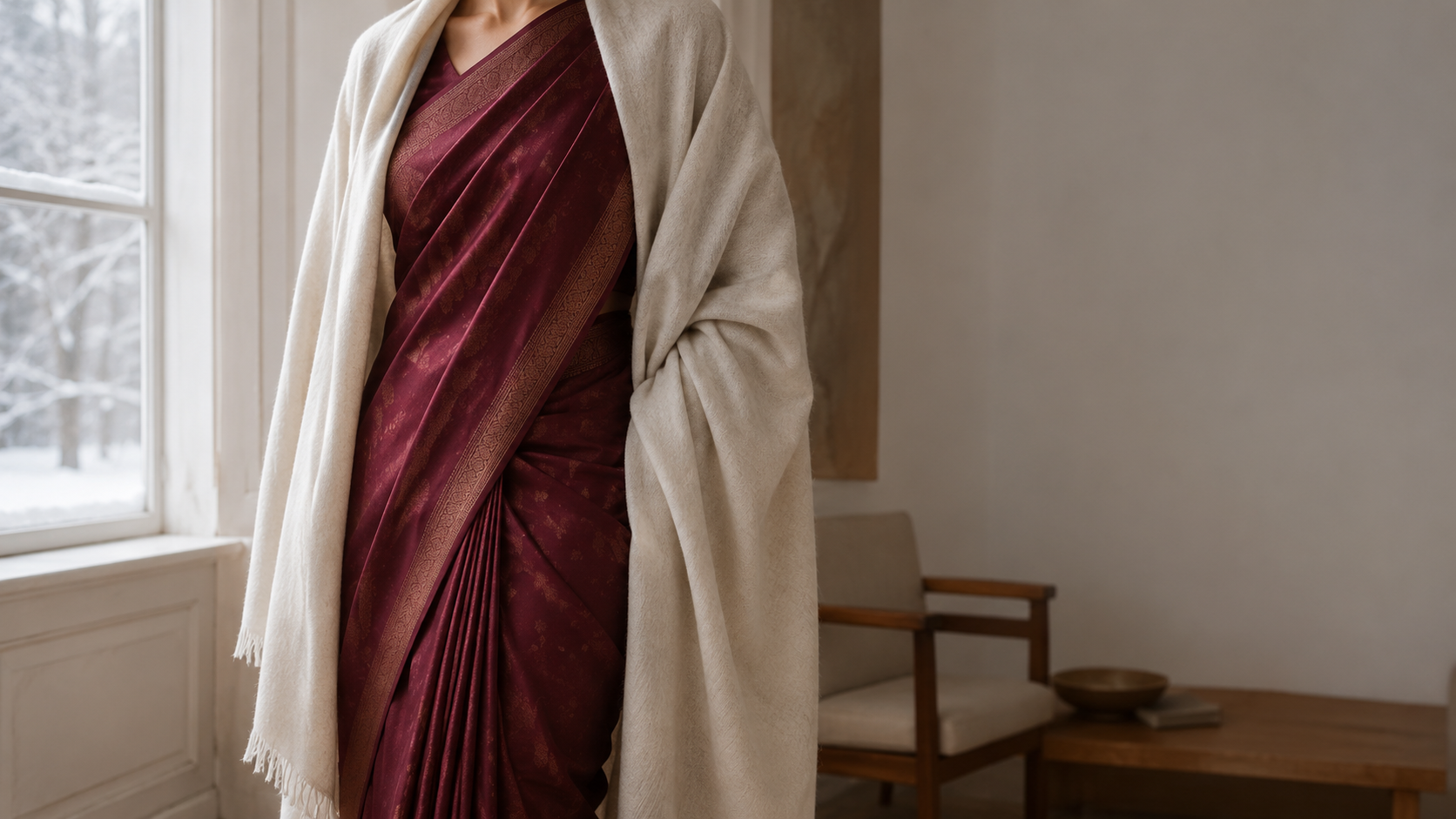
A saree in winter is one of the questions every European saree wearer has asked us in the past year. The honest answer is that wearing a saree in winter takes a little more thought than wearing one in May — but it is entirely possible, often beautiful, and a good deal warmer than the photographs you have seen online suggest. We have spent the past two winters in Munich figuring out what works, what does not, and how to drape a saree in winter without losing the elegance the garment is known for. This is what we have learned, written as a practical guide for readers in Germany and across Europe.
In this guide
The honest reality of a saree in winter in Europe
Most online saree photography is shot in warm Indian weather. The wearer stands in soft afternoon light wearing a cotton-blend blouse, no jacket, no tights, bare ankles. That is not the reality of a saree in winter in Munich, Frankfurt, Paris, or Stockholm.
European winter weather creates three practical problems for the saree wearer. The first is cold air around the midriff — the small section of skin traditionally left visible above the petticoat. The second is cold air around the arms and back where a standard short-sleeved blouse offers little protection. The third is heated indoor air that is often dry to the point of being uncomfortable for fine silk fabrics. None of these problems is insurmountable. All of them shape how a saree in winter is best worn.
There is also a social question. A saree at a European winter wedding sits visually beside wool dresses, velvet jumpsuits, structured coats. Photographing well in this context means thinking about layering, contrast, and warmth as part of the styling — not afterthoughts.
Choosing the right fabric for a saree in winter
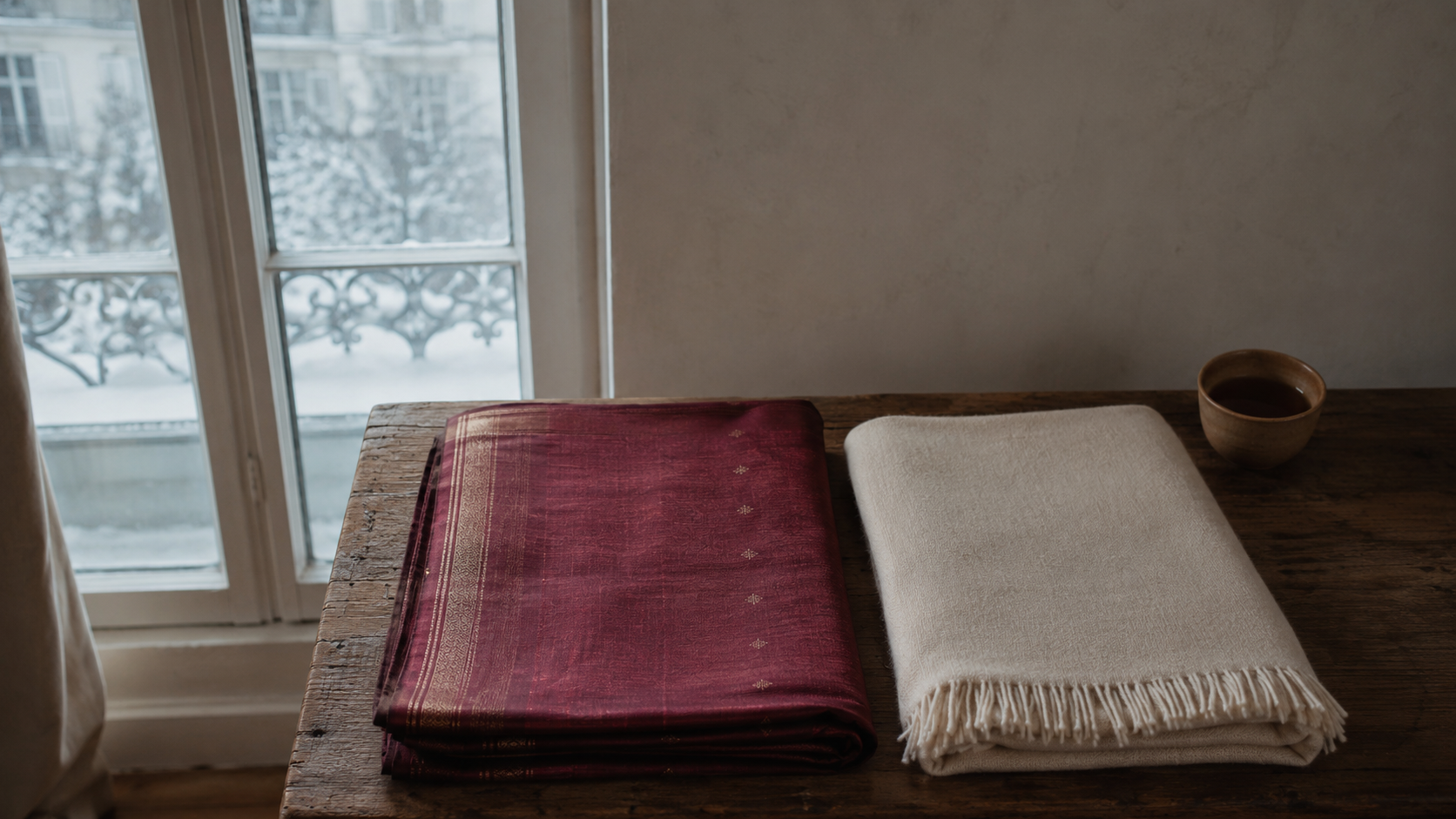
Fabric is the single most important decision for a saree in winter. The wrong fabric will leave you cold or look thin against winter coats. The right fabric will look richer in winter than it does in summer.
Silk sarees in winter — Banarasi, Kanjivaram, Mysore silk
Silk is the natural choice for a saree in winter. Silk holds body heat better than cotton and drapes with more weight, which reads as formal in cold-weather settings. A Banarasi or Kanjivaram silk saree in winter has the additional advantage of looking spectacular under warm indoor lighting — the zari catches light differently in winter interiors than it does outdoors in summer. Read our comparison of Banarasi and Kanjivaram silks if you are still choosing between the two for winter wear.
For a saree in winter, we tend to recommend silk in the middle weight range. A very light Banarasi (under 600 grams) can feel insubstantial against heavy winter clothing. A very heavy bridal Kanjivaram (over 2 kilograms) becomes tiring to wear with the additional layers winter requires. Aim for a silk saree in the 700g–1.5kg range.
Wool and tussar silk — the underrated winter choices
Wool sarees are the most overlooked option for a saree in winter. Pashmina sarees, fine merino wool sarees, and shawl-weave sarees from Kashmir and Kullu have existed for centuries precisely because winters in northern India and the Himalayas are cold. These sarees layer beautifully against European winter coats and feel naturally suited to the season.
Tussar silk — also called wild silk — has a slightly thicker texture and warmer hand than cultivated mulberry silk. A tussar silk saree in winter sits between a cotton and a Kanjivaram in weight and reads as quietly luxurious. Tussar also takes natural dyes well, so the colour palette tends toward warm earth tones that suit winter light. Our tussar silk saree guide covers the regional variants, the natural-dye palette, and the case for tussar as a winter-appropriate first silk.
Fabrics to avoid in cold weather
Pure chiffon, georgette, and organza are summer fabrics. They flow beautifully in warm air but feel insubstantial against a winter coat and provide almost no warmth. Pure cotton sarees, however well-woven, are also a poor choice for a saree in winter — cotton breathes too well and cools the body. If you must wear a lighter fabric for a daytime winter event, choose silk-cotton blends like Chanderi rather than pure cotton. Our chanderi saree guide covers the silk-cotton blend tradition in full, and our cotton saree guide covers cotton’s strengths (summer, everyday) and limits (winter, very formal evening). For the contemporary fabrics that are particularly winter-unsuitable, see our chiffon, georgette, and organza guides.
The layering principle — how to wear a saree in winter without losing warmth
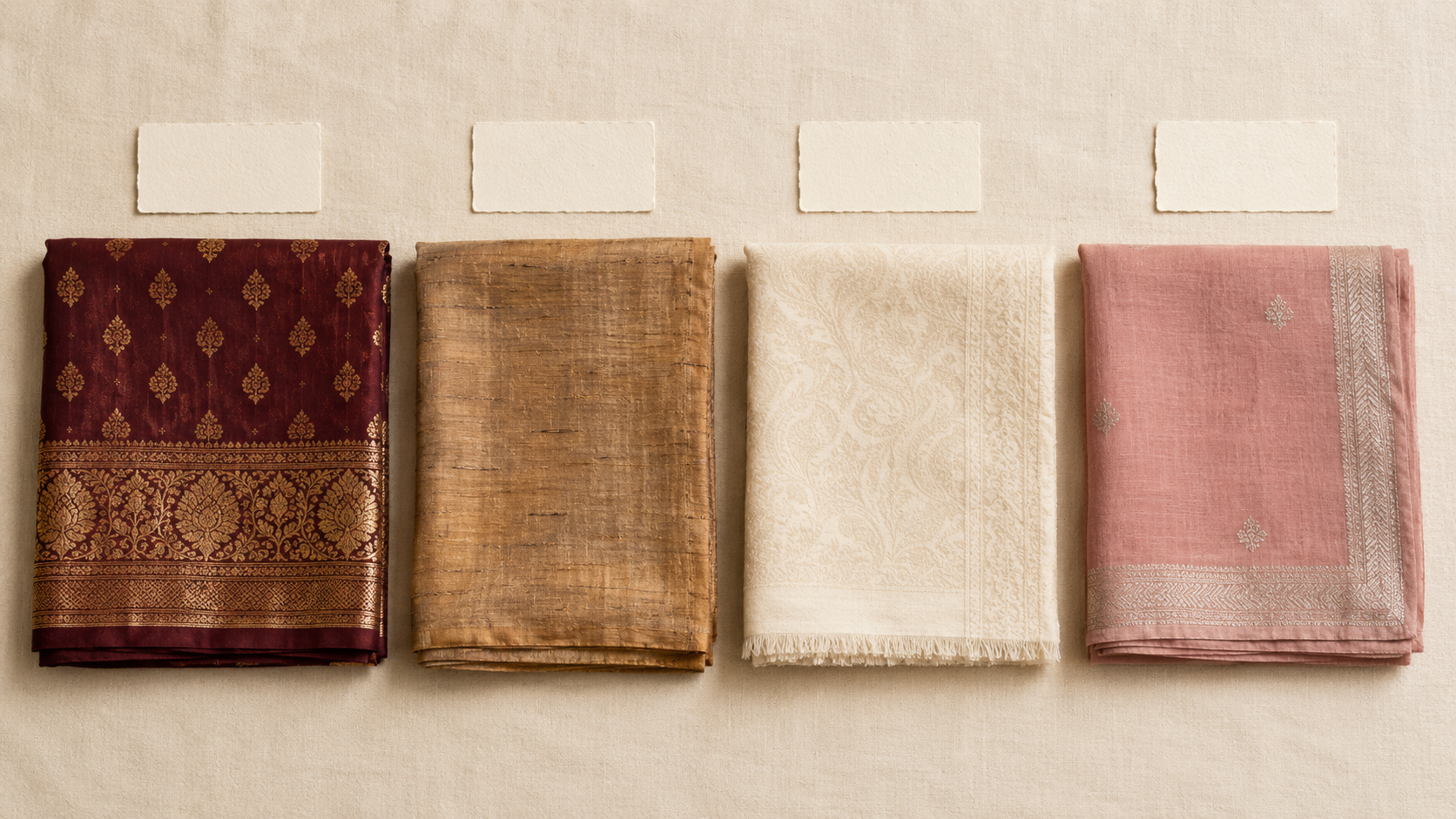
The single biggest shift in mindset for a saree in winter is layering. In Indian summer styling, the saree is the outermost layer over a thin blouse and petticoat. In European winter styling, the saree is the middle layer — with thermal pieces beneath and a shawl or jacket above.
The base layer — thermals under the blouse
A fine merino wool or silk thermal top, long-sleeved and snug, worn under the blouse provides the single biggest warmth gain for a saree in winter. Choose a thermal that matches your blouse fabric in tone — cream, dusty rose, or warm beige work under most blouse colours. The thermal sleeve should end just at or above the blouse cuff so it is not visible.
For the lower body, a high-waisted thermal legging or fleece-lined tights under the petticoat changes the experience of a saree in winter completely. Opaque, skin-toned, full-length. We have worn these under sarees through entire winter weddings without anyone seeing them.
The blouse layer — sleeves, fabric, fit
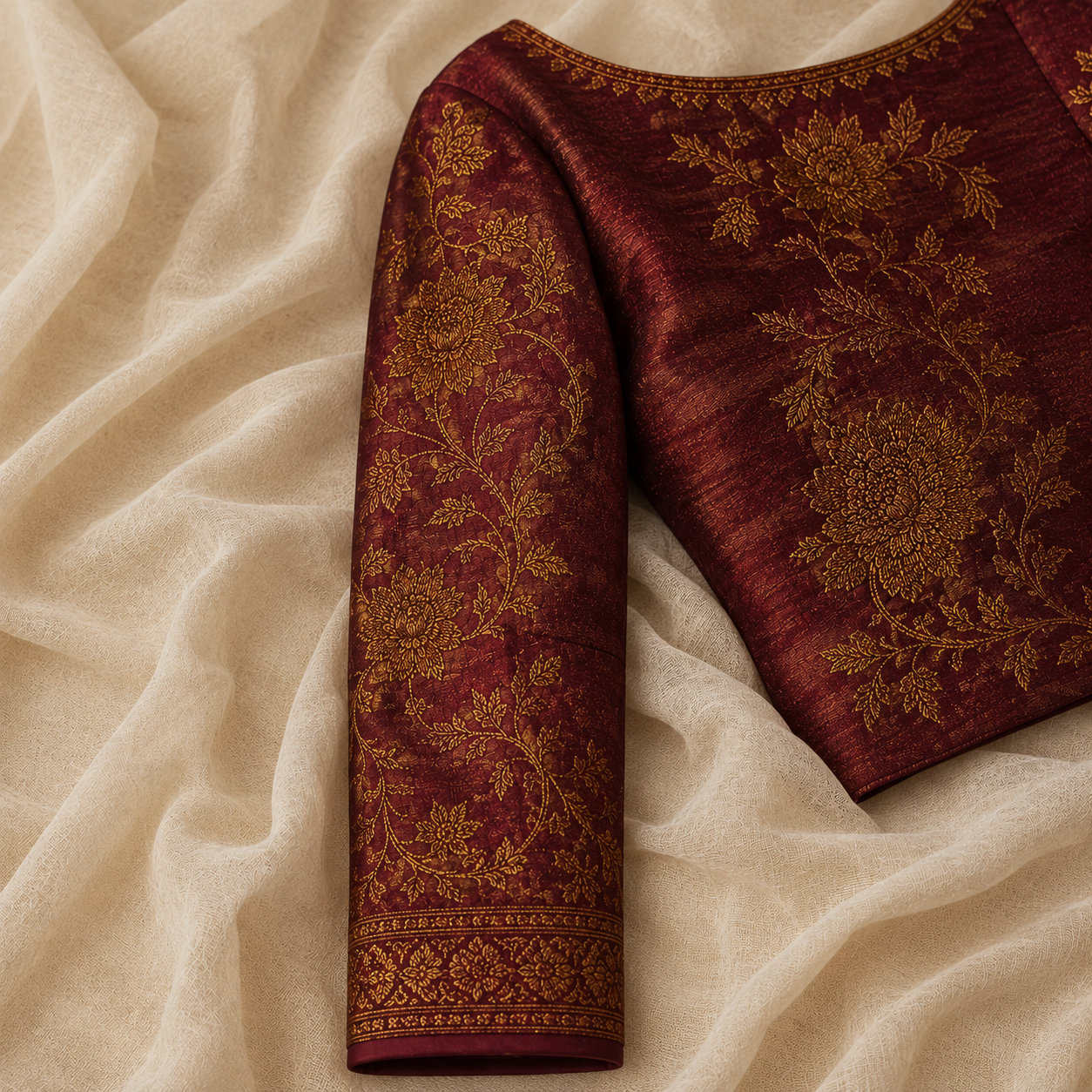
The blouse itself does meaningful work for a saree in winter. A short-sleeved cotton blouse leaves arms exposed; a long-sleeved blouse in raw silk, brocade, or velvet adds visible warmth and reads beautifully against winter coats. The cut matters too — a high boat neck or jewel neckline covers more chest skin than a deep scoop neck. We come back to blouse design in the next section. Our complete blouse design guide covers the winter-appropriate cuts, fabrics, and sleeve lengths in detail.
The shawl or jacket layer — the most important choice
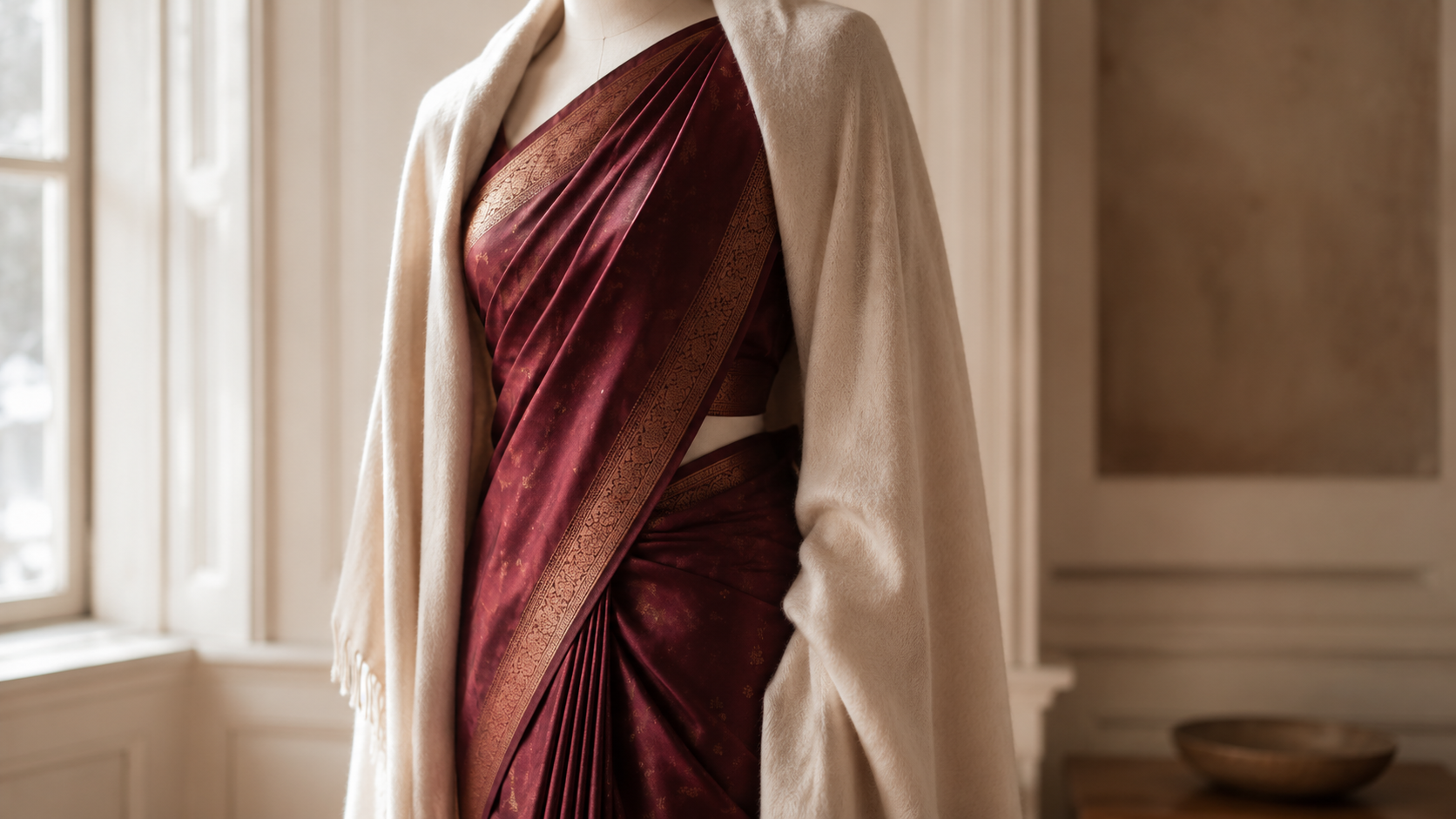
The third layer is what makes or breaks a saree in winter aesthetically. A standard down jacket over a Banarasi looks wrong; a fine pashmina shawl over the same saree looks intentional and elegant. The shawl layer should be chosen with the saree in mind, not pulled from your everyday wardrobe.
Three options that work consistently. First, a large pashmina or fine wool shawl draped over both shoulders or wrapped once around the body. Second, a fitted velvet or wool blazer for a more structured look — particularly good for office or daytime saree wear in winter. Third, a long structured wool coat in a solid colour (cream, camel, deep forest green) over the saree for transit — removed when indoors.
Blouse design choices for a saree in winter
A long-sleeved blouse changes a saree in winter more than any other single decision. The blouse is the only stitched part of the saree outfit, so it is also the layer you can adapt most precisely for cold weather.
The most useful winter blouse style is a full-sleeved blouse in a fabric heavier than the saree itself. A brocade blouse with a silk saree, a velvet blouse with a Banarasi, a raw silk blouse with a Kanjivaram. The contrast in texture creates visual depth and the heavier fabric retains warmth. Long sleeves should reach the wrist; three-quarter sleeves are a compromise that works for indoor events but leaves the forearms cold during transit.
Neckline matters for warmth as well as styling. A high boat neck, a jewel neck, or a closed mandarin collar covers more chest and back skin than a wide V-neck. For very cold weddings, a turtleneck blouse in fine merino wool can be paired with a saree — unconventional in India, but quietly elegant under a European winter light. The full saree blouse design guide walks through the four key decisions (neckline, sleeve, fabric, fit) with winter-specific notes.
Footwear and tights — the forgotten layer
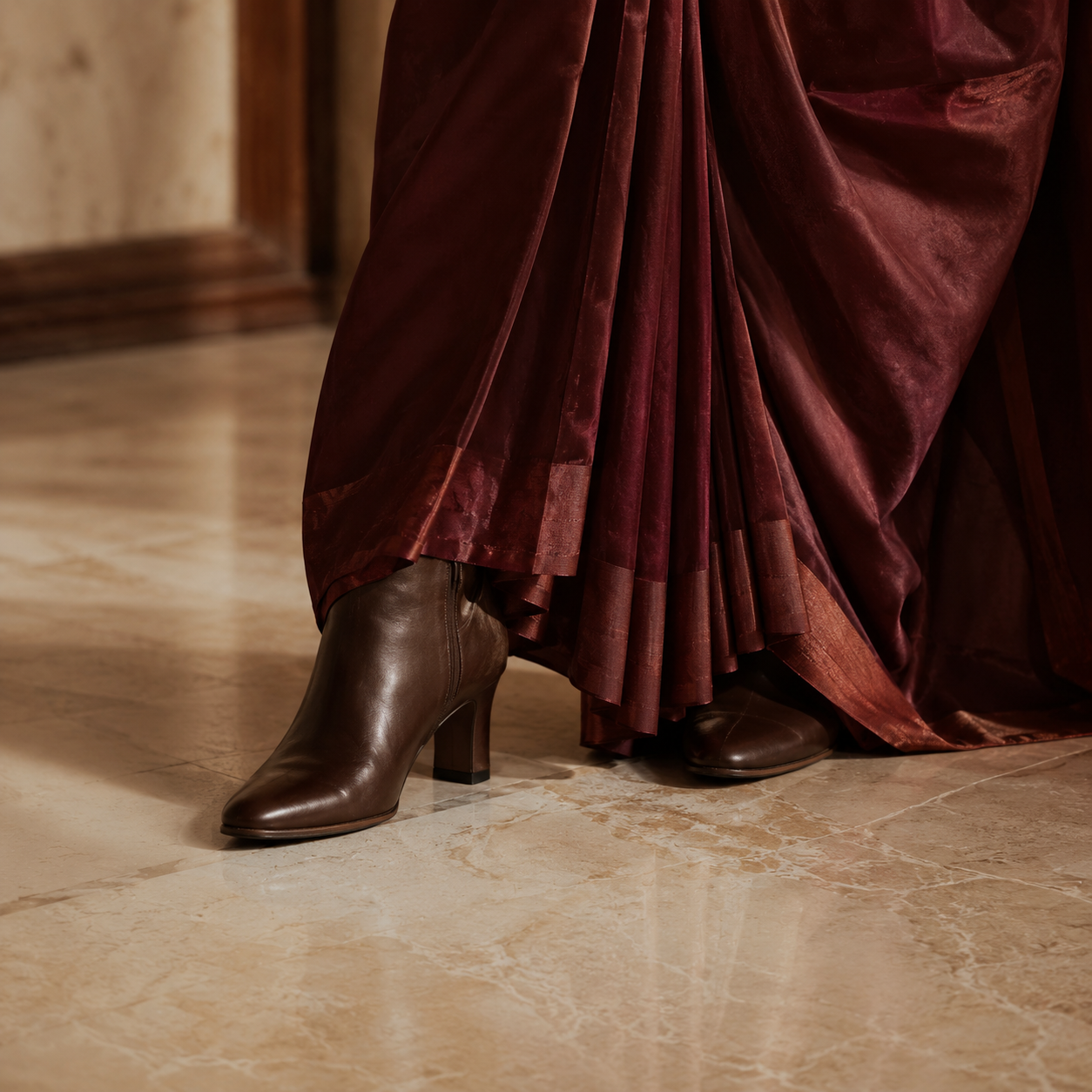
Footwear for a saree in winter is the most commonly neglected detail. The classic Indian winter saree photograph shows the wearer in delicate sandals, ankles bare. In a Munich January at minus five degrees, this is not just uncomfortable — it is genuinely cold enough to ruin the evening.
Two practical options. First, ankle boots or short heeled boots in a neutral colour (black, cream, deep brown) hidden under the saree pleats. The boot is invisible during wearing and the ankle is warm. Second, opaque skin-toned tights worn under the saree petticoat, paired with a closed-toe heel or pump. The tights are invisible if matched correctly to skin tone and add significant warmth to the legs.
For a daytime winter saree, even more flexibility is acceptable — knee-high leather boots under a longer petticoat work well for everyday or office saree wear, particularly with wool or tussar sarees. The Indian saree silhouette is forgiving enough to absorb a structured boot underneath.
How to wear a saree in winter to a wedding
European winter weddings are some of the most rewarding occasions for a saree. The formality of the event matches the formality of the saree; the indoor heating means the saree can be enjoyed without a heavy coat for most of the evening. According to Vogue India, silk sarees are increasingly being worn at international winter weddings — the global wedding-guest aesthetic has expanded to welcome the saree in formal European settings. Our wedding saree Europe guide covers the broader guest-wear logic for European weddings.
For a winter wedding saree, we would recommend a Kanjivaram or heavy Banarasi silk in a rich winter palette — deep maroon, wine, forest green, midnight navy, ochre gold. Pair with a long-sleeved brocade or velvet blouse, opaque skin-toned tights or thermal leggings under the petticoat, and a fine pashmina shawl for transit and the colder moments of the evening.
Footwear: closed-toe heels in a neutral colour or ankle boots concealed by the saree. Jewellery: heavier than you might wear in summer — gold or temple jewellery reads beautifully under warm indoor wedding lighting. Bring a small clutch with a lipstick refresh and a folded scarf in case the venue is colder than expected.
A saree in winter for everyday or office
Not every saree in winter is for a wedding. Wool sarees, tussar silks, and Chanderi-silk-cotton blends work beautifully for office and daytime winter wear in Europe — particularly for those of us who wear sarees regularly and do not want to reserve them only for occasions. Our tussar silk and chanderi guides cover both fabrics in depth.
For everyday winter saree wear, the layering shifts slightly. The blouse can be plainer (a solid raw silk in a winter tone), the shawl can be a structured wool or cashmere rather than an ornate pashmina, and the footwear can be a low knee-high boot. A fitted wool blazer over a saree blouse — increasingly common at offices in India — translates well to European workplaces. The look is professional, distinctive, and warm.
The saree in winter for everyday wear also benefits from pre-stitched ready-to-wear styles. A pre-stitched winter saree can be put on in minutes, layered with a wool blazer or shawl, and removes the cold-fingers struggle of pleating in winter weather. Our pre-stitched saree guide covers the three construction formats and the practical case for ready-to-wear in cold months.
Care after a winter wearing
European winters are hard on silk. Central heating creates dry air that is unkind to fine fabrics, and the temperature differential between cold outdoor air and warm indoor heating creates condensation that silk fibres do not love.
After wearing a silk saree in winter, hang it in a well-ventilated room for at least twelve hours before folding and storing. Do not store the saree near a radiator. If the saree has been worn through snow or rain, dry-clean before storing — water damage on fine silk can become permanent if not addressed promptly. For long winter storage, fold the saree in unbleached muslin or cotton, refold every two months to prevent permanent creases at the fold lines, and keep away from direct sunlight.
The Victoria and Albert Museum’s textile care guidance applies directly to saree storage. The principles that preserve museum textiles preserve heirloom sarees too.
Frequently asked questions
Can I wear a saree in winter without freezing?
Yes, with the right layering. The combination of a thermal base layer under the blouse, opaque tights or thermal leggings under the petticoat, a long-sleeved blouse, and a fine wool or pashmina shawl makes a saree in winter genuinely comfortable in European weather — we have worn sarees through Munich winters at minus seven degrees without being cold.
What is the warmest saree fabric for winter?
Pure wool sarees are the warmest — pashmina, fine merino wool, or Kullu wool sarees designed for the Himalayan winter. Among silks, heavier Kanjivaram and Banarasi pieces hold warmth well. Tussar silk sits in the middle (see our tussar silk saree guide). For a saree in winter that needs to be both warm and formal, a medium-weight Kanjivaram with a velvet blouse and pashmina shawl is the most reliable combination.
How do I keep my saree in winter from looking bulky with layers?
Match the thermal layer’s tone to the blouse fabric — cream thermal under cream blouse, dusky pink thermal under maroon blouse. Keep thermal sleeves at or above the blouse cuff so they are not visible. Use fine merino or silk thermals rather than fleece (fleece bulks). And remember that a saree’s natural draping silhouette is generous enough to absorb a slim thermal layer underneath without changing the visible shape.
Are pre-stitched sarees easier in winter?
Yes. Pre-stitched ready-to-wear sarees remove the pleating-with-cold-fingers problem entirely. The pleats and pallu are already stitched into place; the saree slips on like a long skirt with an attached pallu. For a saree in winter wedding where you are getting ready in a hotel room, a pre-stitched silk saree saves twenty minutes and significant frustration. Our pre-stitched saree guide covers the construction types and the choosing criteria.
Can I wear boots under a saree in winter?
Yes — and we recommend it. Ankle boots in a neutral colour are invisible under the saree pleats and dramatically warmer than open sandals. Knee-high boots work for everyday or office winter saree wear. The boot must be slim enough not to bulk visibly under the saree drape; chunky combat boots do not pair well, but a slim leather ankle boot or a low knee-high boot is undetectable.
What jewellery suits a saree in winter outfit?
Winter saree styling can carry heavier jewellery than summer styling because the indoor lighting is warmer and the layered fabrics balance bolder accessories. Gold or temple jewellery, a heavier maang tikka, statement earrings, and stacked bangles all read beautifully under European indoor winter light. For everyday winter wear, scale down — a single pair of jhumkas or a delicate chain works against the wool blazer or pashmina shawl.
One more thing
A saree in winter in Europe is not a compromise. It is a different version of the garment — heavier fabrics, considered layering, structured footwear — that has its own quiet beauty. The first winter you wear a saree outside India will feel like an experiment. By the second winter, it will feel like a wardrobe you have always known. We are still in our second winter, and the lessons keep coming.
This guide is one part of our larger Sarees in Europe series. To understand the foundations, read what a saree is at its essence. For a deep comparison of two of the most popular winter silk sarees, read our honest Banarasi vs Kanjivaram comparison. For broader fabric knowledge, our fabric library now covers each major saree fabric — cotton, georgette, chanderi, organza, tussar silk, and chiffon. And for wedding-specific guidance, our wedding saree Europe guide covers what to wear as a guest.
Follow the journey
Be there from day one.
IndiaNiva is launching its online shop soon. Until then we are building quietly — sourcing winter-appropriate silks, researching tailors in Europe, and writing what we learn. Two thoughtful emails a month. Nothing more.
Continue reading
- What is a saree? An essential beginner’s guide — start here if sarees are new to you
- Tussar silk saree guide — the underrated winter silk from East India
- Chanderi saree guide — the silk-cotton blend for daytime winter
- Banarasi vs Kanjivaram — choosing between two winter favourites
- Cotton saree guide — when cotton works and when it does not
- Georgette saree guide — the layered approach for borderline-cold months
- Chiffon saree guide — why chiffon is not a winter fabric
- Organza saree guide — another summer-only fabric explained
- Pre-stitched saree guide — the cold-month convenience option
- Your first saree wardrobe — Piece 4 of the capsule is the winter saree
- Saree blouse design — long-sleeved winter blouses in depth
- How to drape a saree — adapting the Nivi drape for winter layering
- Wedding saree Europe — winter wedding guest-wear logic
- About IndiaNiva — why we are building IndiaNiva from Munich
This saree in winter guide draws on two winters of practical experience in Munich, conversations with European saree wearers in Germany, France, and the Netherlands, and the Victoria and Albert Museum’s textile care guidance. Where specific figures appear, the source is linked. All information is correct at the time of writing.