
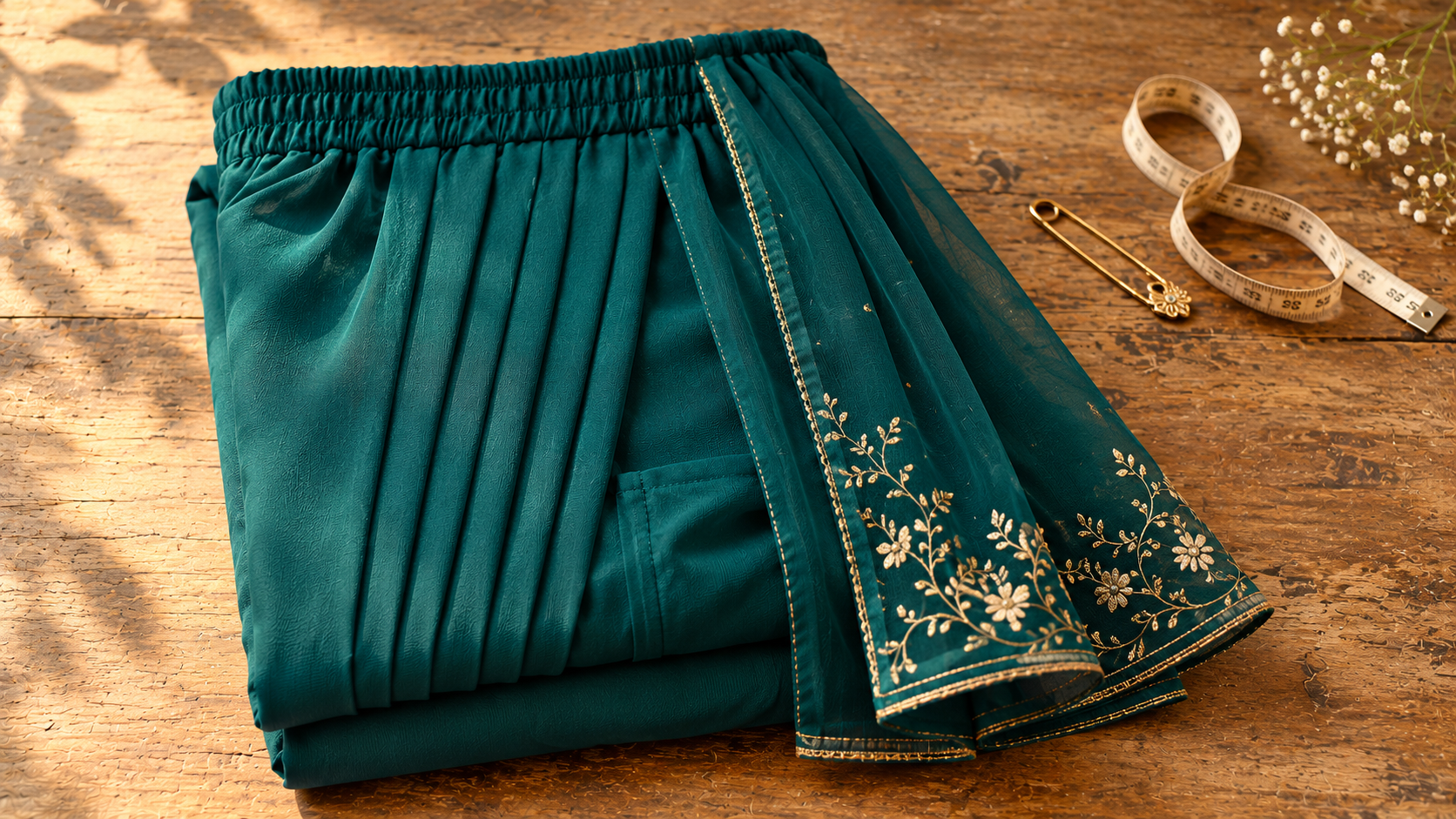
A pre-stitched saree guide is, in some ways, a guide to the saree that European wearers actually have time for. The traditional six-metre drape is beautiful, meaningful, and worth learning — but it also takes practice, patience, and the kind of leisurely morning that a working life in Munich, Paris, or London rarely permits. The pre-stitched saree is a contemporary response to that problem: a saree where the pleats and pallu are pre-arranged, requiring only a simple wrap to wear.
This pre-stitched saree guide covers what a pre-stitched saree actually is, the three main types, when the format makes sense (and when it doesn’t), the honest cons, and how to choose your first pre-stitched saree for European wear. Written from Munich, for European readers.
In this pre-stitched saree guide
What is a pre-stitched saree?
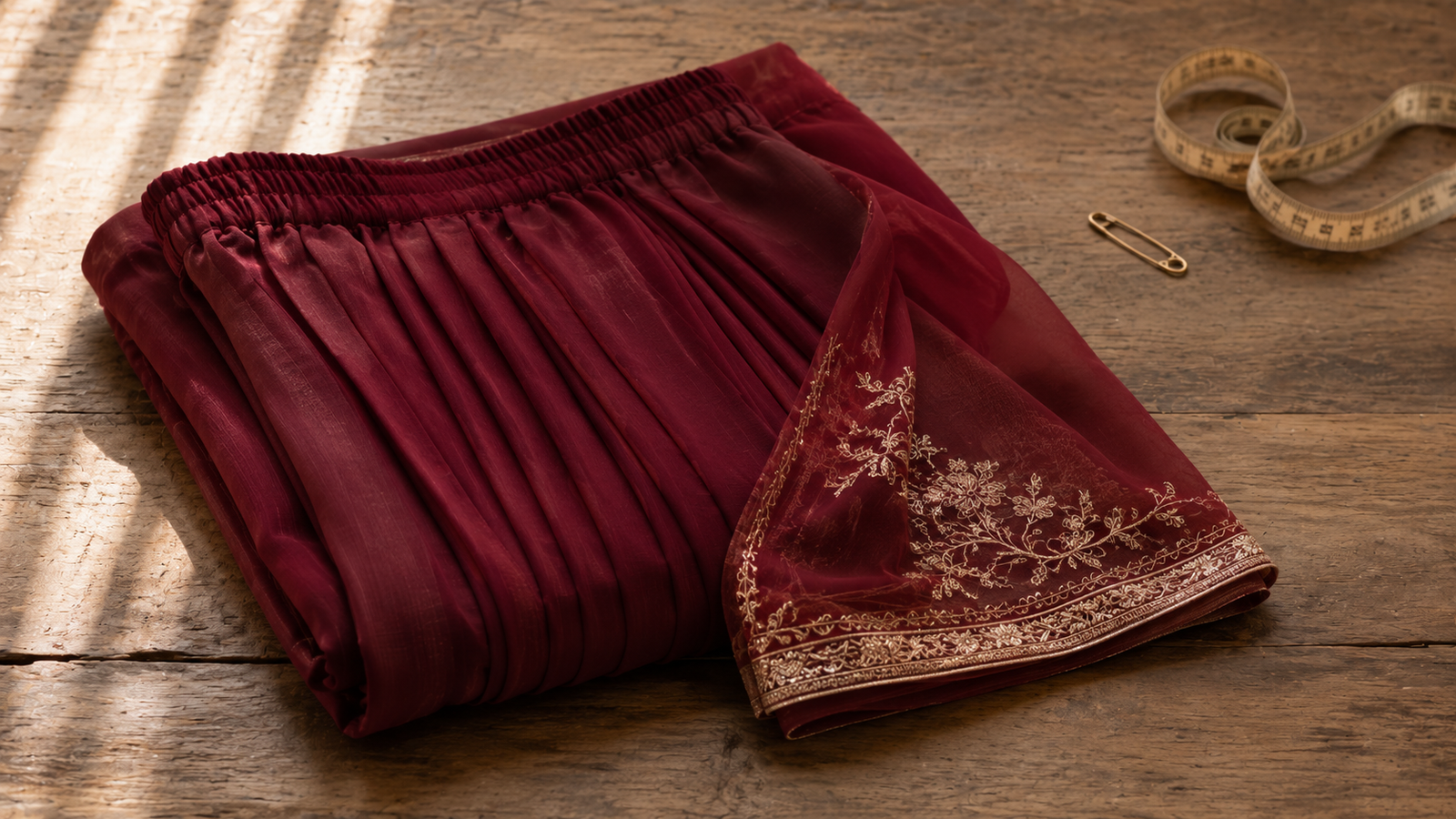
This pre-stitched saree guide begins with a definition, because the category is broader than many first-time wearers realise. A pre-stitched saree is one where the pleats, pallu, or both have been arranged and partially stitched in advance, so the wearer does not need to drape the six-metre fabric from scratch. Some pre-stitched sarees are minimally constructed — just the pleats stitched to a waistband, with the pallu still draped loose. Others are fully constructed as a single garment with a zip closure, functioning more like a gown that looks like a saree. Any thorough pre-stitched saree guide must walk through the full range.
The category is sometimes called “ready-to-wear saree,” “ready-pleated saree,” “pre-draped saree,” or “saree-gown” depending on construction. This pre-stitched saree guide treats all these formats as variants of a single underlying idea: a saree where the time-consuming draping work has been done in advance, and the wearer puts the garment on rather than wrapping it.
The defining feature any pre-stitched saree guide must explain is that the format is not a fabric — it is a construction approach. A pre-stitched saree can be made from any fabric: cotton, georgette, silk, Chanderi, organza, chiffon, or any blend. The fabric guides we have published — our cotton saree guide, georgette saree guide, chanderi saree guide, and organza saree guide — all apply equally to pre-stitched versions of those fabrics.
A short history of the pre-stitched saree
The pre-stitched saree is a contemporary innovation rather than a heritage tradition. Sarees were draped from scratch for centuries, and the assumption that draping was simply part of wearing the garment held until the late 20th century. The shift began in urban India in the 1990s, when working women began asking tailors to pre-pleat their everyday sarees to save time before office. The format remained niche and somewhat looked-down-upon through the 1990s and early 2000s.
The contemporary pre-stitched market took off from around 2010 onward, driven by two forces. The first was designer adoption — Tarun Tahiliani, Sabyasachi, and Anita Dongre began offering pre-stitched and saree-gown versions of their couture collections, lending the format a high-fashion credibility it had previously lacked. The second was the rise of the urban Indian working woman with disposable income but limited time, for whom a two-minute saree-equivalent was genuinely valuable. Today, the pre-stitched saree is a major segment of the Indian saree market, no longer a workaround but a deliberate aesthetic choice for many wearers. A complete pre-stitched saree guide must acknowledge this contemporary acceptance.
According to Vogue India, the pre-stitched and concept saree segment has grown significantly through the 2010s and 2020s, with major fashion weeks featuring pre-stitched designs prominently in bridal and occasion collections. This pre-stitched saree guide sits within that contemporary moment.
The three types of pre-stitched saree
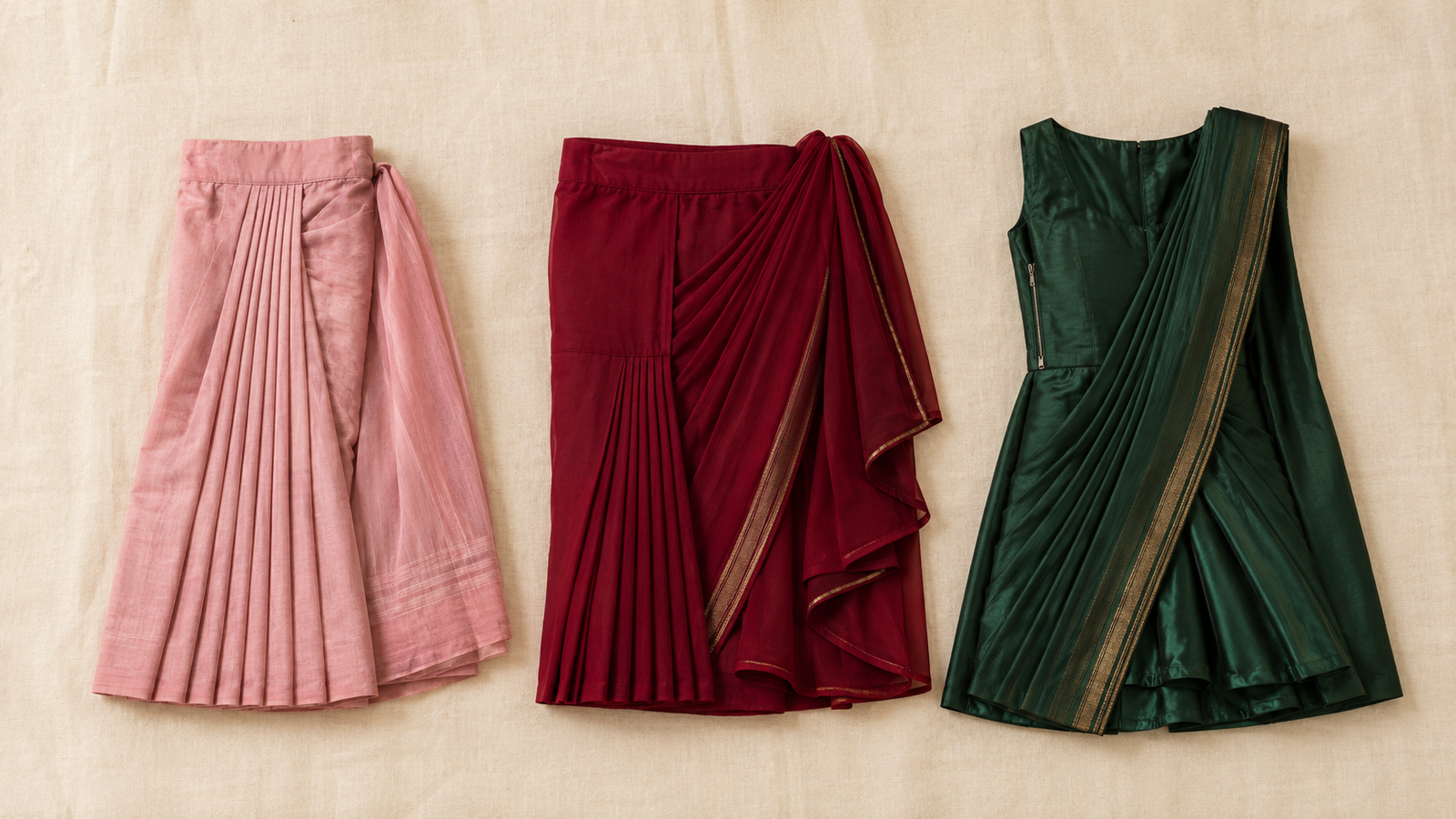
Any thorough pre-stitched saree guide must distinguish the three main construction types. The differences matter for how the saree wears, how it looks, and how versatile it is across occasions. This pre-stitched saree guide places the three-type distinction as the most important practical decision a buyer makes.
Pre-pleated saree
The simplest and most traditional variant. The pleats at the front are arranged and stitched into a fixed pattern, attached to a waistband or simply pre-arranged with hidden tacks. The rest of the saree — the body wrapping around the waist and the pallu — is still draped as normal. A pre-pleated saree wraps in three to five minutes rather than the fifteen-plus minutes a from-scratch Nivi drape requires. The look is virtually identical to a traditional drape because most of the fabric is still being wrapped naturally. In this pre-stitched saree guide we treat pre-pleated as the most invisible of the three constructions.
Drape-style pre-stitched saree
A more developed variant where both the pleats and the pallu are pre-arranged. The pleats are stitched into a fixed pattern, and the pallu is pre-folded with its drape and any pleating already set. The wearer essentially steps into a pre-arranged garment, secures it at the waist, and pins the pallu at the shoulder. This format wraps in two to three minutes and looks like a traditional saree to anyone who isn’t examining the construction closely. In this pre-stitched saree guide we treat the drape-style as the best balance of convenience and traditional appearance. The drape-style is the first-purchase recommendation in this pre-stitched saree guide.
Saree-gown (jumpsuit saree)
The most contemporary variant — a single-garment construction that looks like a saree but functions like a gown. The saree-gown typically has a stitched-in petticoat, fixed pleats, attached pallu, and a side or back zip closure. The wearer simply steps in and zips up; no wrapping or pinning is required. Saree-gowns wear in under a minute. The look is more occasion-specific than traditional pre-stitched — the construction is sometimes visible if you know what to look for, and the silhouette is fixed at one size at purchase. This pre-stitched saree guide treats the saree-gown as a separate category from traditional pre-stitched, useful for specific occasions but limited in versatility.
How a pre-stitched saree looks vs a traditional drape
This is the question every honest pre-stitched saree guide must address directly. The answer depends entirely on the quality of construction and the type of pre-stitched chosen. The visibility question is the most asked one in any pre-stitched saree guide written for European audiences.
Pre-pleated and drape-style pre-stitched sarees from quality designers look virtually indistinguishable from traditional drapes when properly fitted and worn. The pleats fall naturally, the pallu drapes correctly, the silhouette reads exactly like a from-scratch Nivi drape. Most people in a room — including other saree wearers — cannot tell that the saree is pre-stitched unless they examine the construction closely. The pre-stitched saree guide truth is that good pre-stitched is invisible to almost all observers.
Cheap pre-stitched sarees from mass-market sources can read “costume-y” — the pleats are too uniform, the pallu drape is too fixed, the silhouette has visible construction lines. This is where the format gets its mixed reputation. The difference between a designer pre-stitched at 200-600 euros and a mass-market pre-stitched at 30-80 euros is significant — and this pre-stitched saree guide is honest about it. Budget choices in this format read more obviously pre-stitched than budget choices in traditional sarees.
Saree-gowns are visually distinguishable from traditional drapes in most cases — the construction shows the fixed silhouette, the stitched pallu placement, and the zip closure. This is not a defect; saree-gowns are a deliberate contemporary aesthetic. But the wearer should understand the saree-gown is closer to a fusion garment than a traditional saree.
When pre-stitched makes sense — and when it doesn’t
This pre-stitched saree guide is direct about use cases. Pre-stitched is the right choice for some wearers and occasions, and the wrong choice for others. Any responsible pre-stitched saree guide must walk through both sides.
Pre-stitched makes sense when: you are a first-time saree wearer attending a wedding next month with no time to learn the full Nivi drape; you are a working professional who wants to wear a saree but cannot spend 20 minutes draping before a meeting; you are travelling and want a saree that fits in a carry-on without the drape complexity at the destination; you have mobility issues that make the wrapping motion difficult; you are confidence-building and want to wear a saree in public without anxiety about the drape coming loose. The wedding-guest case is particularly common in this pre-stitched saree guide — the format solves a genuine problem.
Pre-stitched does not make sense when: you want to learn to drape a saree properly (use a traditional saree from our cotton saree guide for practice instead); you are wearing an heirloom saree (heirlooms should never be pre-stitched; the modifications damage resale and emotional value); you want to drape the saree in different regional styles (Bengali, Gujarati, Nauvari); you want maximum length customisation. The trade-off this pre-stitched saree guide reflects is real: convenience comes at the cost of flexibility. Any honest pre-stitched saree guide must say so.
The honest cons of pre-stitched
Any complete pre-stitched saree guide must walk through the honest disadvantages of the format. The pre-stitched saree market sometimes oversells the benefits without acknowledging the trade-offs. This pre-stitched saree guide takes the opposite approach: a clear-eyed accounting of what you give up when you choose pre-stitched.
Less drape customisation. A traditional saree can be draped with the pallu long or short, pleats wide or narrow, body wrap high or low. A pre-stitched saree fixes these at construction. If you change your mind after purchase, the saree cannot be easily re-styled.
Fixed sizing at purchase. The waist measurement, hip measurement, and overall garment fit are determined at construction. If your size changes after purchase — gain or loss of a few kilograms — the pre-stitched saree may no longer fit. A traditional saree adapts to size changes simply by adjusting the petticoat and the wrap. The sizing caveat in this pre-stitched saree guide is one buyers should consider seriously before purchase.
Lower resale value. Pre-stitched sarees retain significantly less resale value than equivalent traditional sarees. The market assumes pre-stitched is a wear-and-replace category rather than an investment piece. For heirloom or designer purchases, traditional construction holds value better. The resale gap in this pre-stitched saree guide is one many buyers underestimate.
Construction wear-out. The stitched seams of a pre-stitched saree are mechanical wear points that traditional sarees don’t have. Over years of regular wear, seams can loosen and the construction begins to show. This pre-stitched saree guide notes that traditional sarees age more gracefully.
Cultural reception varies. Within the broader Indian saree community, opinions on pre-stitched are mixed. Some traditional wearers view pre-stitched as a shortcut; others embrace it as sensible adaptation. This pre-stitched saree guide is neutral on the cultural debate but acknowledges it exists.
Pre-stitched care
Pre-stitched care depends primarily on the fabric, but the construction adds specific considerations. Any complete pre-stitched saree guide must walk through both. The care section of this pre-stitched saree guide is the most consulted by new owners.
Fabric care first. The base fabric determines most of the care routine. Cotton pre-stitched follows cotton care; georgette pre-stitched follows georgette care; silk pre-stitched follows silk care. The fabric guides we have published cover the specifics — see our cotton saree guide, georgette saree guide, chanderi saree guide, or organza saree guide for fabric-specific care.
Stitching care. The pre-stitched construction adds care requirements. Avoid machine-washing any pre-stitched saree even if the fabric would technically permit it — the agitation stresses the seams. Dry-cleaning is the safer choice for any pre-stitched saree, regardless of fabric. Inspect the seams every six months for loose threads or weakened stitching; small repairs done early prevent larger construction failures.
Storage. Pre-stitched sarees benefit from hanging storage more than traditional sarees, because folding creates pressure on the construction seams. Hang on a padded hanger with the pleats arranged naturally; cover with a muslin garment bag for protection. Avoid plastic storage bags; the construction needs to breathe.
The fitting question. If a pre-stitched saree begins to fit poorly (size change, stretching at the waistband), a tailor familiar with saree construction can sometimes adjust the fit. The adjustment is more complex than altering a traditional saree, but it is possible for quality pre-stitched constructions. Budget pre-stitched is generally not worth adjusting.
Pre-stitched for European wearers
This pre-stitched saree guide takes a particular position on the format for European wearers: the case for pre-stitched is stronger in Europe than in India, for several specific reasons. The European-wearer argument runs throughout this pre-stitched saree guide.
First, European wearers typically lack the network of friends, family, or tailors who can help with a traditional drape. In India, a first-time wearer can call on a mother, aunt, or neighbour to assist with the wrap. In Munich or Paris, this support rarely exists, and a pre-stitched saree removes the dependency. This is the single strongest argument any European pre-stitched saree guide can make.
Second, European wearers often face climate-driven layering challenges that complicate traditional draping. The thermal layers under a saree in European winter (covered in our winter saree guide) interact with the drape in unpredictable ways. A pre-stitched saree handles the layering more reliably because the silhouette is fixed. This is a less-discussed but real advantage in any European-focused pre-stitched saree guide.
Third, European events often have time pressures that Indian events do not. A European wedding ceremony at 14:00 sharp does not wait for the saree-wearing guest to finish draping; an Indian event runs on more flexible time. Pre-stitched solves the punctuality problem entirely.
Fourth, European wearers attending occasional Indian events may not want to invest the practice time for a Nivi drape they will use three to five times a year. A pre-stitched saree delivers the visual result without the practice investment.
For European wearers building a saree wardrobe, this pre-stitched saree guide suggests one pre-stitched saree (likely in georgette, for the sangeet-evening case) as Piece 5 of the five-piece capsule — the saree you wear when time, confidence, or logistics make the traditional drape impractical.
How to choose your first pre-stitched saree
The practical section of this pre-stitched saree guide is now. For a European wearer choosing a first pre-stitched, four decisions matter most, and any useful pre-stitched saree guide must walk through each one.
Choose drape-style over pre-pleated or saree-gown. Drape-style is the most versatile of the three constructions — it looks traditional, wraps in two to three minutes, and works for a wide range of occasions. Pre-pleated still requires some draping skill; saree-gown is too occasion-specific. The middle category, drape-style, is what this pre-stitched saree guide recommends for first-time pre-stitched buyers.
Choose georgette or Chanderi as the fabric. Georgette pre-stitched is the most popular choice for sangeet, reception, and evening events; Chanderi pre-stitched works for daytime weddings and dressy daytime occasions. Cotton pre-stitched is also widely available but reads more casual. Avoid organza pre-stitched for a first purchase — the fragility plus construction makes for a high-maintenance combination. Avoid heavy silk pre-stitched until you know the format.
Choose mid-tier price (150-400 euros). The construction quality matters more in pre-stitched than in traditional sarees. A 30-50 euro pre-stitched reads “costume”; a 150-400 euro pre-stitched reads “traditional drape.” For European wearers, the price tier this pre-stitched saree guide recommends is mid-range from a quality retailer with verified construction standards.
Get the size measured precisely. Pre-stitched sarees are fitted at purchase. Take accurate waist, hip, and height measurements; for online purchases, request a video consultation with the retailer if possible. A mis-sized pre-stitched is unwearable in a way a mis-sized traditional saree is not.
Frequently asked questions
Is a pre-stitched saree appropriate for a wedding?
Yes — quality pre-stitched and drape-style pre-stitched sarees are entirely appropriate for weddings, including formal Indian weddings, European weddings, and fusion weddings. The wedding-occasion verdict in this pre-stitched saree guide is positive, with one caveat: choose drape-style or pre-pleated construction rather than saree-gown for traditional Indian wedding ceremonies, where the saree-gown construction may read out of place. Many readers of this pre-stitched saree guide will find their first wedding-saree decision lands here. Our wedding saree Europe guide covers the broader wedding-occasion decision-making.
How much should I pay for a pre-stitched saree?
Quality designer pre-stitched sarees cost 200-600 euros; couture pre-stitched from major Indian designers (Sabyasachi, Anita Dongre, Tarun Tahiliani) can run 800-3,000 euros. Mass-market pre-stitched costs 30-150 euros but reads obviously pre-stitched. The pricing guidance in this pre-stitched saree guide places the sweet spot at 150-400 euros for European wearers seeking the traditional-drape appearance without designer-couture prices.
Can a tailor pre-stitch my existing saree?
Yes — a specialist saree tailor can convert a traditional saree into a pre-stitched construction. The conversion typically costs 30-80 euros depending on the construction complexity. This pre-stitched saree guide notes one important caveat: the conversion is generally not reversible. Once a saree is pre-stitched, returning it to traditional drape requires removing all the stitching, which may leave visible thread marks on the fabric. For heirloom sarees, the firm rule in this pre-stitched saree guide is: do not convert.
Does pre-stitched look obvious to others?
Quality pre-stitched (designer or mid-tier) looks indistinguishable from traditional drape to almost all observers. Even other saree wearers usually cannot tell the difference without examining the construction closely. Mass-market budget pre-stitched looks more obviously pre-stitched, particularly because of uniform pleat placement. The visibility question in this pre-stitched saree guide reduces to a price question — quality construction reads traditional, budget construction reads pre-stitched. This is the single most important takeaway from any honest pre-stitched saree guide.
What’s the difference between pre-stitched and saree-gown?
Pre-stitched sarees have pre-arranged pleats and pallu but still wrap around the body, with the silhouette flexible at the waist. Saree-gowns are single-garment constructions with zip closures, looking like a saree but functioning like a gown. Pre-stitched reads more traditional; saree-gowns read more contemporary. This pre-stitched saree guide treats them as related but distinct formats — pre-stitched is the safer choice for traditional Indian occasions, saree-gowns work better for fusion or contemporary events.
Can I take in or let out a pre-stitched saree later?
Limited adjustments are possible. A specialist saree tailor can typically take in a pre-stitched saree by up to 5 cm at the waist; letting out is harder because the construction fabric is fixed. For significant size changes, the saree may need full reconstruction. According to the Victoria and Albert Museum’s South Asia collection, the contemporary pre-stitched format is a 21st-century development.
One more thing
A pre-stitched saree is the saree that solves the most common European-wearer problem: the gap between wanting to wear a saree and having the time, confidence, or support network to drape one from scratch. For a first-time European saree wearer attending a wedding next month, this pre-stitched saree guide is direct — start with a quality drape-style pre-stitched in georgette or Chanderi, and add the traditional drape skill later when time permits. The format is not a compromise; for the right wearer and occasion, it is the better choice. This pre-stitched saree guide closes Batch 1 of our fabric and format guides at IndiaNiva.
The other guides in our library support the pre-stitched journey. Our cotton saree guide, georgette saree guide, chanderi saree guide, and organza saree guide cover the fabric options; our draping tutorial covers the traditional alternative; our blouse guide handles the structural pairing; our wedding-occasion guide places pre-stitched in the wedding context. Read alongside this pre-stitched saree guide, they form the complete reading path for a European wearer choosing between traditional and pre-stitched formats.
Follow the journey
Be there from day one.
IndiaNiva is launching its online shop soon. Until then we are sourcing quality pre-stitched sarees from Indian designer workshops, researching tailors in Europe, and writing guides like this one. Two thoughtful emails a month. Nothing more.
Continue reading
- How to drape a saree — the traditional alternative to pre-stitched
- Cotton saree guide — the foundational fabric
- Georgette saree guide — the most common pre-stitched fabric
- Chanderi saree guide — the daytime pre-stitched option
- Wedding saree Europe — pre-stitched at weddings
- Your first saree wardrobe — where pre-stitched sits in your starter five
This pre-stitched saree guide draws on conversations with European saree wearers in Germany, France, and the UK, contemporary Indian designer collections offering pre-stitched and saree-gown variants, and the Victoria and Albert Museum’s South Asia collection for context on the evolution of saree construction in the 21st century. Where specific references appear, the source is linked. All information is correct at the time of writing.