
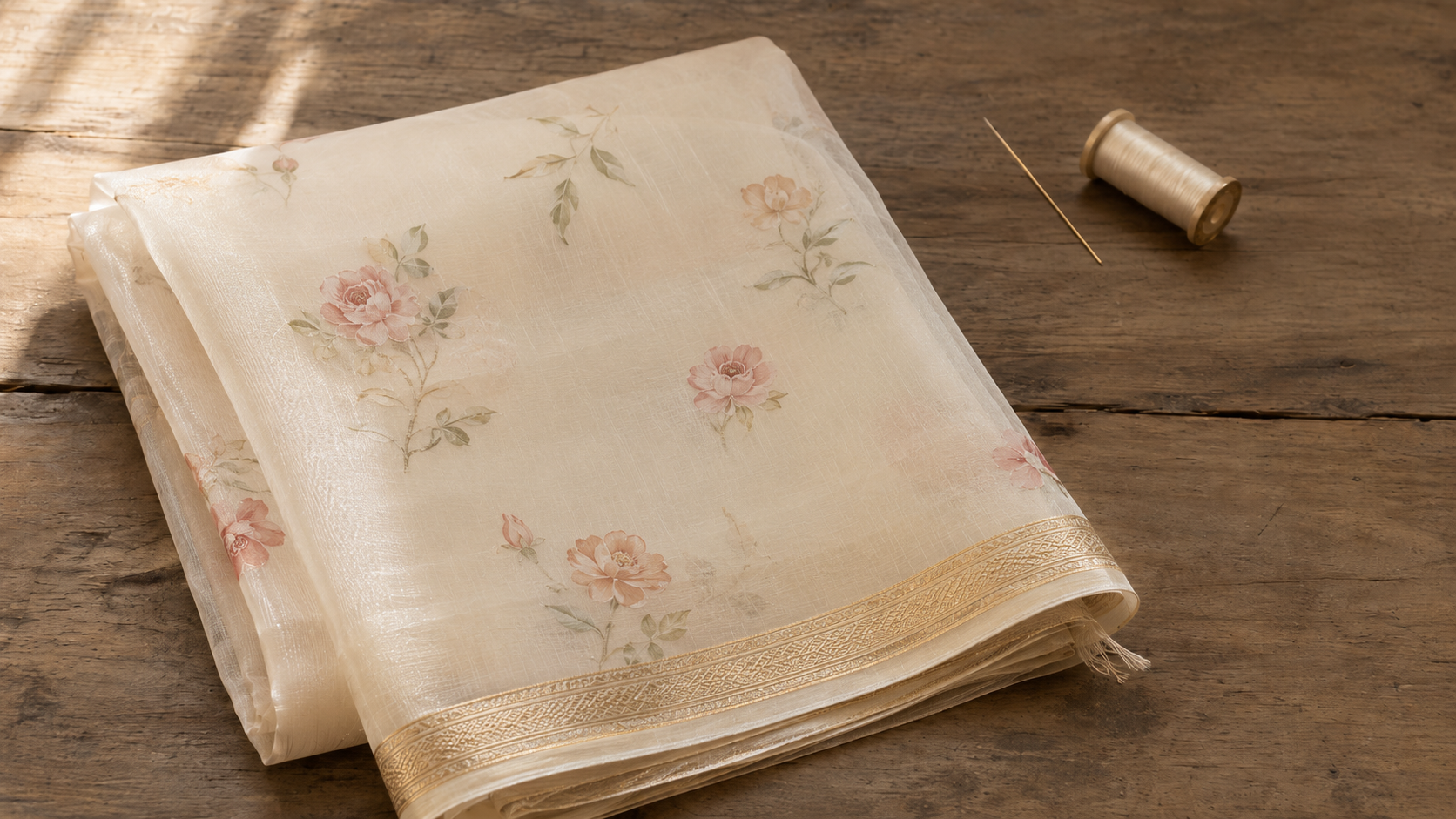
An organza saree guide opens with a paradox: organza is simultaneously the sheerest and the most structured fabric in the contemporary Indian saree wardrobe. The fabric is transparent enough to read as gauze, yet crisp enough to stand away from the body in voluminous pleats. It is lightweight, but the drape reads sculptural rather than fluid. Over the past decade, organza has emerged as the signature fabric of contemporary Indian designer collections — Sabyasachi, Anita Dongre, Manish Malhotra and others have built entire couture lines around it.
This organza saree guide covers what makes the fabric distinctive, the four organza types, designer use, the fragility question, how to drape and care for it, and how to choose your first organza saree for European wear. Written from Munich, for European readers.
In this organza saree guide
What makes an organza saree different
This organza saree guide begins with the fabric’s defining paradox. Organza is woven from highly twisted yarns, traditionally silk, with a plain weave construction that produces a fabric both sheer and crisp. Hold a piece of organza up to the light and you can see through it almost completely. Drape the same piece around a structure and it stands up rather than falls down. This combination — transparent yet structured, lightweight yet voluminous — is unique to organza among contemporary saree fabrics.
Organza differs from the fabrics we have covered so far in fundamental ways. Where cotton is opaque and stiff, organza is transparent and crisp. Where georgette is fluid and body-skimming, organza is structural and stands away from the body. Where Chanderi has subtle translucency, organza has full sheerness. This organza saree guide treats the sheer-crisp paradox as the central technical character of the fabric — every drape, care, and styling decision flows from it. A serious organza saree guide must keep returning to this paradox.
The other defining feature this organza saree guide must explain is the fragility question. Organza is the most delicate fabric in our series. The high-twist yarns that give organza its crispness also make it vulnerable — snags, water damage, sharp edges, and rough handling all cause permanent harm. Owning an organza saree requires more careful storage and wear than any other fabric. The fragility is real, and any honest organza saree guide must walk through it.
A short history of organza
Organza has a long and geographically dispersed history. The fabric originated in medieval Central Asia, most likely in the silk-producing regions of Turkestan and Uzbekistan, sometime in the 13th or 14th century. The name “organza” itself is believed to derive from “Urgench,” a major silk-trade city on the Silk Road. From Central Asia, organza spread eastward to China, where it became part of the imperial textile vocabulary, and westward to Persia, the Ottoman Empire, and eventually Europe.
In India, organza had a presence in court textiles from the Mughal period onward, but never became a major regional handloom tradition the way Banarasi, Kanjivaram, or Chanderi did. The contemporary Indian organza saree is largely a 2010s phenomenon, driven by couture designers who embraced the fabric for its photographable qualities and its compatibility with intricate floral embroidery and digital printing. Any complete organza saree guide must acknowledge this contemporary arc — organza is one of the few major saree fabrics whose moment is now rather than centuries ago.
According to Vogue India, organza has become one of the most photographed saree fabrics of the contemporary couture era. The sheer-crisp drape catches light beautifully under flash photography, the fabric accepts hand-painted floral motifs and digital prints with clarity, and the voluminous pleats read sculptural rather than draped. This organza saree guide sits within that contemporary couture moment.
The types of organza
Any thorough organza saree guide must distinguish the organza variants. Unlike Chanderi (where the three types share a single regional tradition), organza variants differ primarily in fibre and weave structure rather than place of origin. This organza saree guide covers the four most relevant variants for European wearers.
Pure silk organza (the original)
The traditional and most premium variant — woven entirely from natural silk yarn with the characteristic high-twist construction. Pure silk organza has a subtle natural sheen, the finest hand-feel, and ages beautifully. It is also the most expensive (typically 500-1,500 euros for a designer-quality saree) and the most fragile. In this organza saree guide we treat pure silk organza as the upgrade purchase rather than the first-time buy. The fragility differential is the practical reason this organza saree guide steers first-time buyers toward synthetic variants.
Synthetic organza (polyester, nylon)
The most common and most affordable variant — woven from polyester or nylon yarn. Synthetic organza mimics the sheer-crisp quality of silk organza convincingly and accepts printed and digitally-embellished designs well. It is more durable than pure silk (less prone to water damage and snagging), warmer against the skin (does not breathe), and typically costs 80-300 euros. For a first organza saree where you will learn the fabric, synthetic organza is a reasonable starting point this organza saree guide recommends. The price-and-durability case for synthetic is one this organza saree guide makes repeatedly.
Crystal organza (with sheen)
A variant with a higher sheen and slight metallic quality, often achieved with a special yarn finish. Crystal organza reads dressier than standard organza and is favoured for evening occasions and festive wear. The fabric tends to be slightly stiffer and more voluminous than plain organza. Prices range 200-700 euros depending on fibre content and embellishment.
Tissue organza (with metallic warp)
The most luxurious variant — woven with a metallic thread in the warp, creating a subtle shimmer across the entire fabric. Tissue organza is the contemporary couture favourite, frequently used by designers for occasion-wear collections. Prices typically range 600-2,000 euros. This organza saree guide treats tissue organza as the most occasion-specific variant — beautiful but limited in wearability.
When designers use organza — and why
Any contemporary organza saree guide must address the designer question, because organza’s contemporary moment is driven almost entirely by designer collections. Sabyasachi, Anita Dongre, Manish Malhotra, Tarun Tahiliani, and Raw Mango have all built major collections around organza in the past decade. The reasons are aesthetic and technical, and any thorough organza saree guide must cover both.
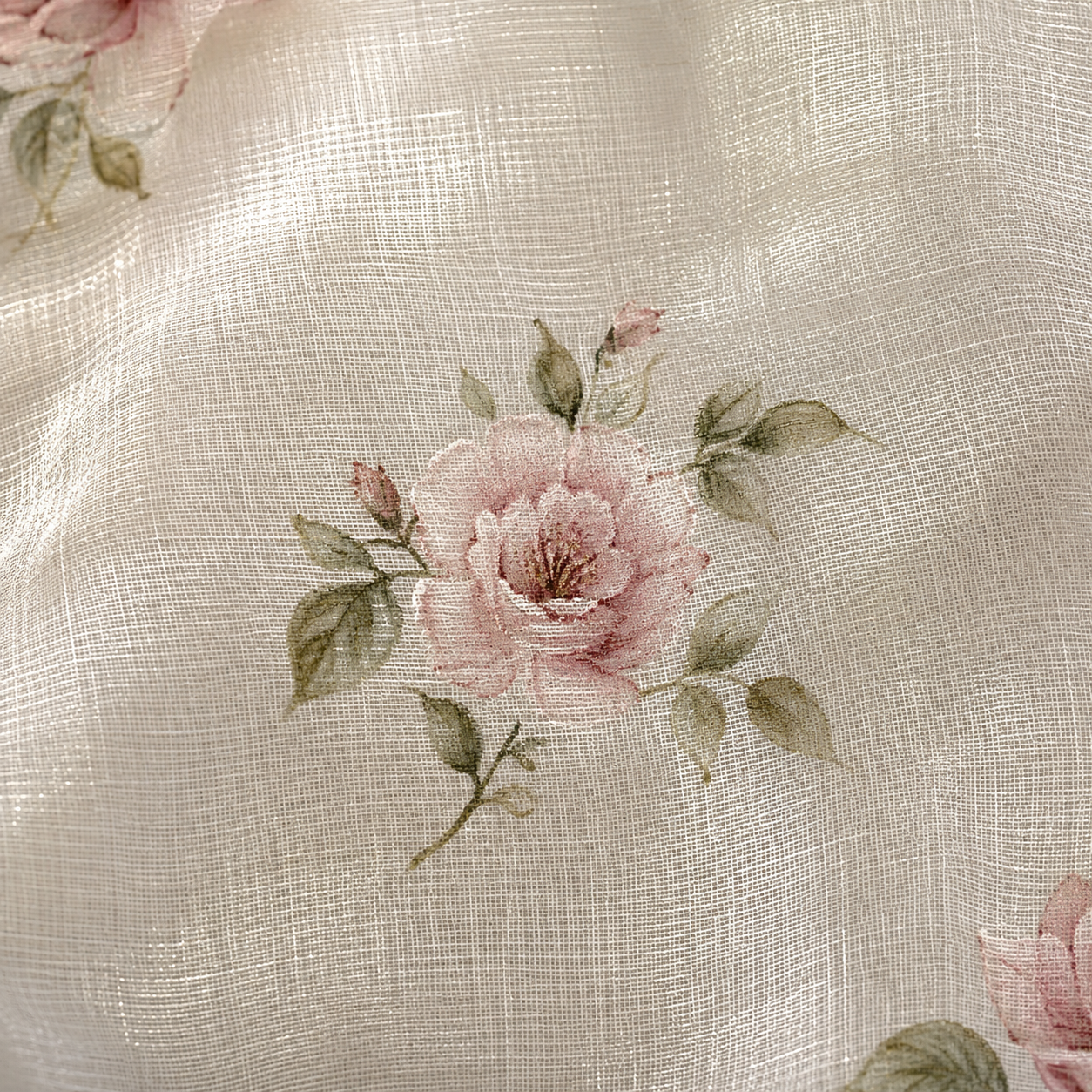
Technically, organza is the easiest fabric to print on at couture scale. The fine weave accepts both traditional hand-painted motifs (often floral) and digital prints with sharp clarity. Hand embroidery — particularly resham thread work, sequin work, and gota patti — sits beautifully on organza without weighing the fabric down. The fabric photographs spectacularly under both natural and studio lighting, which is why organza dominates contemporary Indian editorial shoots.
Aesthetically, organza reads contemporary in a way few traditional Indian fabrics can. The sheer-crisp drape, the floral prints, and the voluminous pleats all evoke the contemporary Indian bridal aesthetic of the past decade — the Sabyasachi-Anita Dongre-Manish Malhotra register. The reader of this organza saree guide who attends a contemporary Indian wedding or sangeet will almost certainly see organza on the bride, the bridesmaids, or the dressier guests. This organza saree guide places the contemporary designer angle as central to understanding the fabric’s current cultural reach.
How an organza saree drapes
An organza saree drapes unlike any other fabric we have covered. Where cotton holds pleats by friction and georgette flows fluidly, organza holds pleats by its own structural stiffness — the high-twist yarn construction makes the fabric stand up rather than fall. This organza saree guide treats the drape character as the most distinctive in the entire saree fabric landscape.
For practical wearing, this has real consequences. Organza pleats stand away from the body in a column with visible volume; the drape reads sculptural rather than draped. The pallu floats rather than falls — it tends to lift slightly with movement, which photographs beautifully but means the pallu needs more secure pinning than other fabrics. Our step-by-step Nivi drape guide works for organza with one adjustment: pin the pallu firmly at the shoulder with at least two safety pins, because organza catches air and the pallu can lift unexpectedly. The pinning advice in this organza saree guide is firmer than for any other fabric.
For European wearers learning to drape, this organza saree guide recommends starting with cotton (per the cotton saree guide) or Chanderi (per the chanderi saree guide) before attempting organza. The sheer-crisp drape of organza is harder to manage than fluid fabrics — small mistakes in pleating show clearly through the transparent body.
Organza saree care — the fragility question
Organza care is the most demanding of any fabric in our series, and any complete organza saree guide must be direct about this. The high-twist construction that makes organza beautiful also makes it vulnerable. Snags, water spots, perfume stains, and sharp edges can cause permanent damage. The care section of this organza saree guide is the most consulted by new owners, and the most important section of any first-time-buyer organza saree guide.
Washing. Pure silk organza should be dry-cleaned, full stop — never washed at home. Synthetic organza can technically be hand-washed in cold water with a gentle detergent, but the risk of stretching, distortion, and permanent creasing is high. Even with synthetic organza, dry-cleaning is the safer choice. Never machine-wash any organza saree under any circumstances.
Drying. If hand-washed (synthetic only), lay flat on a clean towel and roll gently to absorb water. Never wring, never twist, never hang dripping wet. Hang to air-dry in the shade only after the fabric is mostly dry — direct sunlight fades both natural dyes and digital prints. The drying advice in this organza saree guide errs on the side of caution.
Ironing. Iron organza on the reverse side with low heat and a pressing cloth between the iron and the fabric. The high-twist yarns flatten permanently if ironed at high heat, losing the crisp character that defines the fabric. Many wearers prefer to steam organza rather than iron — steaming preserves the structural quality.
Storage. Hang organza sarees on padded hangers rather than folding — folding creates permanent crease lines through the sheer fabric that are visible when worn. For storage drawers, fold loosely with multiple layers of acid-free tissue paper. Wrap embellished organza in muslin to protect the embroidery from snagging. Avoid plastic storage; the fabric needs to breathe.
Snag risk. Organza is the most snag-prone fabric in our entire fabric guide series. Rough surfaces, jewellery hooks, fingernails, sharp jewellery, even fabric tags on other garments can catch and pull threads. A snagged thread on organza is visible immediately and difficult to repair. The snag-awareness practice this organza saree guide recommends: handle the fabric only by the heaviest, most-reinforced sections (the border or the embroidered pallu), never by the sheer body. Any honest organza saree guide acknowledges that snag risk is part of owning this fabric.
Organza for European weather
This organza saree guide must address the climate question with particular directness. Organza is the most weather-specific fabric we cover — it works beautifully in some European months and is genuinely unsuitable in others. The climate verdict in this organza saree guide is firmer than for any other fabric: organza is a strictly seasonal saree.
For late spring, summer, and early autumn in Europe, organza is one of the most beautiful saree fabrics available. The sheer construction allows air movement and keeps the wearer comfortable through warm-weather events. The voluminous pleats catch light at outdoor garden settings. The floral prints read elegant under natural daylight. For daytime weddings, garden parties, festival celebrations, and dressy summer events from May to September, organza works almost anywhere.
For autumn and winter, organza is genuinely problematic. The sheer fabric retains no body heat, the structural drape does not layer well under coats or shawls, and the fragility increases in cold air (silk organza becomes more brittle at low temperatures). The layering approach we cover in our winter saree guide works less well for organza than for any other fabric. This organza saree guide is firm on this point — organza is not the right fabric for European autumn or winter, period. Save the organza for May-September occasions.
For European wearers in cooler northern cities — Stockholm, Helsinki, Edinburgh, Berlin — the organza window is even narrower (June to early September). For southern Europe — Madrid, Rome, Athens — the season extends from May to October.
How to choose your first organza saree
The practical section of this organza saree guide is now. For a European wearer choosing a first organza, four decisions matter most, and any useful organza saree guide must walk through each one. The choosing guidance throughout this organza saree guide leans cautious — start synthetic, start floral, start light, and upgrade later.
Choose synthetic organza over pure silk for your first piece. The price differential is significant (80-300 euros for synthetic vs 500-1,500 euros for pure silk). More importantly, the fragility differential is significant — pure silk organza is dramatically more delicate. For a first organza saree where you will learn the fabric, a quality synthetic organza removes the anxiety of damaging an expensive piece. Once you know you wear organza regularly, the next acquisition can be pure silk for special occasions. This is the most important first-purchase recommendation in this organza saree guide.
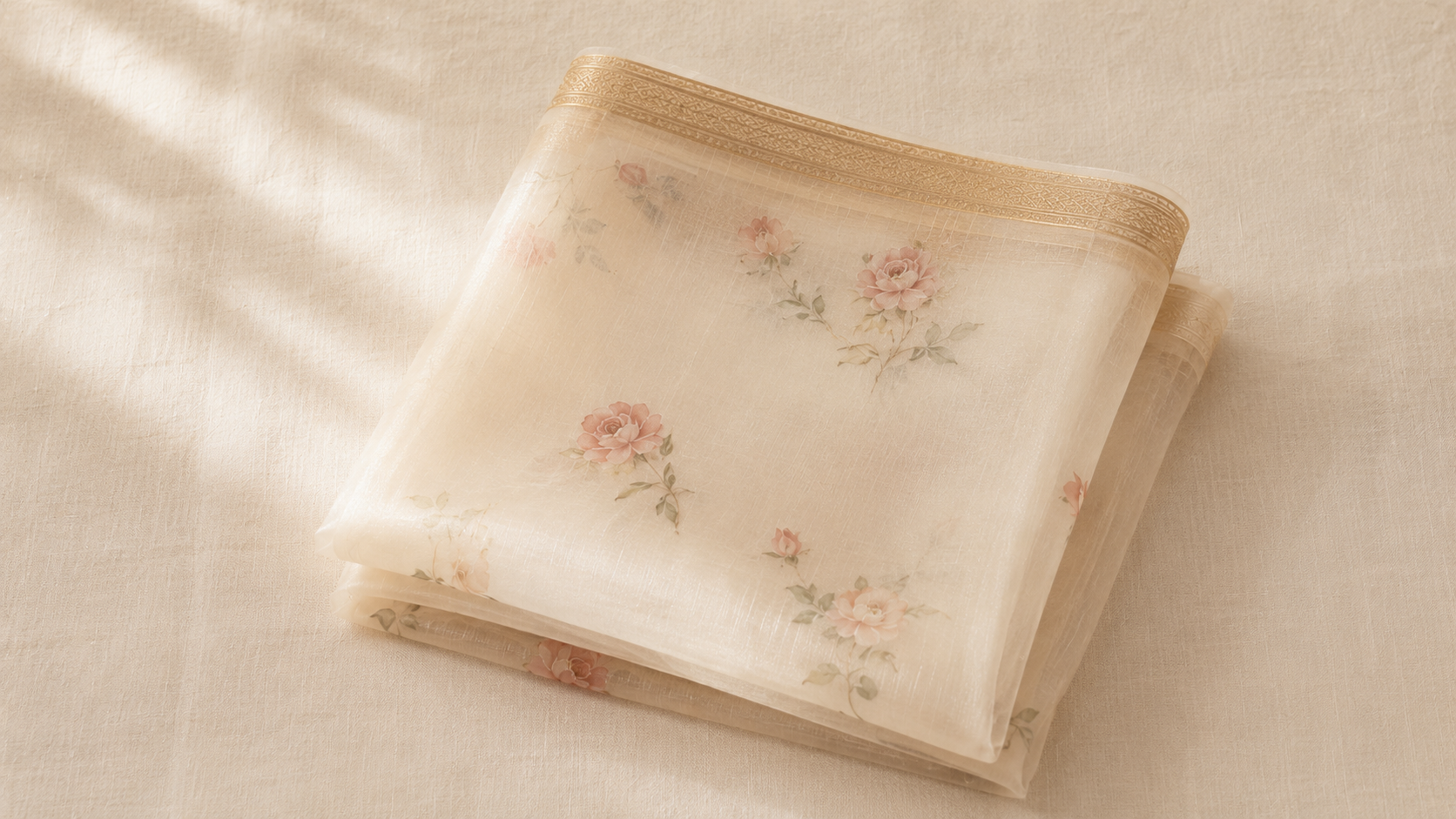
Choose a floral printed design. Floral organza is the contemporary signature look — printed botanical motifs across the sheer body, often with a contrasting solid border. Floral prints read contemporary, photograph beautifully, and work across multiple occasions. Avoid all-over heavy embellishment for a first organza; the saree becomes too occasion-specific and harder to handle. Save heavy embroidery for second or third organza purchases.
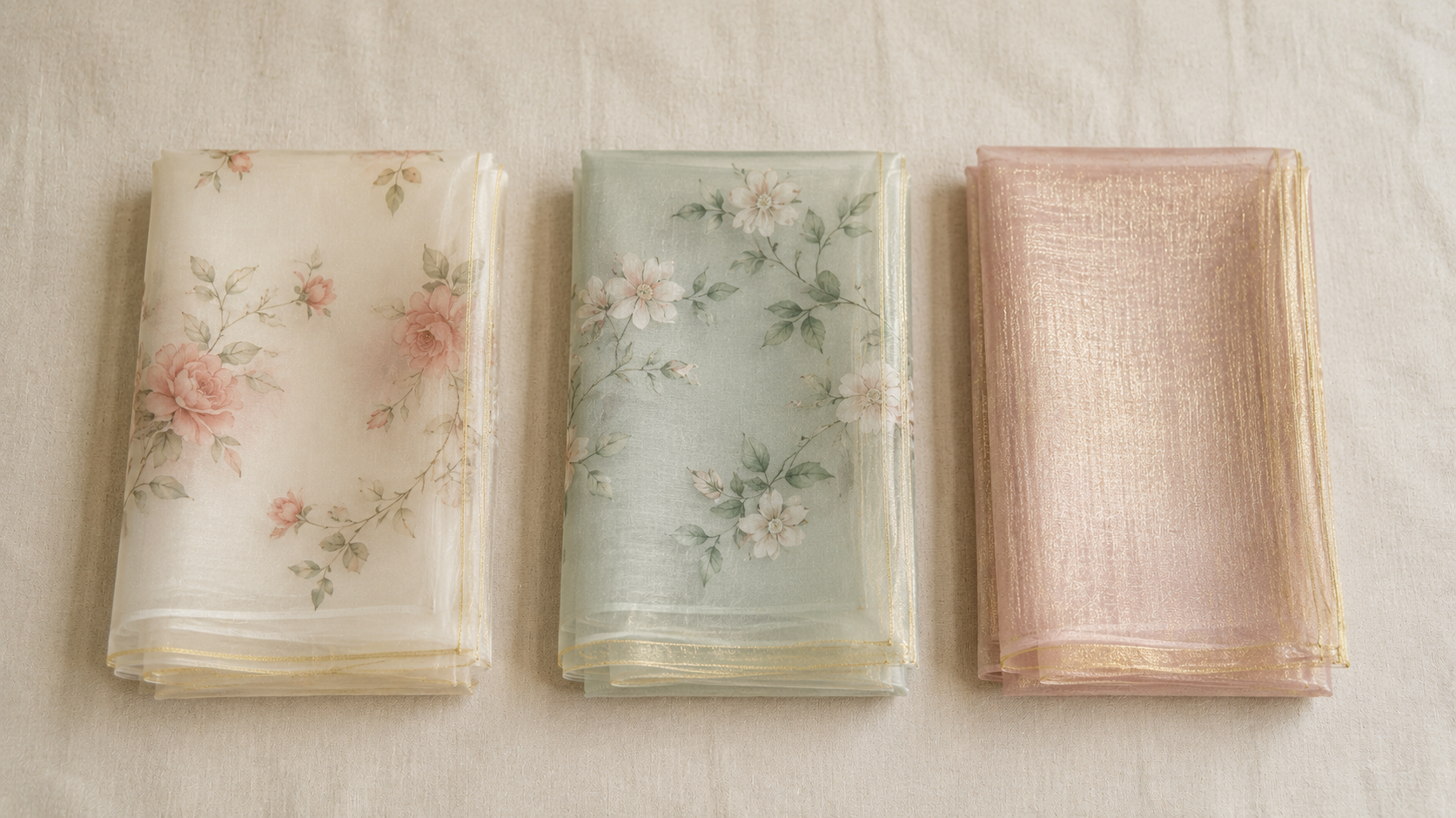
Choose a soft, light colour base. Organza comes alive in pastels and soft mid-tones — ivory, pale pink, soft mint, dusty lavender, sage green, peach, powder blue. The sheer construction and floral prints read beautifully in light colours. Avoid very dark base colours for a first organza — black or deep navy organza is striking but more occasion-specific and harder to style. The colour guidance in this organza saree guide leans firmly toward pastels for first-time buyers. This is the colour rule any new-buyer organza saree guide must repeat.
Choose a fitted, well-constructed blouse. Organza demands a structured blouse because the voluminous drape needs an anchor at the bodice. Our saree blouse design guide covers the full decision framework. For organza specifically, a fitted brocade, silk, or velvet blouse in a complementary solid colour balances the sheer body and printed motifs. Avoid loose-fitting blouses with organza; the contrast in structure looks unbalanced.
Frequently asked questions
Is an organza saree appropriate for daytime weddings?
Yes — organza is one of the most appropriate fabrics for daytime weddings, garden ceremonies, and morning sangeet celebrations. The voluminous drape photographs beautifully under natural light, the floral prints read celebratory, and the sheer construction is comfortable through long warm-weather events. The wedding-occasion verdict in this organza saree guide places organza alongside Chanderi as a daytime-wedding favourite. Many readers of this organza saree guide will find their first wedding-saree decision lands here. Our wedding saree Europe guide covers the broader wedding-occasion decision-making.
How much should I pay for a pure silk organza saree?
A pure silk organza saree from a reputable Indian designer source costs 500-1,500 euros at retail, depending on weight, embellishment, and designer label. Synthetic organza typically costs 80-300 euros. Add 30-50 percent for international shipping to Europe. Anything sold as “pure silk organza” for under 200 euros is almost certainly synthetic — the silk yarn alone exceeds that price point. The pricing guidance in this organza saree guide reflects current designer-market pricing.
Why is organza so fragile?
The high-twist yarn construction that gives organza its crisp drape also creates structural vulnerabilities. The yarns are spun with a tight twist that adds stiffness but reduces tensile strength — meaning the threads break more easily under stress than less-twisted yarns. The sheer weave means there are fewer threads per square centimetre to absorb impact, so a single broken thread shows immediately. This is why the fragility question runs through every section of this organza saree guide.
Does organza wrinkle?
Less than cotton, more than silk. Organza tends to develop sharp crease lines if folded for long periods — the high-twist yarns hold the crease. Hang organza sarees rather than folding when possible. For travel, the rule in this organza saree guide is to roll loosely with multiple layers of tissue paper, then hang for several hours at the destination to release travel wrinkles. Steaming, not ironing, is the safest way to relax wrinkles in organza.
Can I wear organza in European winter?
This organza saree guide does not recommend it. The sheer construction retains no body heat, the structural drape does not layer well under coats, and silk organza becomes more brittle in cold air. From October to April in most of Europe, organza is the wrong fabric. Save organza for May-September occasions. The winter verdict in this organza saree guide is firmer than for any other fabric — organza is genuinely unsuitable in cold weather. For winter wear, see our winter saree guide for fabrics that handle European cold better.
What blouse works best with an organza saree?
A fitted brocade, silk, or velvet blouse pairs best with organza. The structural drape needs a structured anchor at the bodice; a loose or thin blouse looks unbalanced against the voluminous saree drape. A solid-coloured blouse complementing the floral print on the saree body is the most reliable pairing for first-time organza wearers. Our saree blouse design guide covers the complete framework and pairs with this organza saree guide naturally. According to the Victoria and Albert Museum’s South Asia collection, the structured-blouse-with-sheer-saree pairing has been documented in court textiles since the Mughal period.
One more thing
An organza saree is the contemporary couture fabric of Indian fashion. Cotton holds the everyday, Chanderi holds the dressy daytime, georgette holds the evening — and organza holds the contemporary statement occasion. For a European wearer who has built confidence with cotton, Chanderi, and georgette, and is ready for the contemporary designer look, this organza saree guide proposes organza as the next acquisition. The fabric is not for everyday wear, but for the right occasion, no other fabric photographs or reads quite like it. The argument for organza in this organza saree guide is narrower than for cotton or Chanderi — but where it lands, it lands clearly.
The other guides in our library support the organza journey. Our cotton saree guide covers the foundational fabric; our chanderi saree guide covers the dressy daytime alternative; our georgette saree guide covers the fluid evening alternative; our blouse guide handles the structural pairing; our wedding-occasion guide places organza in the daytime-wedding context. Read alongside this organza saree guide, they form the complete reading path for a European wearer adding organza to a developing saree wardrobe.
Follow the journey
Be there from day one.
IndiaNiva is launching its online shop soon. Until then we are sourcing organza from Indian designer workshops, researching tailors in Europe, and writing guides like this one. Two thoughtful emails a month. Nothing more.
Continue reading
- Cotton saree guide — the foundational fabric to learn first
- Chanderi saree guide — the dressy daytime alternative
- Georgette saree guide — the fluid evening alternative
- Wedding saree Europe — organza at daytime weddings
- Saree blouse design — the right blouse for an organza
- Your first saree wardrobe — where organza sits in a developing wardrobe
This organza saree guide draws on conversations with European saree wearers in Germany and France, contemporary Indian designer collections from Sabyasachi and Anita Dongre studios, and the Victoria and Albert Museum’s South Asia collection for historical context on the silk-trade origins of organza. Where specific references appear, the source is linked. All information is correct at the time of writing.