
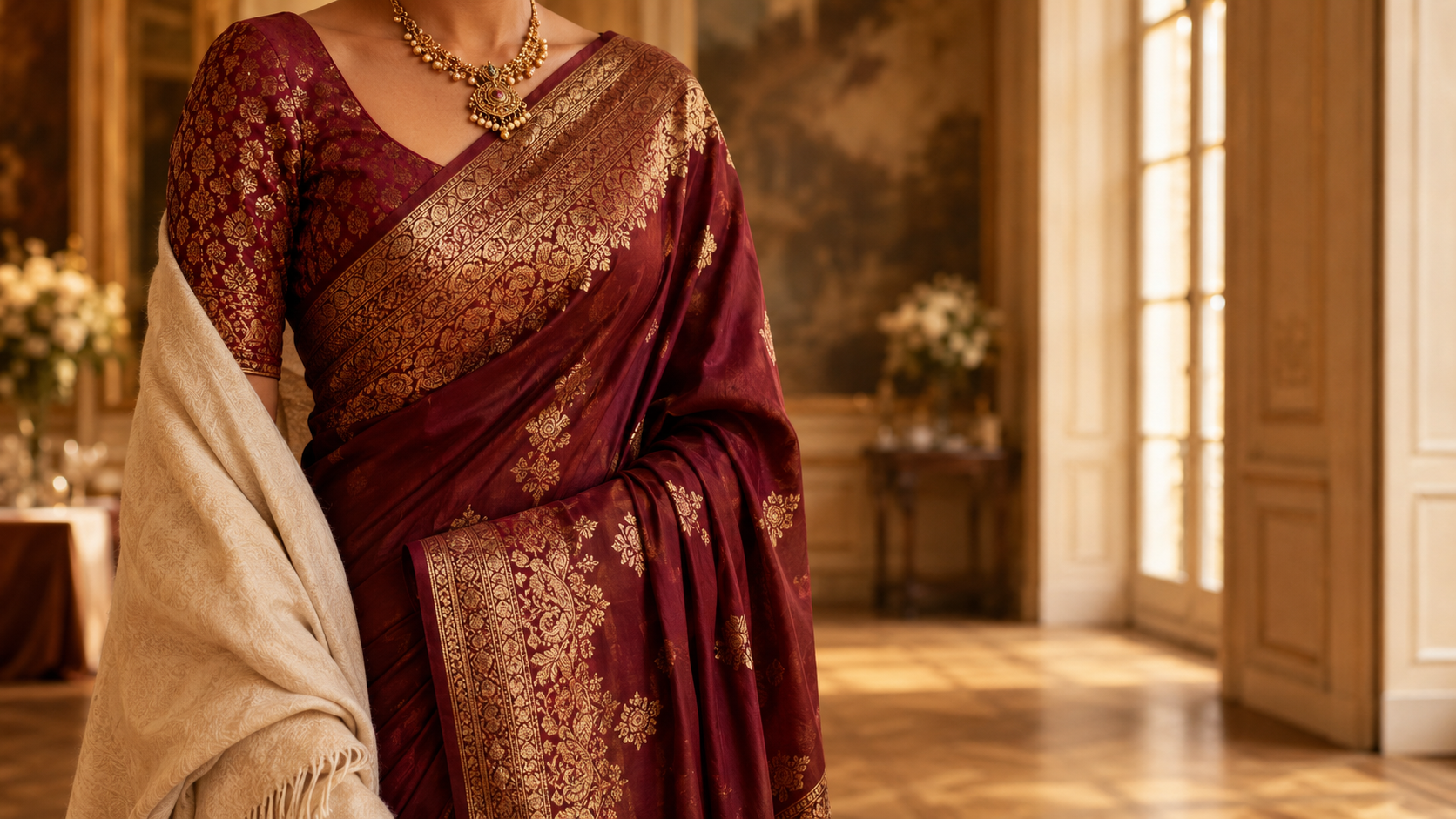
A wedding saree Europe scenario is one of the most rewarding occasions for an Indian saree wearer abroad, and one of the most strategically complicated. The fabric must work for the venue. The colour must respect the dress code. The blouse must keep you warm in a December reception or cool in an August garden. The drape must hold for ten hours. This guide is our complete wedding saree Europe playbook, written from Munich, for European readers attending Indian, fusion, or Western weddings as a saree-wearing guest.
In this guide
Reading the wedding invitation
The first decision in any wedding saree Europe scenario starts with the invitation. Three details on the invite shape every wedding saree Europe styling decision that follows. The first is the venue type — a church, a registry office, an Indian community hall, a luxury hotel, a country estate, a garden marquee. The second is the dress code, if specified — black tie, cocktail, festive, traditional Indian, or “elegant.” The third is the time of day — morning ceremonies, afternoon receptions, and evening dinners each call for different saree choices.
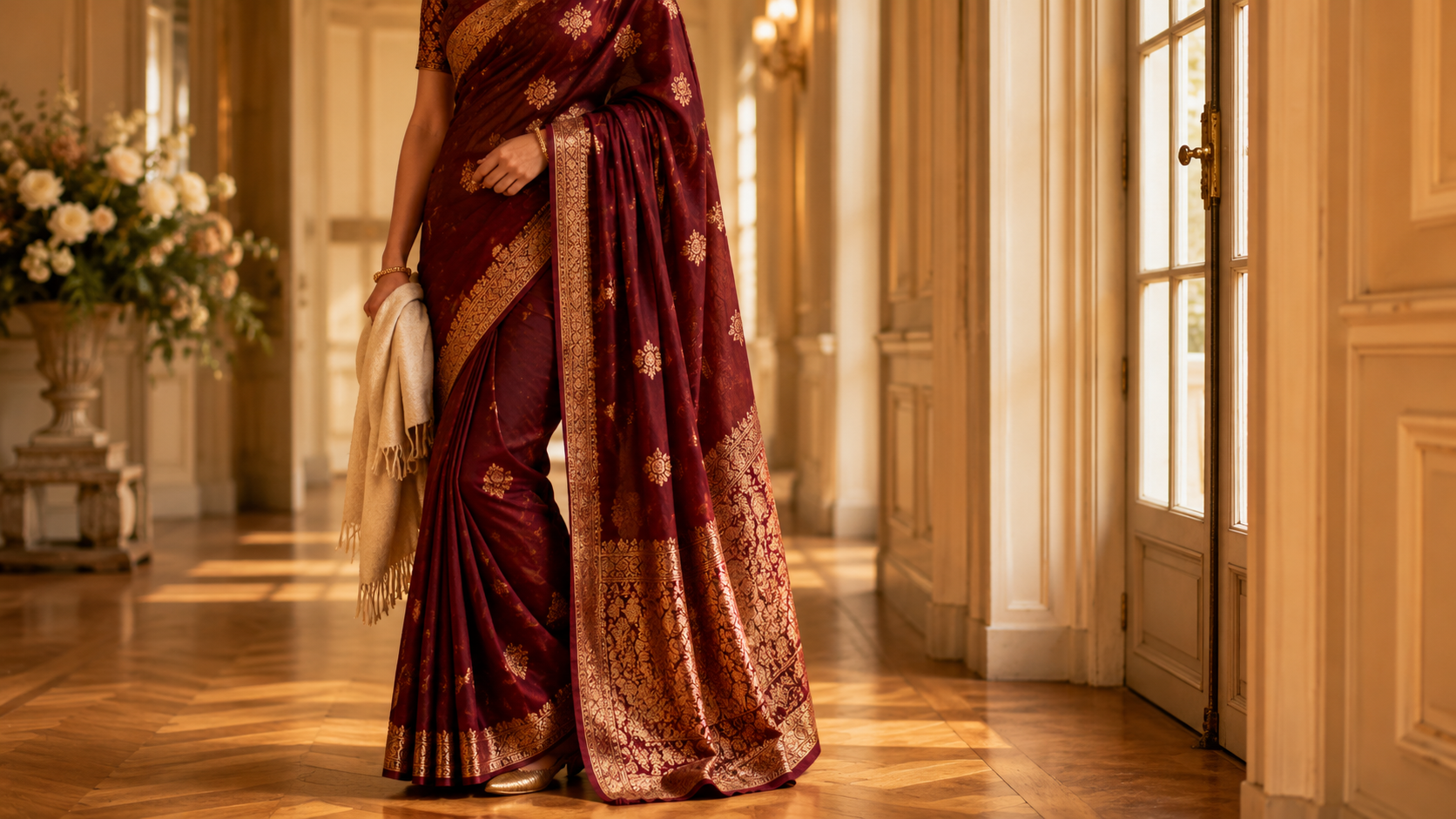
If the invitation specifies “traditional Indian attire,” the saree is the most formal and most welcomed choice you can make. If it specifies “black tie” or “formal,” the saree still works — a heavy silk Banarasi or Kanjivaram is the saree equivalent of a black-tie gown. If it specifies nothing, the venue and time of day become your guide.
Three types of weddings, three saree approaches
A wedding saree Europe choice is also shaped by whose wedding it is. Three broad wedding saree Europe scenarios cover most invitations.
An Indian or fusion wedding in Europe
If the couple is Indian or one partner is Indian, expect a multi-day celebration with sangeet, mehndi, ceremony, and reception. Each event has its own wedding saree Europe convention. The ceremony tends toward heavy silk (Banarasi, Kanjivaram, or heritage handloom — see our silk comparison guide). The sangeet welcomes lighter, more festive pieces — Chanderi, organza, embellished georgette, or chiffon. Our Chanderi, organza, georgette, and chiffon guides cover each fabric in depth. The reception is the most flexible — anything from a contemporary designer saree to a classic silk works.
A European wedding where you are the saree-wearing guest
If the couple is European and you are attending as an Indian or saree-wearing friend, the wedding saree Europe choice should feel celebratory but not so loud that it competes with the bride. A formal silk in a deep but not bridal colour — wine, forest green, midnight navy, ochre — works beautifully. Avoid red, white, and ivory; the first reads bridal in Indian convention, the latter two read bridal in European convention.
A registry or civil ceremony
Smaller, more intimate weddings call for lighter sarees. A Chanderi or organza piece, or a quietly elegant tussar silk, is the right register for this kind of wedding saree Europe occasion. Save the heavy silk for the reception or the larger celebration that often follows.
Fabric choice for a wedding saree Europe occasion
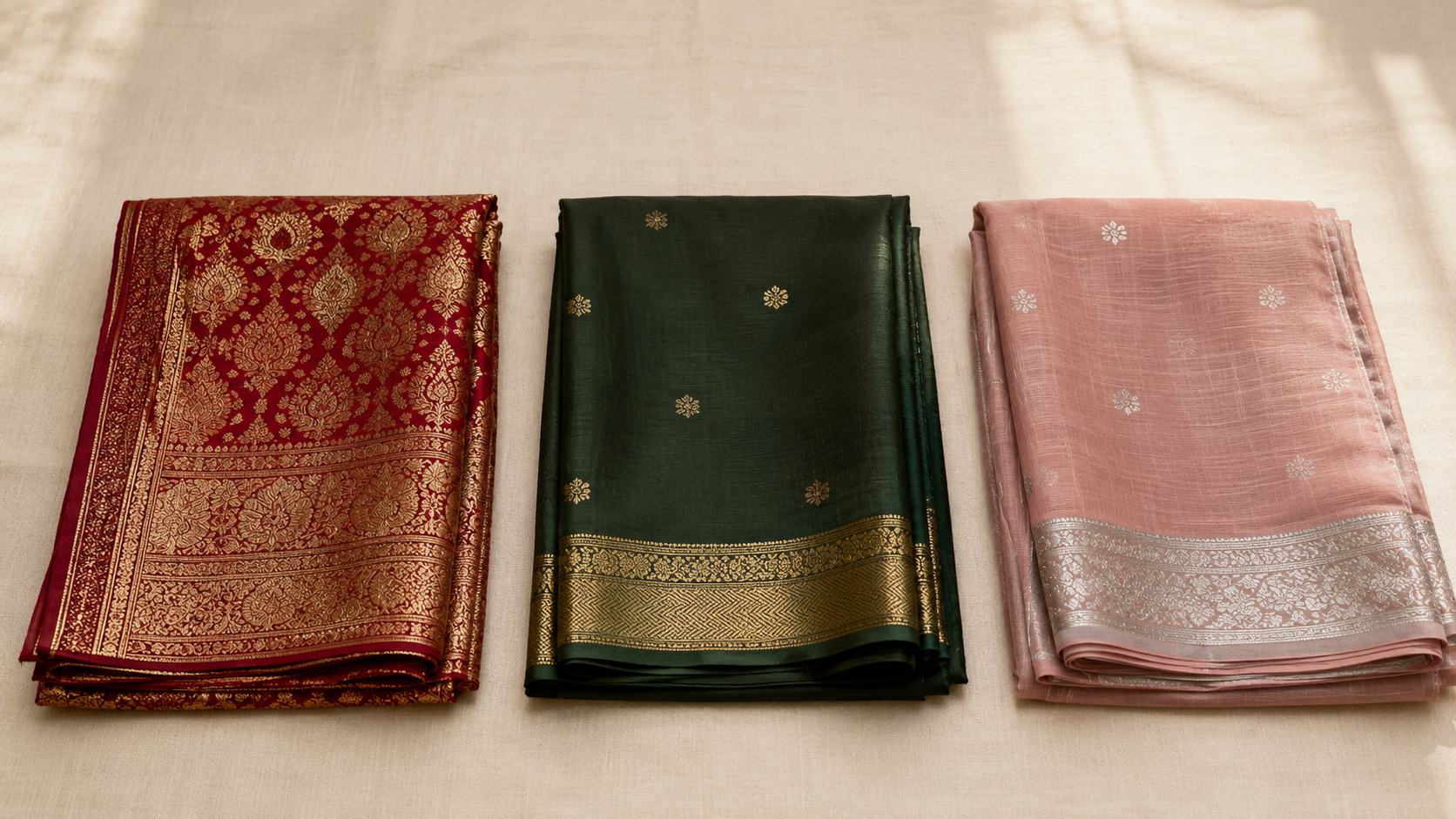
Fabric is the single most important wedding saree Europe decision. The wrong fabric will leave you cold, look thin in photographs, or feel inappropriate for the venue. The right fabric reads instantly correct. Our complete fabric library covers each major saree fabric in depth.
For a formal evening reception in winter or autumn, a medium-weight silk is the most reliable wedding saree Europe choice. A Banarasi in the 800g–1.2kg range or a non-bridal-weight Kanjivaram works beautifully. For deeper detail on the choice between the two, our honest comparison covers the full decision. For a summer or spring daytime wedding, a Chanderi, organza, or lightweight pure silk works better as a wedding saree Europe option — heavier silks become tiring through long warm-weather receptions. For garden weddings specifically, organza’s crisp volume and Chanderi’s silk-cotton breathability are both well-suited.
For evening winter weddings, our chiffon saree guide covers the indoor-evening chiffon case — though chiffon is firmly an indoor and warmer-month fabric. For a sustainable wedding-formal alternative to mulberry silk, our tussar silk saree guide covers the wild silk tradition — particularly suited to garden weddings and afternoon receptions where the slubby texture reads natural and elegant. For the cold-weather case specifically — December weddings, January receptions, anywhere from October to March in Europe — our winter saree guide covers the layering, blouse choices, and footwear adaptations that make a wedding saree Europe-appropriate.
Colour conventions and what to avoid
Colour at weddings is sensitive in both Indian and European conventions, and a wedding saree Europe guest navigates both. The safe wedding saree Europe palette: deep maroon, wine, burgundy, forest green, midnight navy, ochre gold, plum, deep teal. These read formal, photograph beautifully under warm indoor lighting, and avoid all the colour controversies.
Three colours to avoid. Pure red reads as bridal in Indian convention — most Indian brides wear red, and a guest in solid red can look like a competing bride. White or ivory reads as bridal in European convention — most European brides wear white, and a guest in white is socially difficult. Pure black reads as mourning in older Indian convention and as too sombre at celebratory occasions; while modern weddings have relaxed this, a quietly contrasted black (black with gold or coloured embroidery) is safer than solid black.
According to Vogue India, the contemporary saree colour palette for weddings has expanded considerably in the past decade — pastels, jewel tones, and unconventional pairings are now widely worn at Indian weddings. The traditional “avoid white, avoid red” guidance still holds, but the in-between palette is wider than it used to be.
Blouse, drape, and structural choices
The blouse choice for a wedding saree Europe occasion deserves more thought than for everyday wear. A wedding saree Europe blouse needs to read formal, photograph well, and hold up through long hours. For a complete blouse decision framework, our saree blouse design guide covers necklines, sleeves, fabric, and fit in detail.
Three blouse cuts work consistently as a wedding saree Europe pairing. A three-quarter-sleeved brocade blouse in a complementary colour (gold, copper, or a contrast jewel tone) reads elegant and formal. A long-sleeved velvet blouse adds winter warmth and contemporary structure. A backless or low-back blouse in matching silk reads more glamorous and is suited to evening receptions — but expect to feel cold in winter without significant layering.
The drape itself is the standard Nivi — our step-by-step Nivi guide covers the technique. Pin the pallu firmly at the shoulder; a wedding saree must hold through dancing, eating, and ten hours of social interaction. Two safety pins are not excessive for a wedding saree drape.
Accessories, footwear, and outerwear
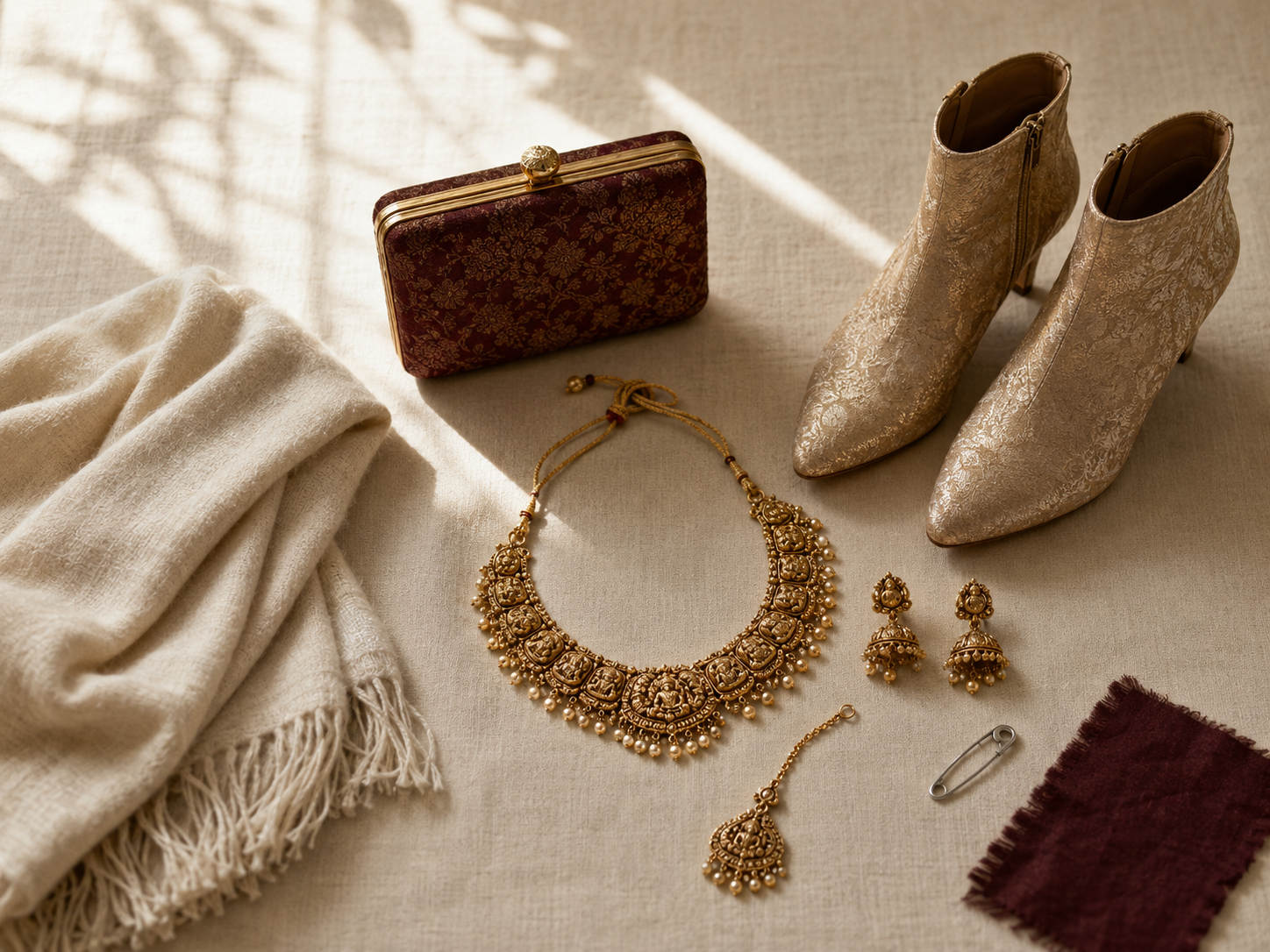
Jewellery for a wedding saree Europe look can be heavier than for everyday wear because the indoor lighting is warmer and the occasion welcomes it. Gold or temple jewellery, statement earrings, stacked bangles, and a maang tikka all read beautifully under wedding-venue lighting. Pearl jewellery works for daytime or pastel sarees. Avoid mixing too many metals — gold or silver, not both.
Footwear matters more than expected for a wedding saree Europe outfit. Closed-toe heels in a neutral colour (champagne, deep brown, black, or gold) work for most venues. For winter weddings, ankle boots concealed under the saree pleats keep your feet warm without being visible. Avoid stiletto heels if the venue has grass, gravel, or wooden floors — the heel will catch.
For outerwear, a fine pashmina or large wool shawl in a complementary colour is the most elegant solution for arriving and leaving. A long structured wool coat in cream, camel, or dark green works for transit; remove on arrival. Avoid a standard winter parka over a Banarasi — the silhouette clash is unforgiving.
Seasonal adjustments by month
A wedding saree Europe choice shifts substantially by season. The same Banarasi that works as a wedding saree Europe option in November feels heavy in July; the same Chanderi that works in May feels insubstantial in January. Three seasonal windows cover most invitations.
October to March (cold season): Heavier silks, full-sleeved or three-quarter-sleeved blouses, thermal layers under the petticoat, pashmina shawl for transit, ankle boots concealed under the saree. The full winter saree treatment — see our winter saree guide for the layering principle, and our tussar silk guide for the most cold-friendly silk.
April to June (spring): Medium-weight silks, Chanderi or organza for daytime, three-quarter or short sleeves, lighter shawl optional. The most flexible season for a wedding saree wardrobe.
July to September (summer): Lightweight silks, Chanderi, organza, even pure cotton for daytime garden weddings. Chiffon for evening receptions only. Cap sleeves or short sleeves. No outerwear needed. Open-toe sandals or heels work where they would not in winter.
What to avoid as a wedding saree Europe guest
A few common mistakes to avoid for any wedding saree Europe occasion. Avoid outshining the bride — no solid red at an Indian wedding, no white at a European one, no neon-bright colours that pull attention from the couple. Avoid under-dressing — a casual cotton saree is not appropriate for a formal evening reception even if it is comfortable. Avoid heavy fragrances near food service. Avoid synthetic fabrics that crease badly on long flights or train journeys to the venue.
Avoid wearing a saree you have not draped at least three times before. A wedding is not the place to debut a new pleating technique. Practise the drape twice at home before the day. If you have any doubt about the drape holding, consider a pre-stitched ready-to-wear option for your wedding saree Europe choice — the visual result is nearly identical and the security is significantly higher. Our pre-stitched saree guide covers the three construction types and the case for ready-to-wear at high-stakes occasions.
Frequently asked questions
Can I wear a saree to a European church wedding?
Yes. A wedding saree Europe choice is welcome at almost every European church we have encountered. A modest neckline, covered shoulders (a three-quarter or long-sleeved blouse), and a pashmina shawl over the shoulders during the ceremony are the simple modifications that work. Avoid a backless blouse or a very deep V neckline for a religious ceremony.
What if I have never worn a saree before and the wedding is in a month?
Practise. Buy or borrow a simple saree to drape for practice — our step-by-step guide covers the technique, and our cotton saree guide covers the practice fabric. Drape it three to five times before the wedding day. If the time pressure is too great, a pre-stitched ready-to-wear wedding saree Europe option for the day itself removes the drape risk entirely while keeping the visual result intact — see our pre-stitched saree guide.
Is it appropriate to wear a saree as the only Indian-attired guest?
Yes, completely. Across most European weddings we have heard about, the saree-wearing guest is welcomed and often photographed. A wedding saree Europe choice reads as formal and considered. The only adjustment we suggest is to make sure your saree feels celebratory rather than statement-making — the goal is to look elegant in the room, not to be the one everyone is looking at.
How do I keep a wedding saree warm enough for a December evening?
Layering. Thermal long-sleeved base under a long-sleeved blouse, thermal leggings under the petticoat, ankle boots, and a pashmina shawl. Our winter saree guide covers the full layering principle. With proper layering, a wedding saree Europe outfit at a December evening is no colder than a winter dress would be.
Can I wear a saree my mother gave me, or should I buy a new one?
An inherited or gifted saree is the most meaningful choice possible for a wedding. The condition matters — if the silk is fragile or showing wear, consider whether the saree will survive a long day. A specialist tailor can often repair fold-line wear or refresh the zari before the occasion. If the saree is in good condition, wearing it carries far more emotional weight than anything new.
What if I wear a saree and feel overdressed?
You will not be overdressed at a wedding. A saree is one of the most formal garments in the world, and weddings are formal occasions. The reverse — feeling underdressed in casual cotton at a black-tie event — is the more common discomfort. When in doubt, lean slightly formal.
One more thing
A wedding saree Europe occasion is one of the moments where wearing a saree feels most rewarding. The photographs last, the compliments are warm, and the choice of garment marks the occasion in a way few other clothes can. A well-planned wedding saree Europe outfit pays off. Practise the drape, choose the fabric for the season, pick the blouse with care, and the rest follows.
For deeper preparation, our complete guide library supports every step. The beginner’s guide covers foundations. The silk comparison covers Piece 2 of a wedding saree wardrobe. Our complete fabric library covers each major fabric — cotton, georgette, chanderi, organza, tussar silk, and chiffon. The draping tutorial teaches the Nivi. The blouse guide handles the structural fit. The winter guide covers cold-weather layering. The pre-stitched saree guide covers the ready-to-wear option. And our saree wardrobe capsule places a wedding-formal piece in your starter five.
Follow the journey
Be there from day one.
IndiaNiva is launching its online shop soon. Until then we are building quietly — sourcing wedding-worthy silks, researching tailors in Europe, and writing guides like this one. Two thoughtful emails a month. Nothing more.
Continue reading
- What is a saree? An essential beginner’s guide — the foundation before any wedding occasion
- Banarasi vs Kanjivaram — the silk decision for a wedding-formal piece
- Cotton saree guide — the practice fabric and the summer wedding option
- Chanderi saree guide — daytime and registry weddings
- Georgette saree guide — sangeet and reception flexibility
- Organza saree guide — garden and daytime weddings
- Tussar silk saree guide — sustainable wedding silk for garden and registry
- Chiffon saree guide — evening receptions and indoor weddings
- Pre-stitched saree guide — the high-stakes ready-to-wear option
- How to drape a saree — practise before the wedding day
- Saree blouse design — the wedding blouse decisions
- How to wear a saree in winter — the cold-weather wedding case
- Your first saree wardrobe — where a wedding piece sits in your starter five
This wedding saree Europe guide draws on conversations with European saree wearers attending weddings in Germany, France, the Netherlands, and the UK, and the Victoria and Albert Museum’s South Asia collection for historical context on saree occasion-wear. Where specific references appear, the source is linked. All information is correct at the time of writing.