
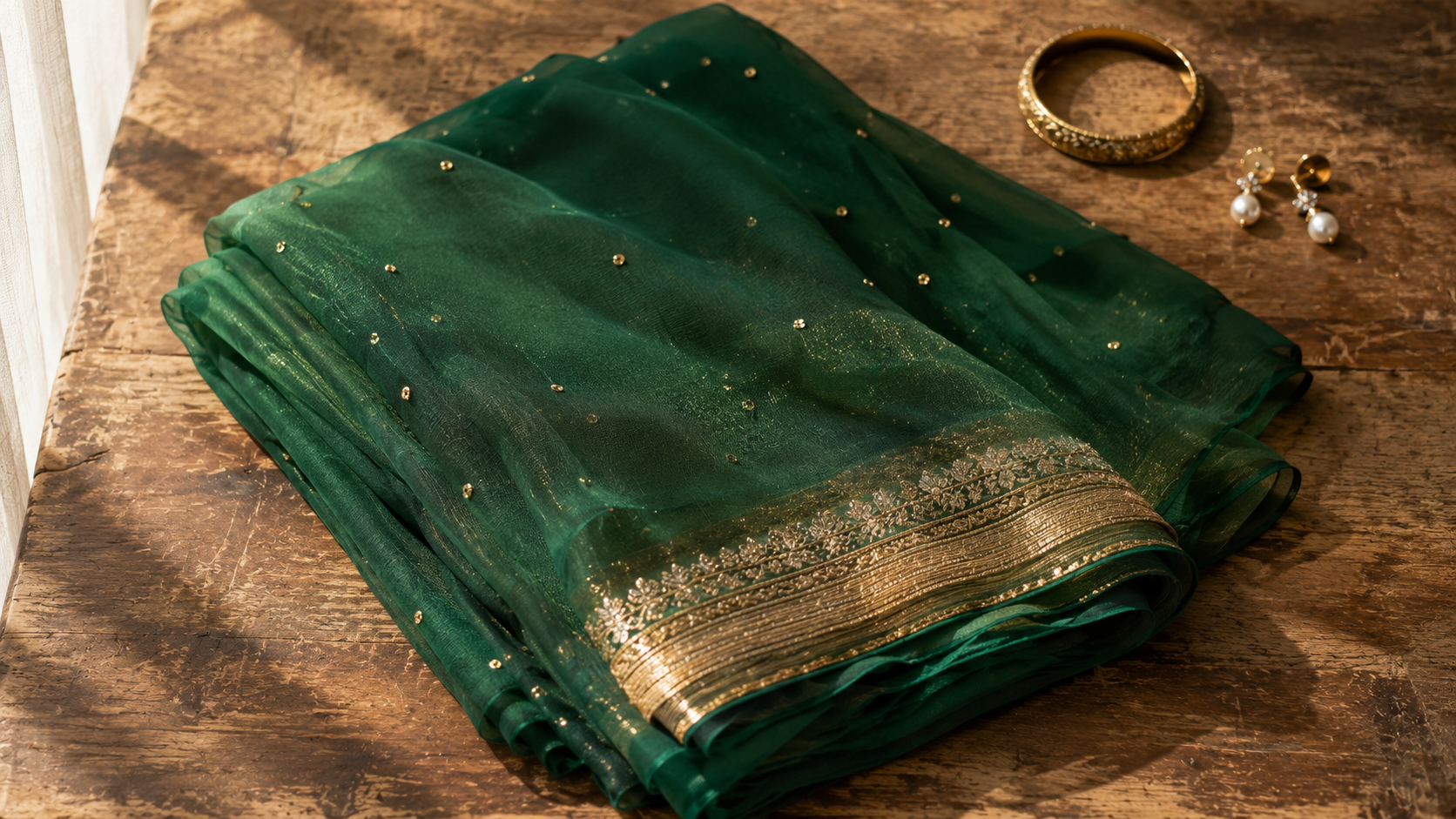
A chiffon saree guide is, in some ways, a guide to glamour. Chiffon is the most fluid of all saree fabrics — sheerer than georgette, lighter than silk, and famously the fabric that defined Bollywood’s golden-age leading-lady wardrobe. From the 1980s through the early 2000s, Rekha, Sridevi, and Madhuri Dixit made the chiffon saree the cinematic shorthand for elegance in Indian cinema, and the fabric has carried that association ever since.
This chiffon saree guide covers what makes the fabric distinctive, its Paris-to-Bollywood history, the two main types, the critical chiffon-vs-georgette question, how to drape and care for it, and how to choose your first chiffon saree for European wear. Written from Munich, for European readers.
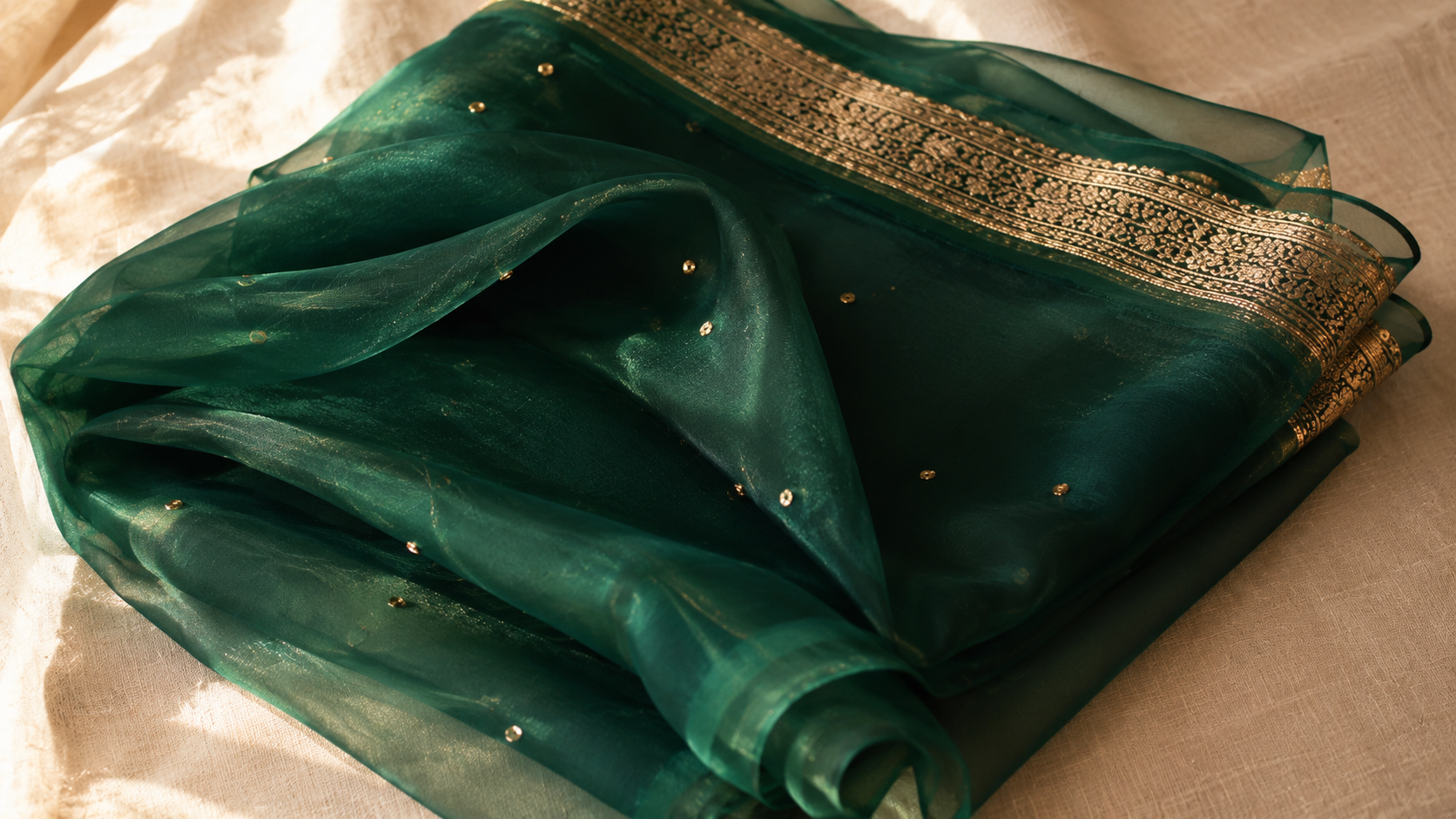
In this chiffon saree guide
What makes a chiffon saree different
This chiffon saree guide begins with the fabric’s defining quality: chiffon is the most fluid fabric in the contemporary Indian saree wardrobe. Where cotton has structural body, organza has crisp volume, and tussar has slubby texture, chiffon has movement. The fabric flows like water around the body, with a drape that responds to every breath and gesture. This fluid character is the source of every distinctive feature of chiffon. A serious chiffon saree guide must keep returning to this fluid character.
Chiffon is also significantly sheer. Hold a piece of chiffon to the light and the fabric is partially transparent — not as transparent as organza, but enough that a saree-wearer must consider what goes underneath. The sheerness combines with the fluidity to produce a drape that reveals body shape more than any other saree fabric. Any honest chiffon saree guide must address both qualities directly.
The third defining feature is softness. Chiffon has no crispness, no body, no structural memory. The fabric feels feather-light in hand and weightless on the body. This softness is what gives chiffon its evening-glamour reputation — the fabric photographs beautifully under low light, catches movement gracefully, and creates a silhouette that no structured fabric can replicate. This chiffon saree guide treats the fluid-soft-sheer combination as the technical character that distinguishes the fabric. Every other section of this chiffon saree guide flows from this fundamental triad.
A short history of chiffon — Paris to Bollywood
Chiffon is one of the few major saree fabrics with a European origin. The fabric was developed in France in the late 19th century — the name “chiffon” comes from the French word for cloth or rag. Originally produced from silk yarn with a specific high-twist weave that creates the sheer fluid character, chiffon became a staple of European evening fashion in the early 20th century. It reached India through colonial-era textile trade and was incorporated into the Indian saree wardrobe by the mid-20th century.
The fabric’s defining cultural moment came in Bollywood. From the 1970s through the early 2000s, chiffon sarees became the signature wardrobe of leading Hindi cinema actresses. Rekha’s chiffon sarees in films like Silsila, Sridevi’s flowing chiffon drapes in her 1980s and 1990s hits, Madhuri Dixit’s iconic chiffon moments — all cemented chiffon as the cinematic shorthand for elegance, romance, and feminine glamour in Indian cinema. Any contemporary chiffon saree guide must acknowledge this association; chiffon arrives in the 21st century carrying the cultural weight of three decades of Bollywood imagery. The Bollywood story runs throughout this chiffon saree guide as a recurring touchstone.
According to Vogue India, the chiffon saree has seen a contemporary revival driven by actresses including Deepika Padukone, Kareena Kapoor, and Alia Bhatt, who have brought the fabric back to red-carpet and editorial photography. Designers including Sabyasachi, Manish Malhotra, and Anita Dongre have produced major contemporary chiffon collections. This chiffon saree guide sits within that contemporary revival.
The two types of chiffon
Any thorough chiffon saree guide must distinguish the two main variants. Unlike Chanderi or tussar, where regional traditions define the categories, chiffon variants differ primarily by fibre — silk or synthetic. This chiffon saree guide treats the silk-vs-synthetic decision as the primary type distinction.
Pure silk chiffon (the original)
The traditional and most premium variant — woven entirely from natural silk yarn with the characteristic high-twist construction. Pure silk chiffon has a soft natural sheen, the finest hand-feel, and a fluid character that synthetic versions struggle to match exactly. It is also the most expensive (typically 400-1,200 euros for a designer-quality saree) and the most fragile — pure silk chiffon snags easily and tears with surprising fragility. In this chiffon saree guide we treat pure silk chiffon as the upgrade purchase rather than the first-time buy. The fragility differential is the practical reason this chiffon saree guide steers first-time buyers toward synthetic variants.
Synthetic chiffon (polyester, georgette-chiffon blends)
The most common and most affordable variant — woven from polyester yarn or polyester-silk blends. Synthetic chiffon mimics the sheer-fluid quality of silk chiffon convincingly and accepts printed and digitally-embellished designs well. It is more durable than pure silk (less prone to tearing and snagging), warmer against the skin (does not breathe as well as silk), and typically costs 60-250 euros. For a first chiffon saree where you will learn the fabric, synthetic chiffon is the practical starting point this chiffon saree guide recommends. The price-and-durability case for synthetic is one this chiffon saree guide makes repeatedly.
A particular sub-category worth noting: georgette-chiffon blends. These fabrics combine some of chiffon’s fluidity with some of georgette’s body — a useful in-between option for wearers who want the chiffon look with slightly more structure. Bollywood costume designers often use georgette-chiffon blends precisely because the drape photographs like chiffon but holds up better through long shoots.
Chiffon vs georgette — what’s the difference?
This is the most asked question in any chiffon saree guide, and it deserves a direct answer. Chiffon and georgette are often confused, sometimes used interchangeably in marketing copy, and frequently mistaken by first-time saree buyers. The distinction matters, and this chiffon saree guide treats the chiffon-vs-georgette question as central to choosing the right fabric.
Chiffon is sheerer, lighter, and more fluid. Hold chiffon up to light and it is partially transparent; the fabric drapes like water and weighs almost nothing in hand. Chiffon has no grainy texture — the surface is smooth and feels soft against the skin.
Georgette has more body, slight grainy texture, and more structure. Georgette is also fluid, but less so than chiffon. The fabric has a subtle crinkle or grain on its surface, holds pleats slightly better than chiffon, and reads as more substantial. Georgette is also less sheer — partially translucent but not transparent.
Practically: chiffon for evening glamour and lighter-weight occasions; georgette for everyday and structured occasions. A chiffon saree photographs beautifully under low light and catches movement gracefully but can read slightly insubstantial in bright daylight; a georgette saree handles daylight better and feels more reliable for office and daytime events. For our complete take on georgette, see our georgette saree guide. This chiffon saree guide treats the two fabrics as siblings — both fluid silk-or-synthetic — with chiffon being the more delicate evening cousin.
How a chiffon saree drapes
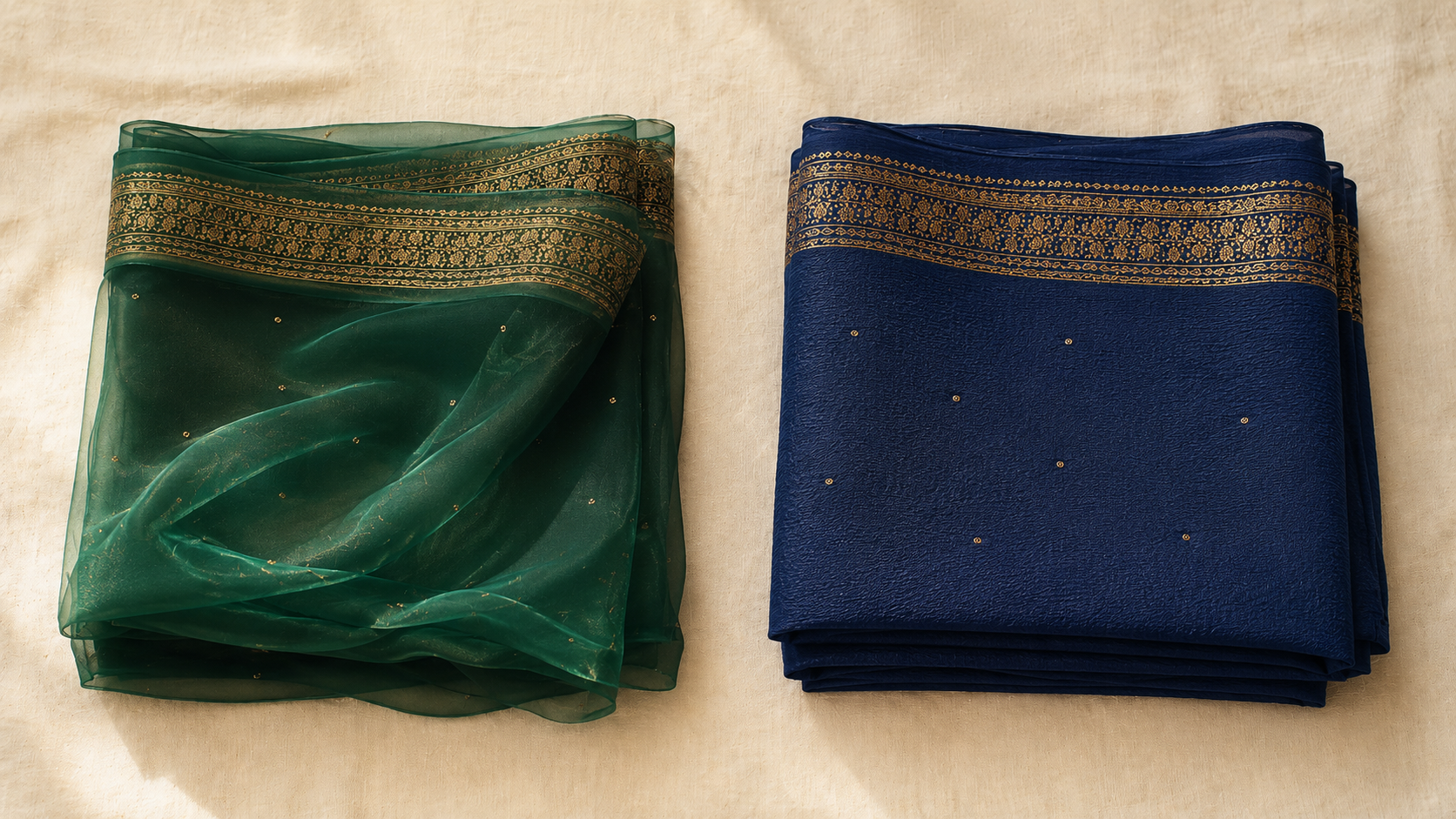
A chiffon saree drapes more fluidly than any other fabric we have covered. The pallu flows in continuous waves rather than discrete folds; the pleats relax against the body rather than standing in a column; the body wrapping clings softly without rigid structure. This fluid drape is the entire point — it is what makes chiffon the evening-glamour fabric. The drape character is what this chiffon saree guide treats as the fabric’s signature quality.
Practically, this has consequences. Chiffon slips against the petticoat fabric, particularly silk chiffon against silk or satin petticoats. The pleats can come undone during long events without proper pinning. The pallu floats away from the shoulder if not secured firmly. Our step-by-step Nivi drape guide works for chiffon with adjustments: use a cotton petticoat (more friction), use at least two safety pins at the shoulder and one at the waist pleat, and consider double-tucking the pleats into the petticoat. The pinning advice in this chiffon saree guide is firmer than for any other fabric except organza.
For European wearers learning to drape, this chiffon saree guide does not recommend chiffon as a first-drape fabric. Start with cotton (see our cotton saree guide) or tussar (see our tussar silk saree guide) before attempting chiffon — the fluid character is harder to manage than any structured fabric.
Chiffon saree care
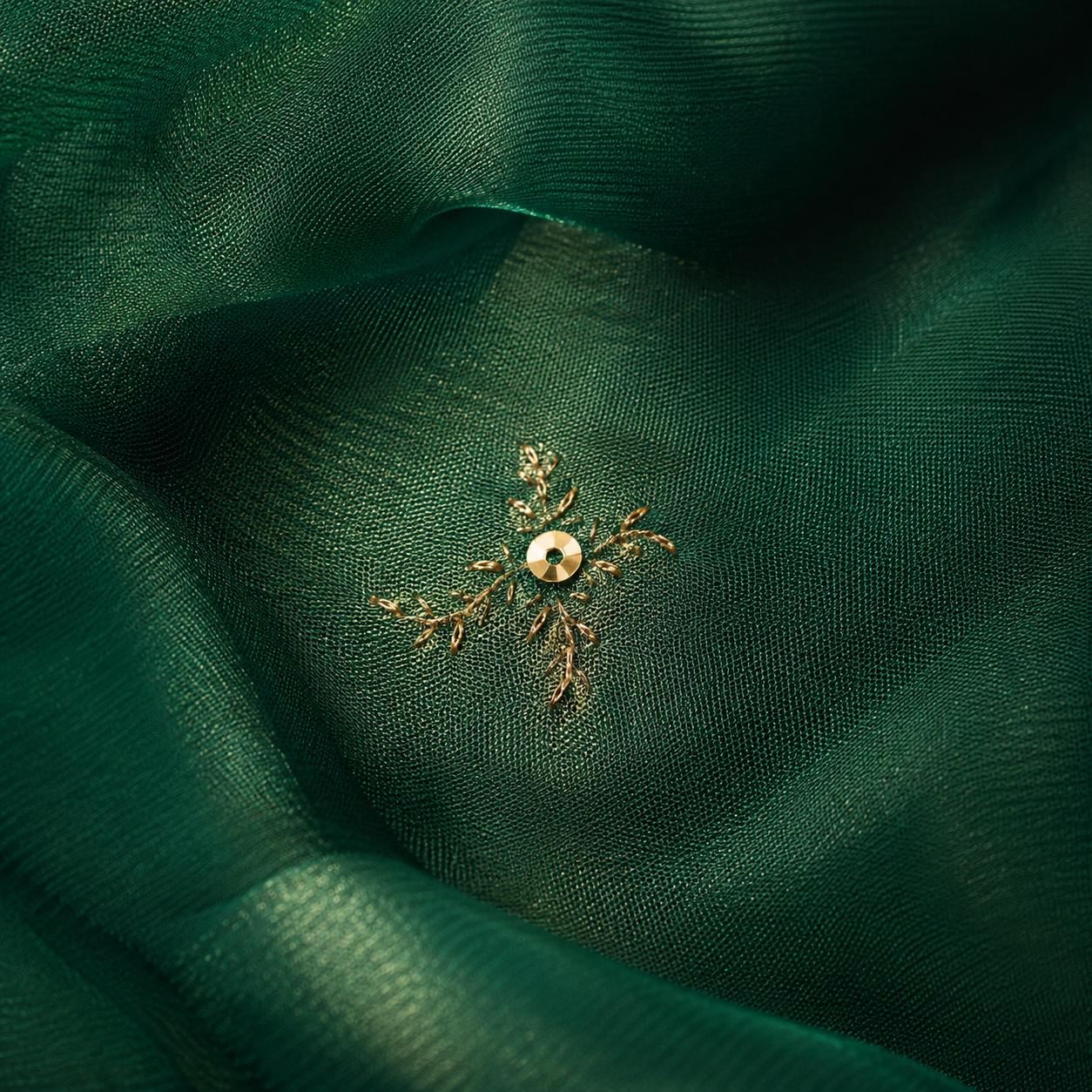
Chiffon care is among the most demanding of any fabric we cover. Any complete chiffon saree guide must walk through the routines, because the fluid sheer fabric is genuinely delicate. The care section of this chiffon saree guide is the most consulted by new owners.
Washing. Pure silk chiffon should be dry-cleaned, full stop — never hand-washed at home. Synthetic chiffon can technically be hand-washed in cold water with a gentle detergent designed for delicates, but the snag risk and the chance of permanent creasing are significant. Even with synthetic chiffon, dry-cleaning is the safer choice. Never machine-wash any chiffon saree under any circumstances.
Drying. If hand-washed (synthetic only), lay flat on a clean towel and roll gently to absorb water. Never wring, never twist, never hang dripping wet — the wet weight can permanently distort the high-twist weave. Hang to air-dry in the shade after the fabric is mostly dry; direct sunlight fades both silk and synthetic chiffon.
Ironing. Iron chiffon on the reverse side with low heat (silk setting) and always use a pressing cloth between the iron and the fabric. The high-twist yarns scorch easily and flatten permanently at high heat. Many wearers prefer to steam chiffon rather than iron — steaming relaxes wrinkles without risking heat damage.
Storage. Hang chiffon sarees on padded hangers rather than folding when possible. If folding is necessary, fold loosely with multiple layers of acid-free tissue paper and refold every two months to prevent permanent crease lines. Wrap in muslin for protection. Avoid plastic storage; the fabric needs to breathe and plastic can cause silk chiffon to yellow.
Snag and tear risk. Chiffon is among the most snag-prone fabrics in our entire fabric guide series. Sharp jewellery, fingernails, rough surfaces, even fabric tags on other garments can catch and pull threads. Pure silk chiffon also tears with surprising fragility under stress — a snagged thread that pulls can lead to a small tear. The handling rule this chiffon saree guide recommends: treat chiffon as gently as you would treat a butterfly’s wing. Any honest chiffon saree guide acknowledges the fragility as part of owning the fabric.
Chiffon for European weather
This chiffon saree guide must address the climate question with directness. Chiffon is among the most weather-specific saree fabrics we cover — it works beautifully in some European months and is genuinely impractical in others. The climate verdict in this chiffon saree guide is firmer than for most other fabrics.
For late spring, summer, and early autumn evening events in Europe, chiffon is one of the most beautiful saree fabrics available. The fluid drape moves elegantly through warm-weather receptions, the sheer construction allows air movement, and the evening-glamour aesthetic suits dinner parties, sangeet celebrations, and reception events from May to September. Indoor venues with climate control extend the chiffon window through most of the year. The seasonal verdict in this chiffon saree guide is straightforward.
For European autumn outdoors and for winter, chiffon is genuinely problematic. The sheer fabric retains no body heat, the fluid drape clings against thermal underclothes in unflattering ways, and the fragility increases in cold dry air. The layering approach we cover in our winter saree guide works poorly for chiffon — the structural mismatch between thermal layers and fluid sheer fabric reads awkward. This chiffon saree guide is firm on this point: chiffon is an evening-and-indoor fabric for European wearers, not an autumn-outdoors or winter fabric.
For European wearers in cooler northern cities — Stockholm, Helsinki, Edinburgh, Berlin — the chiffon outdoor window is short (June to August). For southern Europe — Madrid, Rome, Athens — the outdoor season extends from May to October. Indoor venues in any European city work year-round.
How to choose your first chiffon saree
The practical section of this chiffon saree guide is now. For a European wearer choosing a first chiffon, four decisions matter most, and any useful chiffon saree guide must walk through each one. The choosing guidance throughout this chiffon saree guide leans cautious — start synthetic, start jewel-tone, plan the underlayer, and upgrade later.
Choose synthetic chiffon over pure silk for your first piece. The price differential is meaningful (60-250 euros for synthetic vs 400-1,200 euros for pure silk). More importantly, the fragility differential matters — pure silk chiffon is dramatically more delicate and tears with surprising ease. For a first chiffon saree where you will learn the fabric, a quality synthetic chiffon removes the anxiety of damaging an expensive piece. Once you know you wear chiffon regularly, the next acquisition can be pure silk for special occasions. This is the most important first-purchase recommendation in this chiffon saree guide, and one this chiffon saree guide repeats throughout the choosing section.
Choose a jewel-tone colour base. Chiffon comes alive in saturated jewel tones — deep emerald, sapphire blue, ruby red, amethyst purple, garnet wine. The fluid drape and subtle sheen catch light beautifully in rich colours. Avoid very pale colours for a first chiffon; the sheerness reads more revealing in light tones, and the silhouette can wash out under low light. Avoid black for a first chiffon as well — beautiful but more occasion-specific. The colour guidance in this chiffon saree guide leans firmly toward jewel tones for first-time buyers. This is the colour rule any new-buyer chiffon saree guide must repeat.
Choose moderate embellishment. Chiffon is often woven with subtle zari borders, occasional sequin work, or all-over embroidery — these read elegant. Avoid extremely heavy embellishment for a first chiffon; the lightweight fabric can sag under the weight of dense embroidery. The middle ground is sequin-and-thread work concentrated at the pallu and border, with the body relatively unadorned. This is the contemporary signature look.
Plan for the underlayer. Chiffon’s sheerness requires careful underlayering. A matched-colour cotton petticoat is the standard solution; for very sheer chiffon, a fitted slip under the petticoat may also be needed. Black or skin-tone underlayers work for most colour chiffon sarees. The underlayer question is the practical consideration this chiffon saree guide treats as essential — a beautifully draped chiffon with a wrong-colour underlayer reads unprofessional. The underlayer rule is repeated throughout this chiffon saree guide.
Frequently asked questions
Is a chiffon saree appropriate for daytime weddings?
For indoor daytime weddings and afternoon receptions, chiffon works well — particularly in jewel-tone colours that read formal under indoor lighting. For outdoor garden weddings in bright daylight, chiffon is less ideal; the sheerness reads less polished in direct sun. The wedding-occasion verdict in this chiffon saree guide places chiffon firmly in the evening-wedding and indoor-reception category rather than the daytime-garden category. Many readers of this chiffon saree guide will find their first wedding-saree decision lands here. For garden weddings, see our organza saree guide or chanderi saree guide for fabrics that handle daylight better. Our wedding saree Europe guide covers the broader decision-making.
How much should I pay for a pure silk chiffon saree?
A pure silk chiffon saree from a reputable Indian designer source costs 400-1,200 euros at retail, depending on weight, embellishment, and designer label. Synthetic chiffon typically costs 60-250 euros. Add 30-50 percent for international shipping to Europe. Anything sold as “pure silk chiffon” for under 150 euros is almost certainly synthetic — the silk yarn alone exceeds that price point. The pricing guidance in this chiffon saree guide reflects current designer-market pricing.
Do I need a slip under a chiffon saree?
Yes, almost always. Chiffon’s sheerness requires a matched-colour petticoat at minimum; for very sheer chiffon or for lighter-coloured chiffon, a fitted slip under the petticoat is also useful. The standard combination is cotton petticoat in a matched colour plus, if needed, a slip in skin tone or black. The underlayer rule this chiffon saree guide repeats is simple: never wear chiffon without thinking about what’s underneath. This is the single most practical recommendation in any chiffon saree guide for first-time buyers.
How can I tell silk chiffon from synthetic chiffon?
Three tests this chiffon saree guide recommends. First, the burn test on a tiny thread snip: silk burns slowly with the smell of burnt hair and leaves a small black residue; polyester melts into a hard bead and smells of burning plastic. Second, the touch test: silk chiffon feels slightly cool against the skin and has more “memory”; polyester feels slightly warmer and has a more uniform texture. Third, the price test: anything sold as pure silk chiffon for under 150 euros is almost certainly synthetic. The authentication rule in this chiffon saree guide: trust the burn test if uncertain.
Does chiffon wrinkle?
Less than cotton, more than synthetic blends. Chiffon tends to resist sharp creasing because the fluid drape relaxes most folds out naturally — hang the saree for an hour and most travel wrinkles disappear. However, chiffon can develop permanent fine crease lines if folded for long periods. For travel, the rule this chiffon saree guide recommends is to roll loosely with tissue paper rather than folding, then hang at the destination. Steaming is the safest way to relax persistent wrinkles. Never use a hot iron directly on chiffon. The travel rule any chiffon saree guide must repeat: roll, do not fold.
What blouse pairs well with a chiffon saree?
A fitted brocade, raw silk, or embellished blouse pairs well with chiffon. The fluid drape needs a structured anchor at the bodice; a loose or flowing blouse looks unbalanced against the soft saree drape. A contrasting-colour blouse in a heavier fabric is the most reliable pairing for first-time chiffon wearers — for example, a deep wine brocade blouse with an emerald chiffon saree. Our saree blouse design guide covers the complete framework. According to the Victoria and Albert Museum’s South Asia collection, the structured-blouse-with-fluid-saree pairing has been documented in regional silk traditions for over a century.
One more thing
A chiffon saree is the evening saree of contemporary Indian fashion — the fabric that carries three decades of Bollywood glamour and continues to define elegance in editorial photography. Cotton holds the everyday, Chanderi holds the dressy daytime, organza holds the contemporary statement occasion, tussar holds the sustainable heritage — and chiffon holds the evening event.
For a European wearer who has built confidence with cotton and tussar, and is ready for the evening-glamour fabric, this chiffon saree guide proposes chiffon as the next acquisition. The fabric demands care, requires planning around weather and underlayers, and rewards the wearer with a drape no other fabric can match. The closing argument in this chiffon saree guide is narrower than for cotton or tussar — but where it lands, it lands clearly.
The other guides in our library support the chiffon journey. Our cotton saree guide covers the foundational fabric; our georgette saree guide covers the structured fluid alternative; our chanderi saree guide covers the dressy daytime fabric; our organza saree guide covers the crisp couture fabric; our tussar silk saree guide covers the wild silk heritage; our pre-stitched saree guide covers the construction format; our blouse guide handles the structural pairing. Read alongside this chiffon saree guide, they form the complete reading path for a European wearer building a thoughtful saree wardrobe.
Follow the journey
Be there from day one.
IndiaNiva is launching its online shop soon. Until then we are sourcing chiffon from designer workshops in Mumbai and Delhi, researching tailors in Europe, and writing guides like this one. Two thoughtful emails a month. Nothing more.
Continue reading
- Georgette saree guide — the structured fluid sibling fabric
- Cotton saree guide — the foundational fabric
- Chanderi saree guide — the dressy daytime alternative
- Organza saree guide — the contemporary couture fabric
- Tussar silk saree guide — the sustainable heritage silk
- Saree blouse design — the right blouse for chiffon
This chiffon saree guide draws on conversations with European saree wearers in Germany and France, contemporary Indian designer collections from Sabyasachi and Manish Malhotra studios, and the Victoria and Albert Museum’s South Asia collection for context on the chiffon fabric’s European origins and Indian adoption. Where specific references appear, the source is linked. All information is correct at the time of writing.