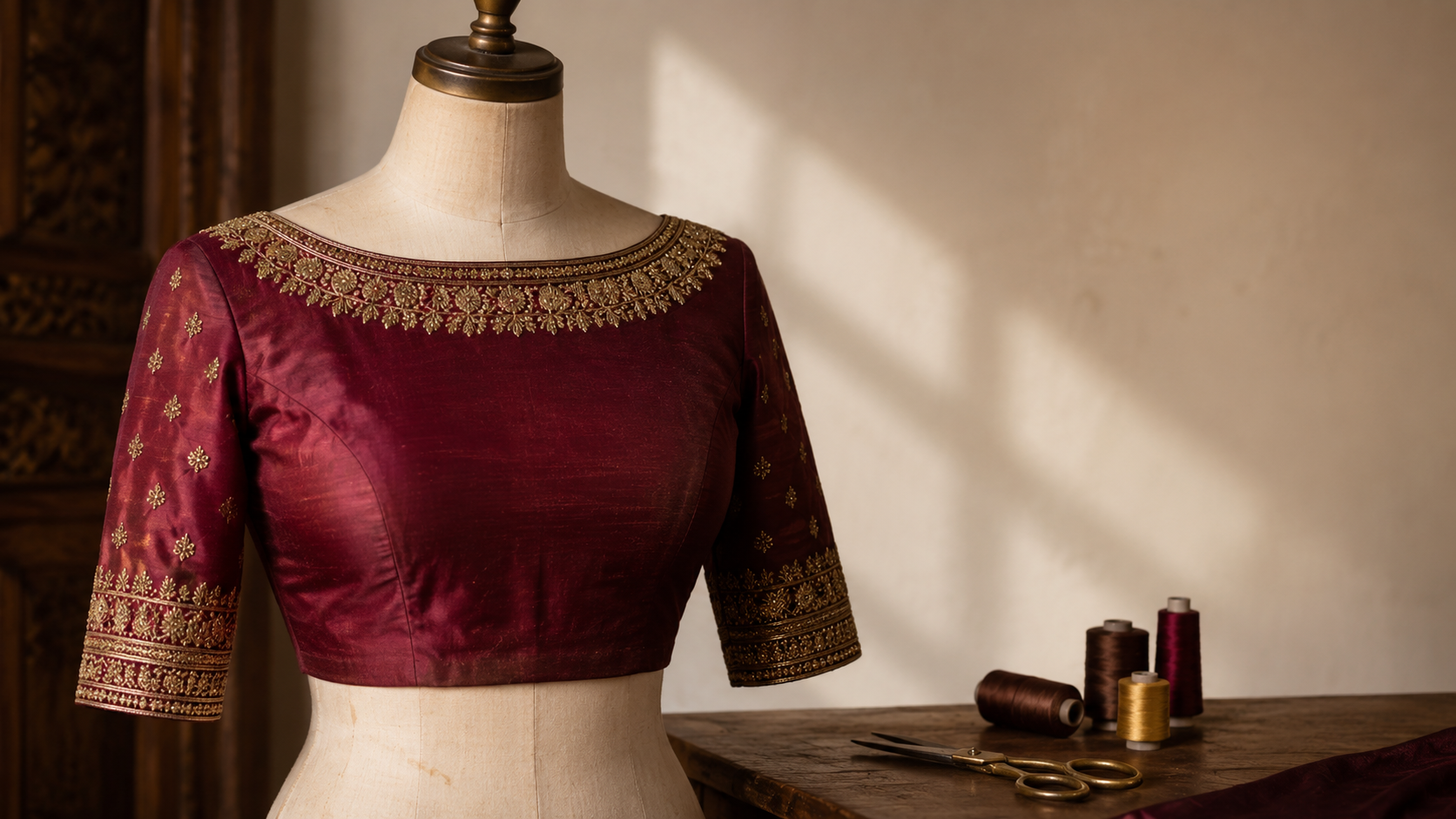
The saree blouse is the part of the outfit most beginners think about last and most experienced wearers think about first. The saree itself is six metres of unstitched fabric — the same piece of cloth fits everyone. The saree blouse is the only stitched-to-your-body part of the entire outfit, and it is what decides whether the saree looks elegant or awkward, comfortable or constricting, modern or dated. This guide walks through how to think about saree blouse design from the ground up, written for European readers choosing their first one or two blouses.
In this guide
Why the saree blouse matters more than the saree
A saree drapes over the body. A saree blouse fits the body. That single difference is why the blouse carries so much of the outfit’s visual weight, even though it covers far less skin than the saree itself. A perfectly cut blouse can make an inexpensive cotton saree look elegant. A badly cut one can make a heirloom Kanjivaram look uncomfortable.
The other reason it matters: it is the part you reuse. A wardrobe of three good blouses in compatible colours can pair with twenty different sarees. The blouse is the smaller investment in fabric but the larger investment in tailoring, and a well-made one lasts years of regular wear.
For European wearers especially, the saree blouse is also the part of the outfit that most needs adapting to climate and context. Sleeve length, neckline coverage, and fabric weight all matter more in Munich or Stockholm than in Mumbai. Our winter saree guide goes deeper on the climate question.
The four decisions in any saree blouse design
Every saree blouse is, at its core, four choices made in combination — neckline, sleeve length, fabric, and fit. Get all four right and the blouse works. Get one wrong and the whole outfit reads off, even if everything else is beautiful. This guide walks through each of the four decisions in turn.
The historical predecessor of the saree blouse is the choli — a short, fitted upper garment worn in many Indian regions for centuries before the British colonial era introduced the modern blouse silhouette. The saree blouse as we know it today is a relatively recent garment, evolved over the past 150 years, and continues to evolve in the hands of contemporary designers. According to Vogue India, the modern saree blouse has been one of the most dynamic areas of Indian fashion design in the past decade.
Necklines — five shapes that work, and when to use each
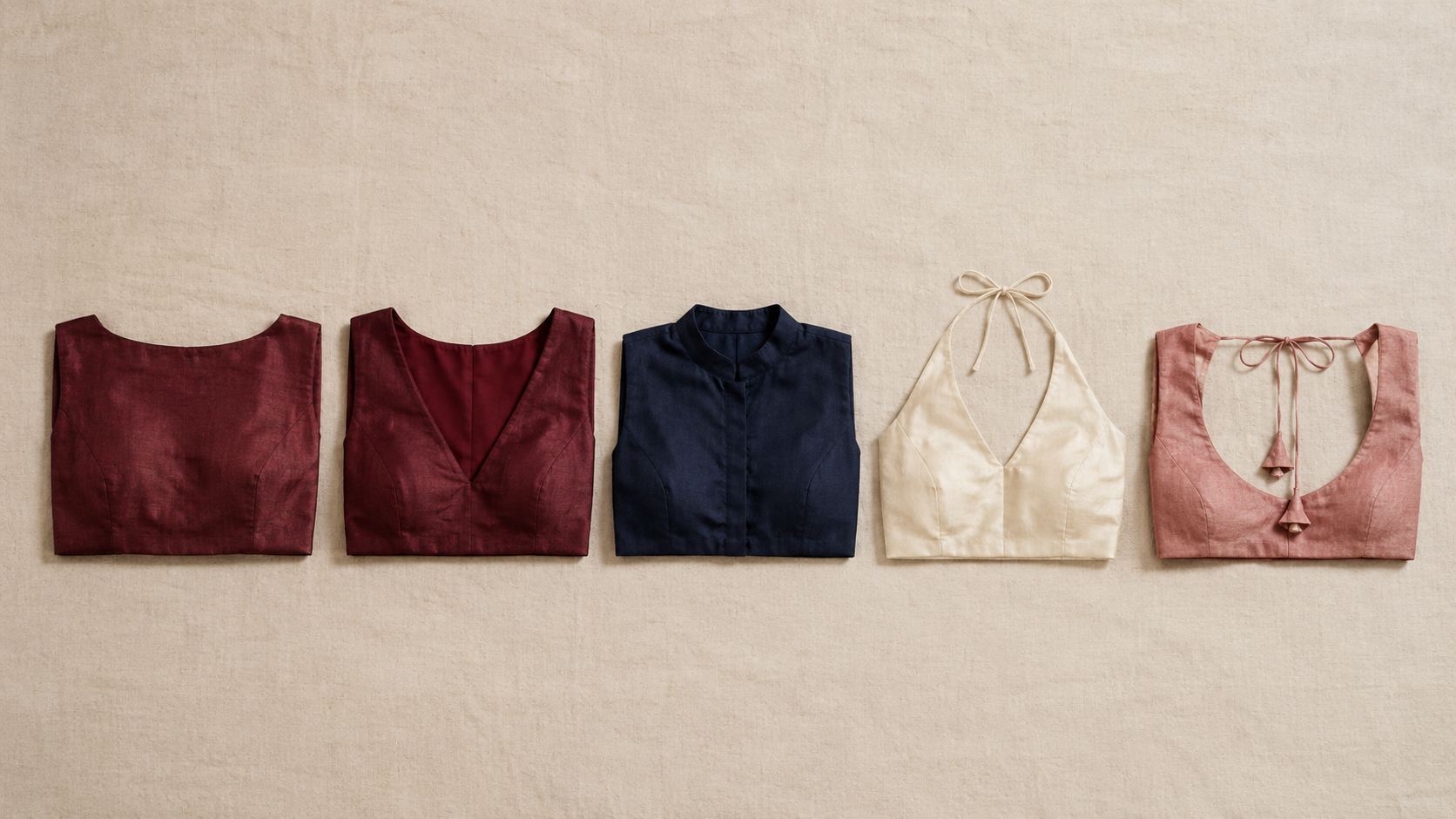
The neckline is the first thing anyone notices about a saree blouse. It is also the easiest decision to get wrong, because a neckline that looks beautiful flat on a hanger can sit completely differently on the body. Five neckline shapes cover almost every saree occasion.
Boat neck or jewel neck
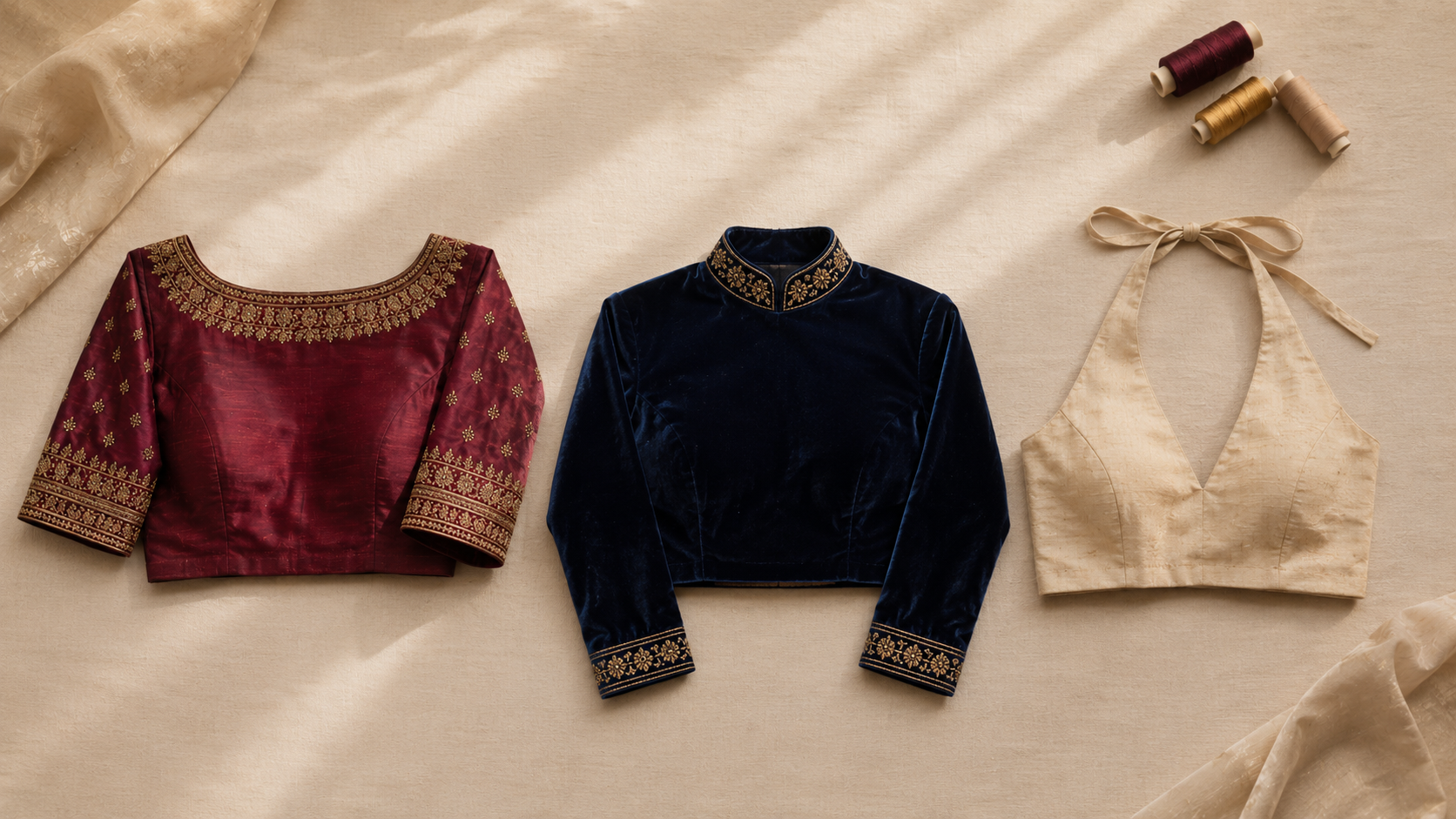
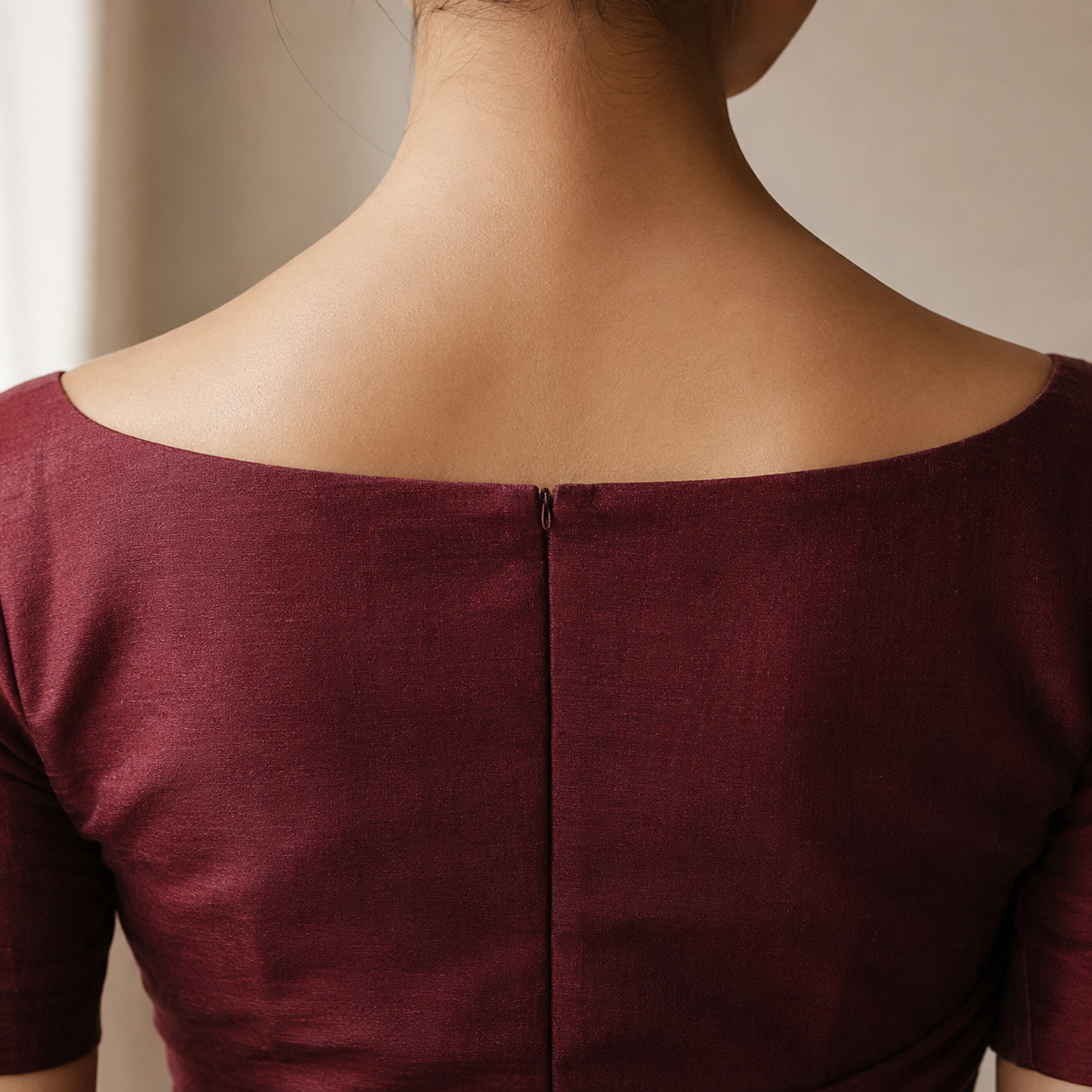
A boat neck runs horizontally across the collarbone; a jewel neck sits round and high, just below the throat. Both are classic, modest, and forgiving. They cover the chest and back well, which makes them especially good choices for office wear, daytime events, and European winter occasions. A boat neck in raw silk or brocade reads instantly elegant and works with almost any saree.
V-neck or sweetheart
A V-neck dips down the centre; a sweetheart neckline curves into a heart shape. Both elongate the upper body visually and add a touch of glamour without being revealing. They suit weddings, sangeet evenings, and formal occasions. The depth of the V is a personal choice — a shallow V works for office settings, a deeper V suits evening wear.
High collar or mandarin
A high collar or mandarin neckline rises up the neck, often with a small stand collar. This is the most conservative neckline, and historically the most fashion-forward — high-collared saree blouses have come in and out of fashion repeatedly, and they look striking in plain colours or solid silks. They suit winter occasions particularly well because they cover the neck and upper chest.
Halter or noodle strap
A halter ties at the neck; a noodle-strap blouse has thin straps over the shoulders. Both expose the upper back and shoulders. These are summer or evening designs, and they work best with sarees worn in the Nivi style where the pallu covers the back. In European winter, halter and noodle-strap blouses need significant layering to work; in summer, they are some of the most beautiful options available.
Backless and low-back designs
A backless saree blouse can have a closed front and an open back — the neckline at the front looks conventional, but the back is dramatically exposed. Designed for evening wear and weddings. Worth knowing about but not where most beginners should start; the fit on a backless cut is harder to get right and demands a more confident relationship with the garment.
Sleeves — from cap to full-length
Sleeve length is the single biggest factor in how formal, how seasonal, and how flattering a saree blouse reads. Four sleeve lengths cover most occasions, each with its own logic.
Cap sleeves
Cap sleeves end just below the shoulder, barely covering the upper arm. They are summer-weight, light, and look beautiful with a soft drape. Cap sleeves work for daytime weddings, festival wear, and any occasion where the arms can be exposed comfortably. In a European summer they are ideal; in winter they need layering.
Short sleeves
The most common sleeve length — ending at the upper bicep. Short sleeves are the workhorse of saree wardrobes. They suit almost every occasion, almost every body type, and almost every saree. If you are stitching your first blouse, short sleeves are the safest starting point.
Three-quarter sleeves
Three-quarter sleeves end between the elbow and the wrist. They read modern, elegant, and slightly more formal than short sleeves. They pair beautifully with heavier silk sarees and structured blouse fabrics like brocade or velvet. For European autumn and spring occasions, three-quarter sleeves often hit the right balance between coverage and ease.
Full sleeves
Full sleeves reach the wrist. They were unconventional in saree wardrobes until quite recently; now they are everywhere, particularly in winter weddings and contemporary designer collections. A full-sleeved blouse in raw silk, velvet, or brocade reads sophisticated and modern, and adds genuine warmth for European winter wear. We covered the winter case in our winter saree guide.
Fabric — matching the saree blouse fabric to the saree
The fabric of the blouse is the third decision, and it works in conversation with the saree itself. A few principles cover most pairings.
Silk blouse with silk saree
The classic pairing. A silk blouse with a silk saree creates a unified, premium look. Match the silk weight roughly — a light pure silk blouse with a heavy Kanjivaram can look mismatched; a heavier raw silk or katan silk blouse balances better. For Banarasi and Kanjivaram pairings specifically, our silk comparison guide covers the fabric weight question in detail. For tussar silk pairings, our tussar silk saree guide covers the slubby-texture pairing question.
Brocade blouse with plain saree
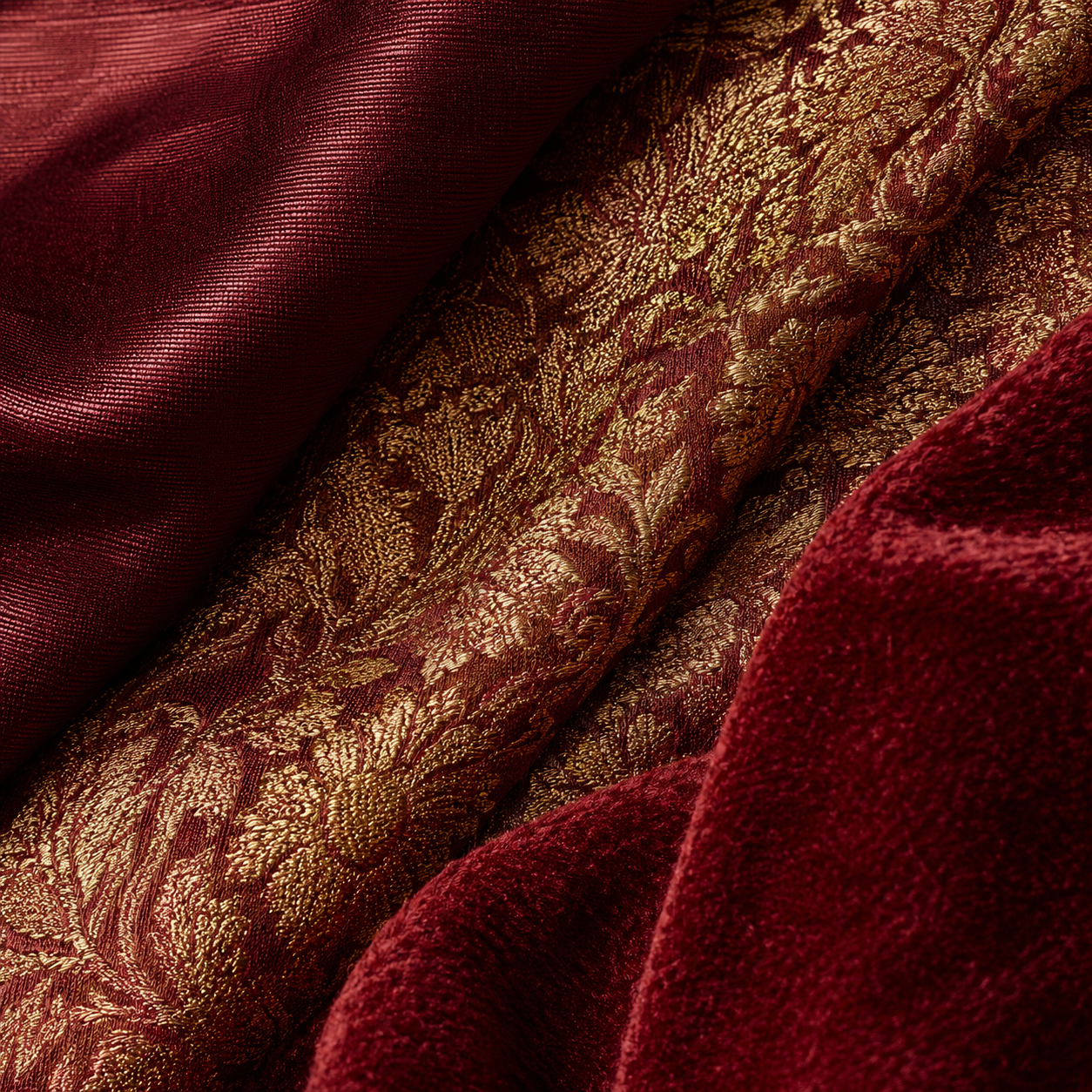
A brocade blouse — heavily embroidered with gold or silver zari — paired with a plain or lightly designed saree is one of the most visually striking combinations in the contemporary saree wardrobe. The brocade becomes the focal point; the plain saree creates the canvas. This pairing works particularly well for weddings, festival evenings, and formal occasions where you want one element to shine.
Cotton blouse with cotton saree
For everyday and office wear, a cotton blouse with a cotton saree is breathable, comfortable, and unfussy. The blouse can be plain or printed depending on the saree. Cotton-on-cotton is the most relaxed combination and works for daytime occasions, summer wear, and offices that allow ethnic clothing. Our cotton saree guide covers the handloom cotton landscape that pairs with this approach.
Velvet, raw silk, and contemporary options
Velvet blouses have become a signature of contemporary Indian fashion, particularly in autumn and winter — designers like Sabyasachi have made velvet saree blouses central to modern bridal collections. Raw silk blouses sit between cotton and pure silk in weight and texture. Both fabrics layer beautifully with European winter wardrobes and read modern without losing the saree blouse’s traditional silhouette.
Blouse pairing by saree fabric
The right blouse depends on the saree it pairs with. Each fabric in our saree guide series has its own ideal blouse-pairing logic. A quick reference:
- Cotton saree — short-sleeved cotton or raw silk blouse in a matched or contrasting solid colour
- Banarasi or Kanjivaram silk — fitted brocade, katan silk, or contrast-colour pure silk blouse
- Chanderi saree — fitted raw silk or fine cotton blouse in a complementary tone
- Georgette saree — structured silk or brocade blouse with the fluid drape
- Chiffon saree — fitted brocade or raw silk blouse; structure balances fluid drape
- Organza saree — fitted brocade, silk, or velvet in a solid complementary colour
- Tussar silk saree — silk, raw silk, or cotton blouse in earthy tones
- Pre-stitched saree — fitted to the construction; sometimes integrated, sometimes purchased separately
Fit — the single most important decision in saree blouse design
Of the four decisions in saree blouse design, fit matters most. A perfectly cut blouse in plain cotton looks better than a beautifully embroidered blouse that does not sit properly on the body. Fit is also the hardest to get right from a distance — it requires either accurate body measurements and a skilled tailor, or in-person fittings.
A well-fitted blouse has six key fit points. The bust line should sit snug against the body without pulling. The shoulder seam should sit exactly on the shoulder bone, not falling off and not riding up. The armhole should be snug but not tight enough to restrict arm movement. The sleeve should follow the natural arc of the arm, not balloon outward. The lower edge of the blouse — usually at or just above the waistline — should sit flat against the torso. And the back closure (hook-and-eye or zipper) should sit smoothly with no gaping.
The bra-and-blouse relationship matters too. A saree blouse is cut to fit a specific bra style, and changing bras changes the fit. We recommend wearing the same bra style you plan to wear with the blouse during all fittings. Sports bras and saree blouses do not pair well; standard everyday bras or a fitted bralette in a matching colour work best.
Where to get a saree blouse made in Europe
This is the question we are asked most often in Munich. The honest answer is that getting a saree blouse made in Europe is harder than it should be, but it is solvable in three ways.
Local tailors who can stitch from a measurement template
Most European tailors have never stitched a saree blouse and will be uncertain when you ask. The workaround is to bring them a detailed measurement template — a printed pattern with all the standard measurements marked — and a sample fabric. A skilled tailor familiar with women’s fitted tops can stitch the garment competently from a clear pattern, even without prior experience of it. Bring a reference photograph of the finished result you want.
Online stitching services with international shipping
Several India-based services accept measurements over the internet, stitch a blouse to specification, and ship to Europe. These services typically charge a stitching fee on top of the fabric cost and take two to four weeks including shipping. The advantage is that the tailors know the garment well; the disadvantage is that you cannot do in-person fittings, so the first blouse may need alterations on arrival.
Pre-stitched ready-to-wear options
An increasing number of Indian brands sell pre-stitched saree blouses in standard sizes, similar to ready-to-wear Western clothing. These work for some body types and not others — the cut is sensitive enough to fit that off-the-rack rarely matches a tailored garment, but for first-time wearers who want to start without committing to tailoring, pre-stitched is a reasonable entry point. Our pre-stitched saree guide covers the broader ready-to-wear approach.
A saree blouse design checklist before you order
Before placing an order — with a tailor or an online service — work through these questions:
- Neckline — which of the five do you want, and how deep?
- Sleeve length — cap, short, three-quarter, or full?
- Fabric — does it complement the saree you plan to pair it with?
- Closure — hook-and-eye, back zipper, or front-open?
- Lining — yes or no? Most silk blouses need a soft cotton lining
- Length — to the waist, just below, or cropped above?
- Fit details — princess seams or darts? Padding or none?
- Bra style — what will you wear underneath?
- Reference photo — do you have one for the tailor?
The more of these decisions you make before approaching a tailor, the closer the first version comes to what you actually want. Saree blouse design rewards specificity at the order stage.
Frequently asked questions
How many saree blouses do I need to start?
Two or three is enough to start. A short-sleeved boat-neck saree blouse in a neutral colour (cream, beige, or dusty rose) pairs with almost any saree. Add a more formal three-quarter-sleeve in raw silk or brocade for weddings and evening occasions. With these two saree blouses, you can wear most of the sarees you are likely to own in the first year. Our five-piece wardrobe guide covers the three-blouse capsule that supports the full saree wardrobe.
Can one saree blouse work with multiple sarees?
Yes — and this is the smart way to build a saree wardrobe. A well-cut saree blouse in a versatile colour (cream, gold, deep maroon, navy, or black) can pair with many sarees of different colours. The trick is to choose blouse colours that contrast or complement broadly rather than matching exactly. A cream saree blouse works with maroons, blues, greens, and many other tones.
What is the most flattering saree blouse design for most body types?
A short-sleeved boat neck or jewel neck saree blouse, well-fitted at the bust and shoulders, suits the widest range of body types. The horizontal neckline elongates the upper body visually; the short sleeve flatters most arm shapes; the boat neck is the most universally photographable. Start here and branch out once you know what you like.
Should the saree blouse always match the saree colour?
No. Matching is one option, but contrast and complement are equally valid. A maroon saree with a gold brocade blouse looks elegant; a navy saree with a cream silk blouse looks contemporary; a black saree with a deep red velvet blouse looks dramatic. Contemporary saree blouse design has moved well past the matchy-matchy convention.
How long does it take to get a saree blouse stitched?
An experienced tailor can stitch a basic saree blouse in two to three days. A more complex blouse — with princess seams, brocade detailing, or a designer neckline — can take a week or more. Online stitching services with international shipping typically take three to four weeks end to end. Order with time to spare before any event.
Can I use a regular crop top as a saree blouse?
For casual or experimental looks, yes — a fitted crop top in the right fabric can substitute for a traditional saree blouse, particularly for everyday wear or fusion styling. For weddings, festivals, and formal occasions, a proper saree blouse cut to fit is still the right choice. Crop tops are a useful gateway for first-time saree wearers who do not want to commit to tailoring before they have worn the garment a few times.
One more thing
The saree blouse is small in fabric, large in influence. Get it right and every saree in your wardrobe looks better. Get it wrong and the most beautiful saree loses its grace. For European readers building a saree wardrobe from a city where saree tailors are rare, this is the part to invest care in — the saree itself is portable, replaceable, and exchangeable. The saree blouse is yours.
For those still learning the foundational vocabulary of the saree, our beginner’s guide to sarees is the place to start. For the draping step that comes after the blouse is ready, our step-by-step draping guide walks through every step. For the fabric question that often precedes blouse choice, our complete fabric guide library covers each major saree fabric — cotton, georgette, chanderi, organza, tussar silk, chiffon, and the pre-stitched format. And for the silk decision specifically, our honest comparison of Banarasi and Kanjivaram covers the two most important silk traditions.
Follow the journey
Be there from day one.
IndiaNiva is launching its online shop soon. Until then we are building quietly — sourcing sarees, researching tailors in Europe, and writing guides like this one. Two thoughtful emails a month. Nothing more.
Continue reading
- What is a saree? An essential beginner’s guide — start here if sarees are new to you
- How to drape a saree — the step-by-step Nivi tutorial
- How to wear a saree in winter — long-sleeved blouses and layering for European cold
- Your first saree wardrobe — the three-blouse capsule that goes with five sarees
- Banarasi vs Kanjivaram — pairing blouses with silk sarees
- Cotton saree guide — blouse pairing for cotton sarees
- Chanderi saree guide — blouse pairing for Chanderi
- Georgette saree guide — blouse pairing for georgette
- Chiffon saree guide — blouse pairing for chiffon
- Organza saree guide — blouse pairing for organza
- Tussar silk saree guide — blouse pairing for tussar
- Pre-stitched saree guide — the ready-to-wear format
This saree blouse design guide draws on Valentine’s own experience commissioning blouses in Munich and India, conversations with European saree wearers, and the Victoria and Albert Museum’s South Asia collection for historical context. Where specific references appear, the source is linked. All information is correct at the time of writing.