
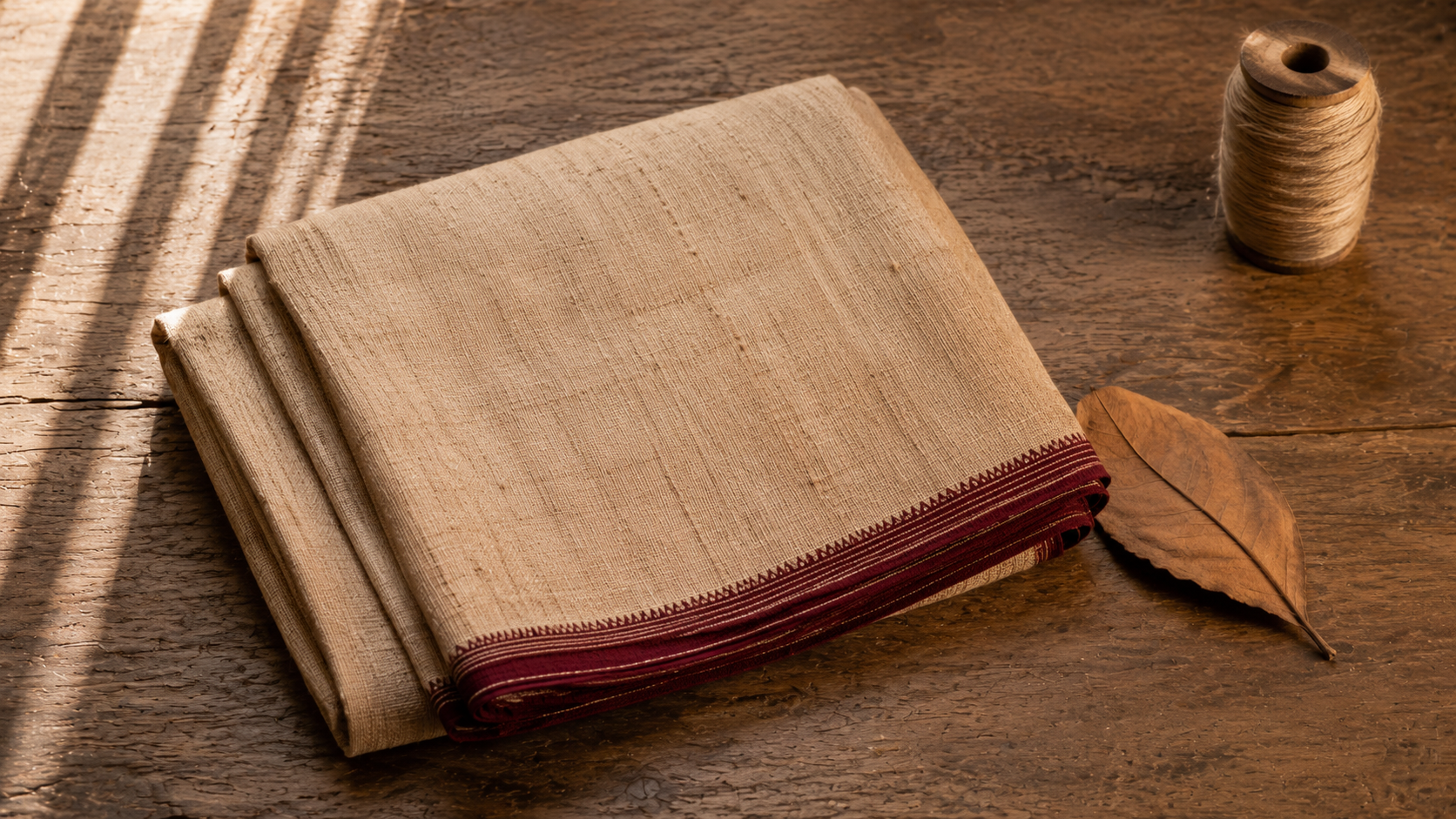
A tussar silk saree guide is, more than any other fabric guide we have written, a guide to a relationship between humans and forests. Tussar silk is wild silk — produced not in commercial silkworm farms but by Antheraea silkworms that feed naturally on saal, arjun, and asan trees in the forests of Jharkhand, Bihar, Chhattisgarh, West Bengal, and Odisha. The cocoons are foraged by tribal weaver communities who have produced tussar silk for centuries.
The resulting fabric has a distinctive slubby texture, a natural gold-beige colour, and the strongest sustainability story of any saree fabric in our series. This tussar silk saree guide covers what makes the fabric distinctive, the regional traditions, the ahimsa silk question, drape and care, and how to choose your first tussar silk saree for European wear. Written from Munich, for European readers.
In this tussar silk saree guide
What makes a tussar silk saree different
This tussar silk saree guide begins with the fabric’s wild origin. Tussar is one of the four major silk types produced in India, and the only one that is not from the domesticated mulberry silkworm. Tussar comes from Antheraea silkworms that live freely on forest trees — primarily saal, arjun, and asan — and produce cocoons that are harvested in their natural habitat. This wild silk character is the source of every distinctive feature of tussar silk. A serious tussar silk saree guide must return repeatedly to this wild silk origin.
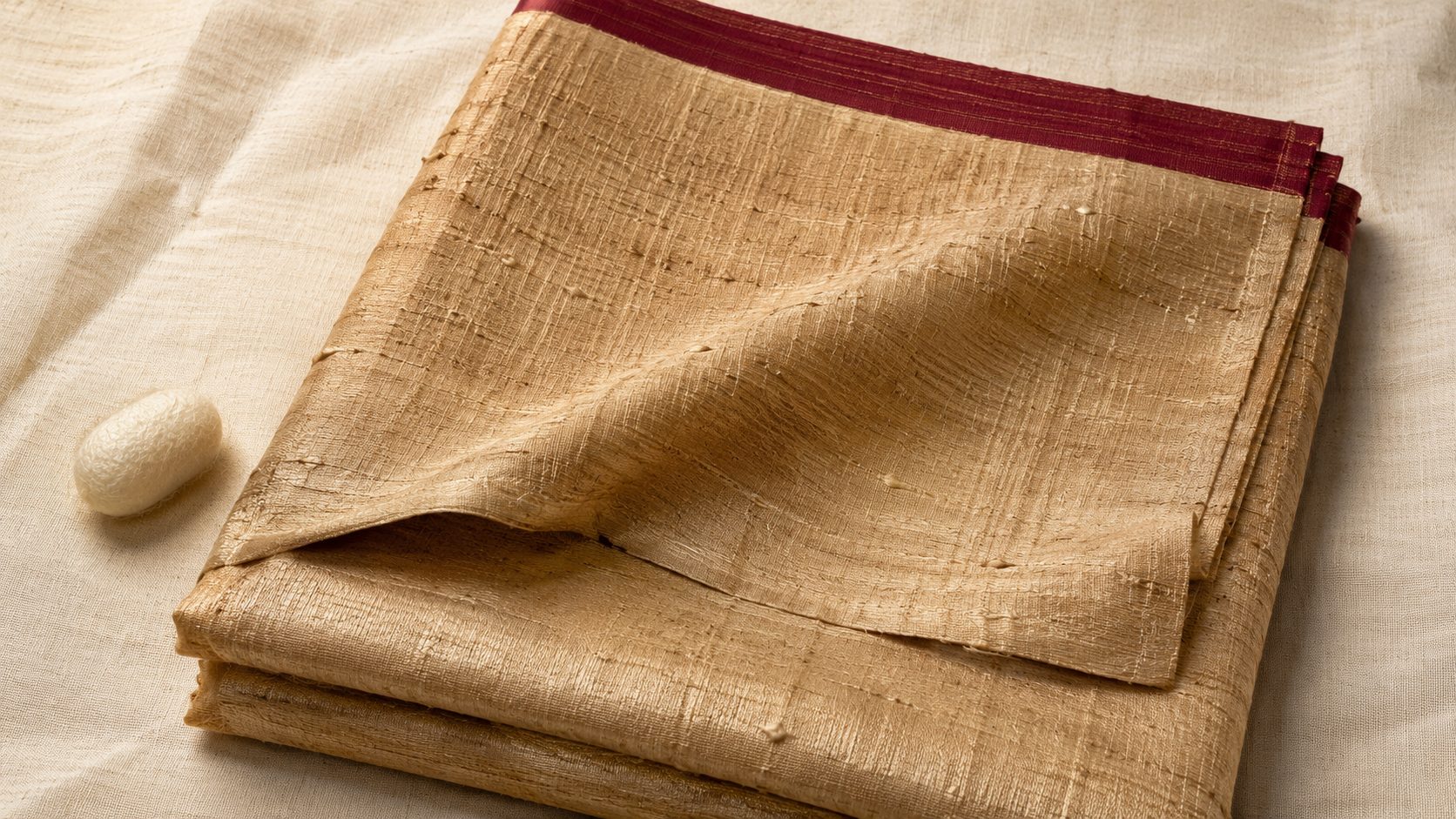
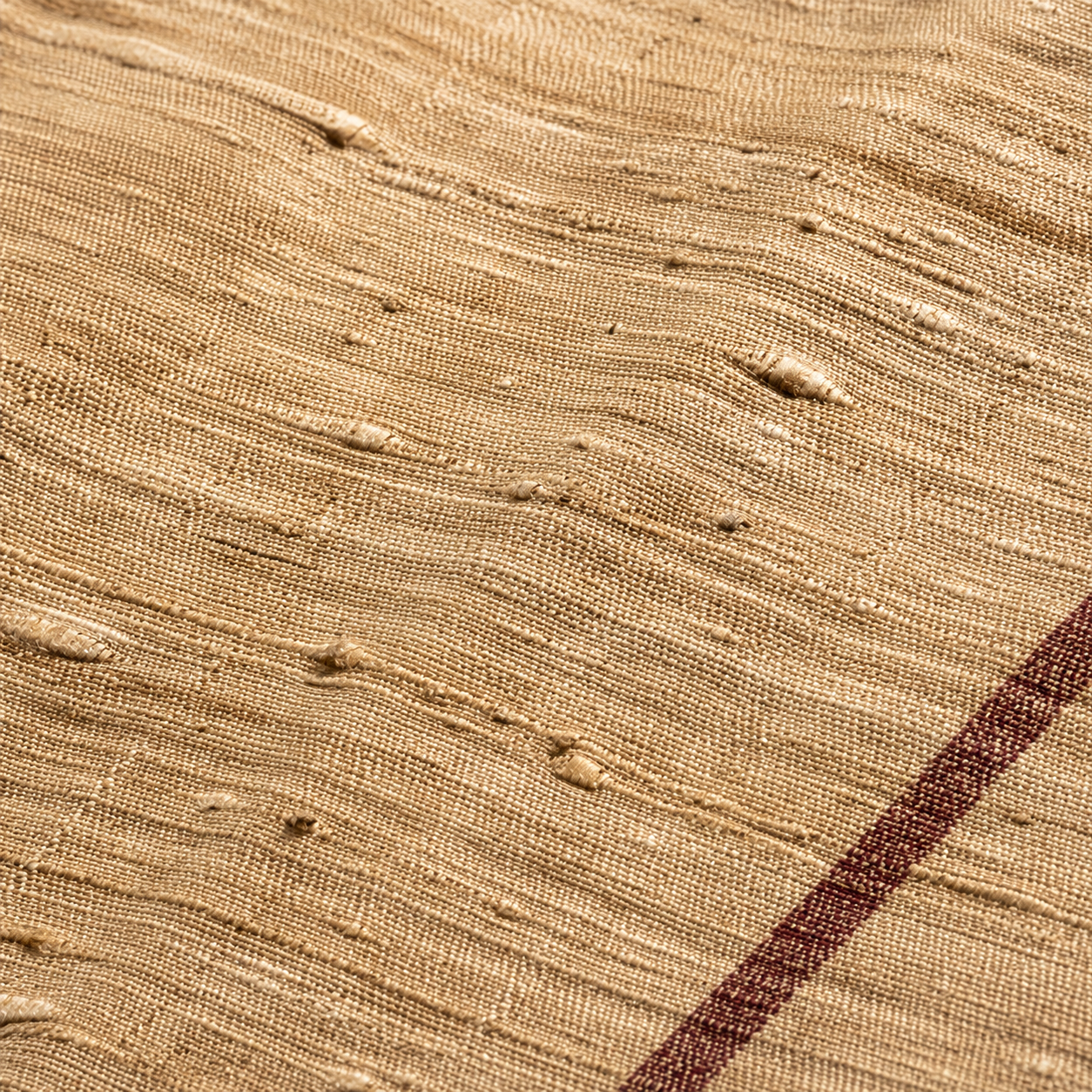
The defining visual quality is the slubby, uneven texture. Unlike mulberry silk, which produces uniform fine threads, tussar yarn has natural irregularities — slightly thicker patches, occasional knots, a visible alive quality that mulberry silk lacks. In commercial textiles, this irregularity would be considered a defect; in tussar, it is the entire point. Any honest tussar silk saree guide must treat the slubby texture as a feature, not a flaw.
The defining colour is natural gold-beige — the original undyed colour of tussar cocoons. This colour is unmistakable and has no equivalent in the rest of the saree spectrum. Dyed tussar is also widely produced (rust, deep maroon, forest green, indigo, mustard), but the natural gold tone remains the signature. The lightweight-yet-structured drape, the matte finish with subtle natural sheen, and the strong sustainability story all flow from the same wild silk origin. This tussar silk saree guide treats the natural gold colour as the entry point for European wearers.
A short history of tussar silk
Tussar silk has been produced in India for at least four thousand years. References to wild silk appear in Vedic-era texts, and the fabric was traded along the same Silk Road routes as mulberry silk during the classical period. The fabric was historically associated with eastern India — the forest regions of what are now Jharkhand, Bihar, Chhattisgarh, Bengal, and Odisha — where tribal communities developed the foraging and weaving skills needed to produce tussar at scale.
The tribal weaver tradition is central to tussar’s contemporary identity. Communities including the Santhals, Mundas, Hos, and Oraons in Jharkhand; the Maithils in Bihar; and various groups in Chhattisgarh and Odisha have produced tussar continuously for centuries. The cocoon foraging and silk processing skills were passed down within these communities, and the modern tussar industry remains anchored in tribal weaver cooperatives. Any complete tussar silk saree guide must acknowledge this tribal heritage — it is part of what gives the fabric its meaning. This tussar silk saree guide treats the tribal-weaver story as inseparable from the fabric itself.
According to Vogue India, tussar silk has seen a sustained contemporary revival driven by interest in sustainable fashion and heritage textiles. Designers including Sabyasachi, Anavila, and Raw Mango have built major collections around tussar in the past decade. The fabric has also benefited from GI tag protection — Bhagalpuri Silk (Bihar tussar) and Champa Silk (Chhattisgarh kosa) are among the protected designations registered with the Geographical Indication Registry of India. This tussar silk saree guide sits within that contemporary revival.
The regional tussar silk traditions
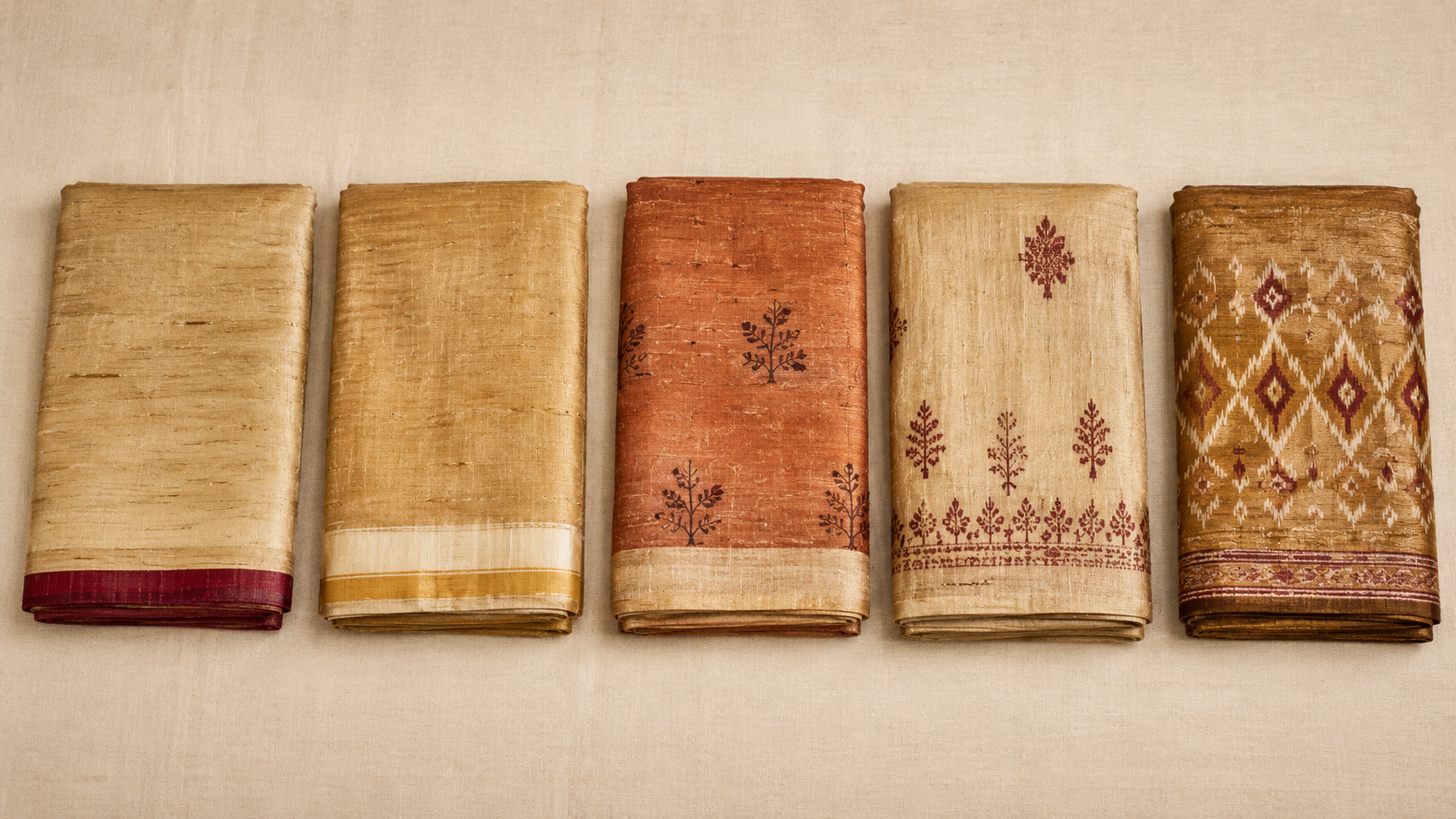
Any thorough tussar silk saree guide must cover the regional variants. Tussar is not one fabric but several, each from a distinct forest region with its own weaver tradition. This tussar silk saree guide covers five regional variants — the most important for European wearers to recognise.
Bhagalpuri tussar (Bihar)
The most famous tussar tradition, centred on the town of Bhagalpur in Bihar. Bhagalpuri tussar is known for its fine quality, distinctive natural colour, and the city’s long history as a silk-weaving centre. The Bhagalpuri designation carries GI tag protection. For most European wearers encountering tussar for the first time, Bhagalpuri is likely the variant they will buy — this tussar silk saree guide treats Bhagalpuri as the entry-point tradition.
Kosa silk (Chhattisgarh)
Kosa is the Chhattisgarh variant of tussar — slightly different processing, slightly more golden hue, and a softer hand-feel than Bhagalpuri. Kosa silk has its own GI protection (Champa Silk) and is increasingly visible in the contemporary saree market. The fabric reads slightly more refined than Bhagalpuri tussar while retaining the slubby character. This tussar silk saree guide places kosa alongside Bhagalpuri as the two most accessible regional variants for European wearers.
Madhya Pradesh tussar
Produced in the forest regions of MP, this variant tends toward medium weight and is often used as a base for printed and embellished tussar designs. Less distinctive than Bhagalpuri or kosa but widely available and reasonably priced. This tussar silk saree guide treats MP tussar as the budget-friendly option.
Bengal tussar
Bengal weavers produce a finer, lighter tussar than the eastern Indian heartland. Bengal tussar often incorporates intricate jamdani-style motifs woven into the fabric, blending the wild silk character with the Bengali design vocabulary. The result is a slightly dressier, more refined tussar — well-suited to occasion wear. Any complete tussar silk saree guide must note Bengal as the most refined regional variant.
Odisha tussar
Odisha weavers specialise in ikat-patterned tussar — the resist-dye patterns of Odisha applied to wild silk. Odisha tussar is one of the most visually distinctive variants, with geometric and figurative motifs that emerge from the ikat process. This regional variant has its own strong following among collectors. The Odisha section in this tussar silk saree guide is the most visually rich.
The sustainability story — ahimsa silk and forest economy
This tussar silk saree guide must address the sustainability question directly, because tussar’s eco-credentials are real but more nuanced than marketing copy typically admits. Three honest points any responsible tussar silk saree guide must make.
Tussar supports forest economies. Because tussar silkworms feed on forest trees rather than commercial mulberry plantations, the tussar economy creates economic value for standing forests. Tribal weaver communities depend on healthy saal, arjun, and asan forests for their livelihoods, which creates a direct economic incentive to preserve those forests. This is genuinely positive — tussar production is one of the few industries where intact forests are worth more than cleared land.
Conventional tussar is not ahimsa silk by default. Standard tussar production involves boiling the cocoon while the silkworm is still inside, killing the worm before the moth emerges. This is the same process used for mulberry silk and is not an ahimsa (non-violent) practice. Most tussar on the market is produced this way.
Ahimsa tussar exists but is rare and more expensive. A small segment of tussar production uses cocoons collected after the moth has emerged naturally — leaving a hole in the cocoon that produces shorter silk fibres but spares the worm’s life. Ahimsa tussar costs roughly twice as much as conventional tussar, has a slightly rougher texture due to the broken fibres, and is genuinely more sustainable. If ahimsa silk matters to you, ask specifically for ahimsa or peace silk tussar, and verify with certification.
The honest position in this tussar silk saree guide: tussar is more sustainable than mulberry silk in most respects, but the ahimsa marketing applied to conventional tussar is not accurate. Choose tussar for the forest economy and tribal weaver support; choose ahimsa tussar specifically if the non-violent silk practice is important to you. This is the most nuanced ethical position in any tussar silk saree guide we have written.
How a tussar silk saree drapes
A tussar silk saree drapes differently from any other silk we have covered. The fabric sits between cotton’s structural stiffness and pure silk’s fluid elegance — closer to Chanderi in feel than to Banarasi or Kanjivaram. The slubby texture creates subtle visual interest in the drape, with the irregularities catching light differently at the pleats and pallu. This tussar silk saree guide treats the drape character as one of the fabric’s most underappreciated qualities.
Practically, tussar holds pleats well. The natural body of the fabric makes the column drape clean and structured. The pallu falls in soft folds with weight, neither stiff like a heavy silk nor fluid like georgette. The fabric does not slip against the petticoat the way mulberry silk does, which makes draping more forgiving for first-time wearers. Our step-by-step Nivi drape guide works for tussar as written; one safety pin at the shoulder is usually sufficient.
For European wearers building drape confidence, this tussar silk saree guide recommends tussar as the second silk to learn after cotton. The slubby texture is forgiving — small pleating mistakes blend into the natural fabric irregularity — and the structural drape holds together through long events. The drape advice in this tussar silk saree guide is consistent: tussar is the friendliest silk for first-time silk wearers.
Tussar silk saree care
Tussar care is more demanding than cotton but less demanding than pure mulberry silk. Any complete tussar silk saree guide must walk through the routines. The care section of this tussar silk saree guide is the most consulted by new owners.
Washing. Dry-clean is the recommended approach for any tussar silk saree, particularly for the first three to five cleans. Tussar can be hand-washed in cold water with mild silk detergent, but colour bleeding and texture changes are real risks. Never machine-wash tussar. The washing rule any tussar silk saree guide must repeat: dry-clean first.
Drying. If hand-washed, lay flat on a clean towel and roll gently. Hang to air-dry in the shade only — direct sunlight fades both the natural gold colour and any dyed tussar. The drying process should be slow and protected. Never wring or twist. This rule is repeated throughout this tussar silk saree guide.
Ironing. Iron tussar on the reverse side with low-to-medium heat and a pressing cloth. The wild silk fibres can scorch at high heat, and the slubby texture can flatten if pressed too hard. Many wearers prefer to steam tussar rather than iron. The ironing advice in this tussar silk saree guide is firm.
Storage. Fold loosely with acid-free tissue paper between the folds. Refold every two months to prevent permanent crease lines. Store in cotton or muslin garment bags rather than plastic. The natural tussar colour can yellow slightly over decades of storage — this is a feature of the fibre rather than a defect, and many collectors prize aged tussar for its deeper natural tone. The storage approach this tussar silk saree guide recommends is conservative.
Tussar for European weather
This tussar silk saree guide must address the climate question. Tussar is one of the most adaptable saree fabrics for European weather — the wild silk character handles temperature variation better than most fabrics. The climate verdict in this tussar silk saree guide is strongly positive.
For spring, summer, and autumn in Europe, tussar is ideal. The fabric breathes well in warm weather, layers cleanly over thermal underclothes, and reads dressy without being heat-trapping. For office occasions, daytime weddings, festival celebrations, and evening events from April to October, tussar works almost anywhere. The natural gold colour also photographs beautifully in European autumn light. The seasonal verdict in this tussar silk saree guide is that tussar covers more of the European calendar than any other fabric.
For winter, tussar handles cold better than georgette or organza but not as well as pure heavy silk. The fabric retains some body heat thanks to the wild silk fibre structure, but European winter weeks (December-February) still require the layering approach we cover in our winter saree guide. With thermal layers, tussar extends into mild winter; without them, it feels insubstantial in cold rooms.
For European wearers building a saree wardrobe, this tussar silk saree guide suggests tussar as an early-stage acquisition after cotton (Piece 1) and Chanderi (Piece 3) of our five-piece capsule. The versatility makes tussar one of the most-worn pieces in a developing European saree wardrobe. The wardrobe-placement argument throughout this tussar silk saree guide is consistent.
How to choose your first tussar silk saree
The practical section of this tussar silk saree guide is now. For a European wearer choosing a first tussar, four decisions matter most, and any useful tussar silk saree guide must walk through each one.
Choose Bhagalpuri or kosa silk for your first piece. Bhagalpuri tussar (Bihar) and kosa silk (Chhattisgarh) are the two most accessible regional traditions — widely available, GI-protected, and well-priced. Save Bengal tussar and Odisha ikat tussar for later acquisitions once you know the fabric. Madhya Pradesh tussar is widely available but reads less distinctive than Bhagalpuri or kosa. The first-purchase recommendation in this tussar silk saree guide is always Bhagalpuri or kosa.
Choose the natural gold colour or a deep earth tone. The natural undyed gold-beige is the signature tussar colour and the most versatile starting point — it pairs with multiple blouse colours and reads elegant across occasions. If you prefer dyed tussar, choose rust, deep maroon, forest green, or mustard — earth tones that complement the slubby texture. Avoid pastels or very saturated colours for a first tussar; they fight the natural fabric character. The colour guidance in this tussar silk saree guide leans toward natural and earth tones for first-time buyers.
Choose moderate embellishment. Tussar is often woven with subtle motifs in coloured silk thread or fine zari — these read well. Avoid heavy sequin work or all-over embroidery for a first tussar; the slubby texture is the visual point, and heavy embellishment competes with it. The embellishment guidance this tussar silk saree guide repeats is: less is more for first-time tussar buyers.
Look for GI protection or ask for fibre certification. A genuine handloom tussar from the GI-protected regions (Bhagalpuri, kosa) costs between 200 and 600 euros at source. Anything sold as “tussar silk” for under 80 euros is likely a tussar-cotton blend or a synthetic imitation. Ask the retailer for GI documentation, Silk Mark certification, or the Handloom Mark before significant purchases. The authentication step is the most important section of any tussar silk saree guide for first-time buyers.
Frequently asked questions
Is a tussar silk saree appropriate for weddings?
For daytime weddings, garden ceremonies, and festival celebrations, tussar is entirely appropriate — the natural elegance of wild silk reads formal without being heavy. For formal evening receptions, tussar can work for less-formal weddings but reads slightly less dressy than Banarasi or Kanjivaram. The wedding verdict in this tussar silk saree guide places tussar in the daytime-wedding and casual-evening categories rather than as a heavy-formal silk. Many readers of this tussar silk saree guide will find tussar suits the garden-wedding case especially well.
How much should I pay for a genuine tussar silk saree?
A genuine handloom tussar from the GI-protected regions costs 200-600 euros at source in India for silk-cotton-blend tussar or pure tussar. Designer tussar (Sabyasachi, Anavila, Raw Mango) can run 800-2,500 euros. Add 30-50 percent for international shipping to Europe. Mass-market “tussar” under 80 euros is almost certainly a tussar-cotton blend, synthetic imitation, or low-grade tussar with poor processing. The pricing guidance in this tussar silk saree guide reflects current source-market pricing from tribal weaver cooperatives.
How can I tell real tussar silk from imitation?
Three tests this tussar silk saree guide recommends. First, look for the natural slubby texture — real tussar has visible irregularities, knots, and thread thickness variation. Synthetic tussar is too uniform. Second, the burn test on a tiny thread snip: silk burns slowly with a smell of burnt hair; polyester melts. Third, the price test: anything under 80 euros sold as pure tussar is almost certainly an imitation. The rule throughout this tussar silk saree guide: trust the texture and verify with the burn test if uncertain.
Is tussar silk ahimsa silk?
Not by default. Most tussar production uses standard silk processing where the cocoon is boiled with the silkworm still inside. Ahimsa or peace silk tussar — where cocoons are collected after the moth has naturally emerged — exists as a specialty category but is rarer and more expensive (roughly twice the price). If ahimsa silk matters to you, ask the retailer specifically for “ahimsa tussar” or “peace silk tussar” with documentation, and expect higher prices. The ahimsa nuance in this tussar silk saree guide is one we revisit deliberately in the sustainability section.
Does tussar silk fade?
The natural undyed tussar gold-beige is colour-stable for decades — it does not fade in the same way dyed fabrics do, though it may yellow slightly with age, which many collectors prize. Dyed tussar in natural-dye colours is generally colour-stable; tussar in chemical synthetic dyes can fade over time, particularly with sunlight exposure. Always dry tussar in shade rather than sunlight to preserve colour. This is the colour-care rule any tussar silk saree guide must repeat.
What blouse works best with a tussar silk saree?
A silk, raw silk, or cotton blouse pairs best with tussar. The slubby texture of tussar reads earthy and natural, so the blouse should complement rather than contrast sharply — cream, deep maroon, forest green, mustard, or terracotta in fitted construction. A heavy brocade blouse can overpower the natural fabric; a very thin synthetic blouse reads out of place. Our saree blouse design guide covers the full framework, and pairs naturally with this tussar silk saree guide. According to the Victoria and Albert Museum’s South Asia collection, the matched-fibre blouse pairing has been documented in regional silk traditions since the medieval period.
One more thing
A tussar silk saree is the saree that carries the strongest sustainability and heritage story of any fabric in our series. The forest economy of eastern India, the tribal weaver communities of Jharkhand and Bihar and Chhattisgarh, the wild silk produced naturally in saal forests — these are real and meaningful. For a European wearer who values traceability and ethical production, this tussar silk saree guide proposes tussar as one of the most rewarding fabrics to own. The drape is forgiving, the colour is timeless, the texture is unmistakable, and the story is true. The closing argument in this tussar silk saree guide is the simplest of any post in our series.
The other guides in our library support the tussar journey. Our cotton saree guide covers the foundational fabric; our chanderi saree guide covers the dressy daytime alternative; our georgette saree guide covers the fluid evening alternative; our organza saree guide covers the contemporary couture fabric; our pre-stitched saree guide covers the construction format. Read alongside this tussar silk saree guide, they form the complete reading path for a European wearer building a thoughtful saree wardrobe.
Follow the journey
Be there from day one.
IndiaNiva is launching its online shop soon. Until then we are sourcing tussar from the forest weaver cooperatives of Jharkhand, Bihar, and Chhattisgarh, researching tailors in Europe, and writing guides like this one. Two thoughtful emails a month. Nothing more.
Continue reading
- Cotton saree guide — the foundational fabric
- Chanderi saree guide — the dressy daytime alternative
- Georgette saree guide — the fluid evening alternative
- Organza saree guide — the contemporary couture fabric
- Pre-stitched saree guide — the modern construction format
- Your first saree wardrobe — where tussar sits in a developing wardrobe
This tussar silk saree guide draws on conversations with tribal weaver cooperatives in Jharkhand and Chhattisgarh, GI Registry of India documentation on the protected tussar traditions (Bhagalpuri Silk, Champa Silk), and the Victoria and Albert Museum’s South Asia collection for historical context on wild silk traditions in eastern India. Where specific references appear, the source is linked. All information is correct at the time of writing.