
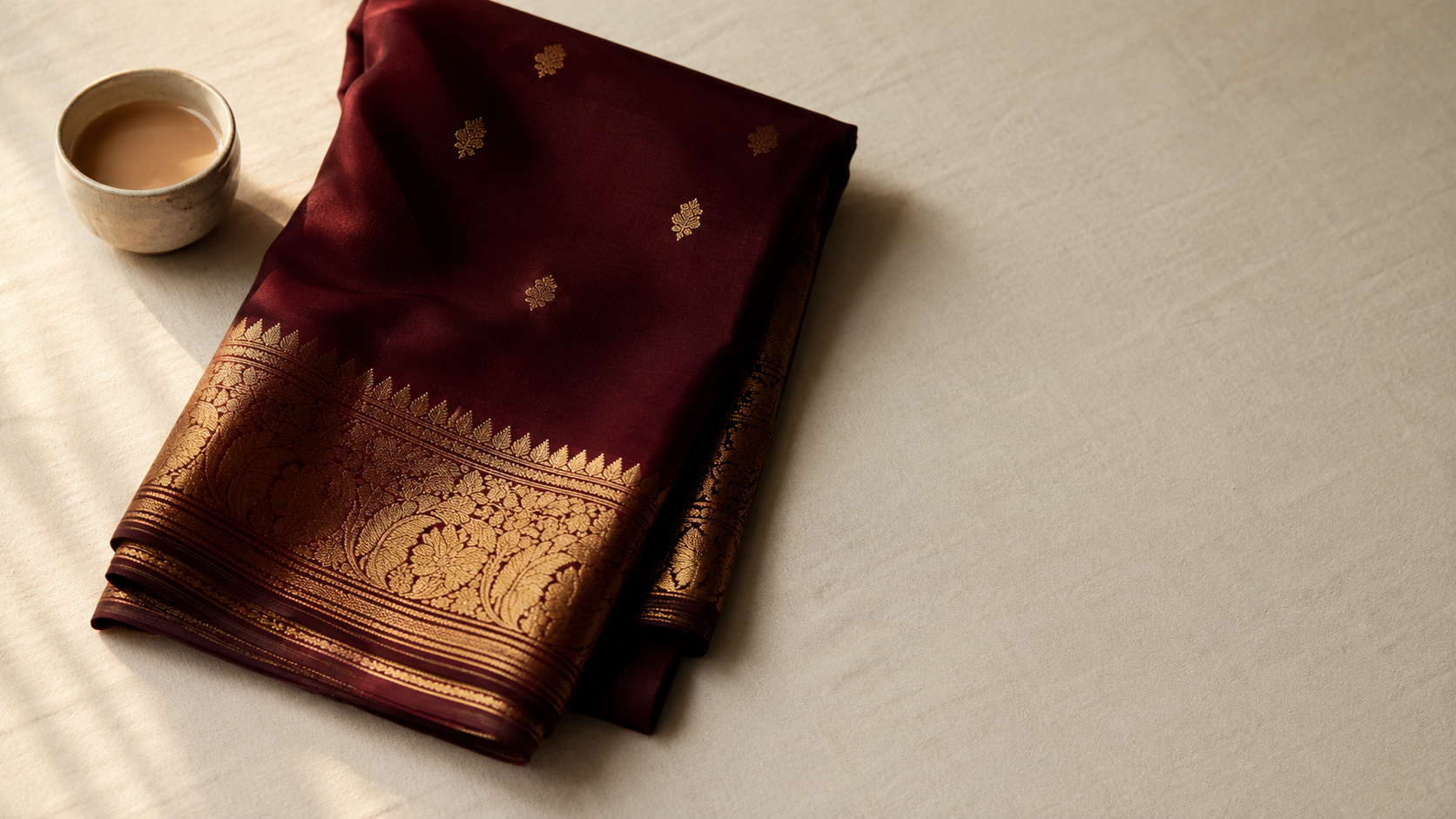
What is a saree? At its simplest, it is a single long piece of unstitched fabric — usually around five and a half metres — draped around the body in a particular way. But that one-line answer hides centuries of craft, an entire ecosystem of weavers, and one of the most loved garments in the world. If you live in Germany or anywhere else in Europe and feel curious about sarees but unsure where to begin, this guide on what is a saree is written for you. We will answer what is a saree at every level — fabric, history, regional variety, and cultural meaning. Let us start at the beginning.
In this guide
What is a saree? A one-sentence answer
A saree is a long, unstitched piece of cloth — most commonly between 5.5 and 9 metres in length, and about 1.1 metres wide — draped around the body without being sewn into a fixed shape.
That last detail is the important one. Most garments in a European wardrobe are stitched. A dress, a coat, a shirt — each one is cut, sewn, and fitted before it reaches you. A saree is the opposite. It begins as a flat rectangle of woven cloth. It becomes a garment only in the moment it is wrapped, pleated, and draped around the wearer. So if you have ever wondered what is a saree in essence, this is it: a piece of cloth that becomes clothing through the act of wearing it.
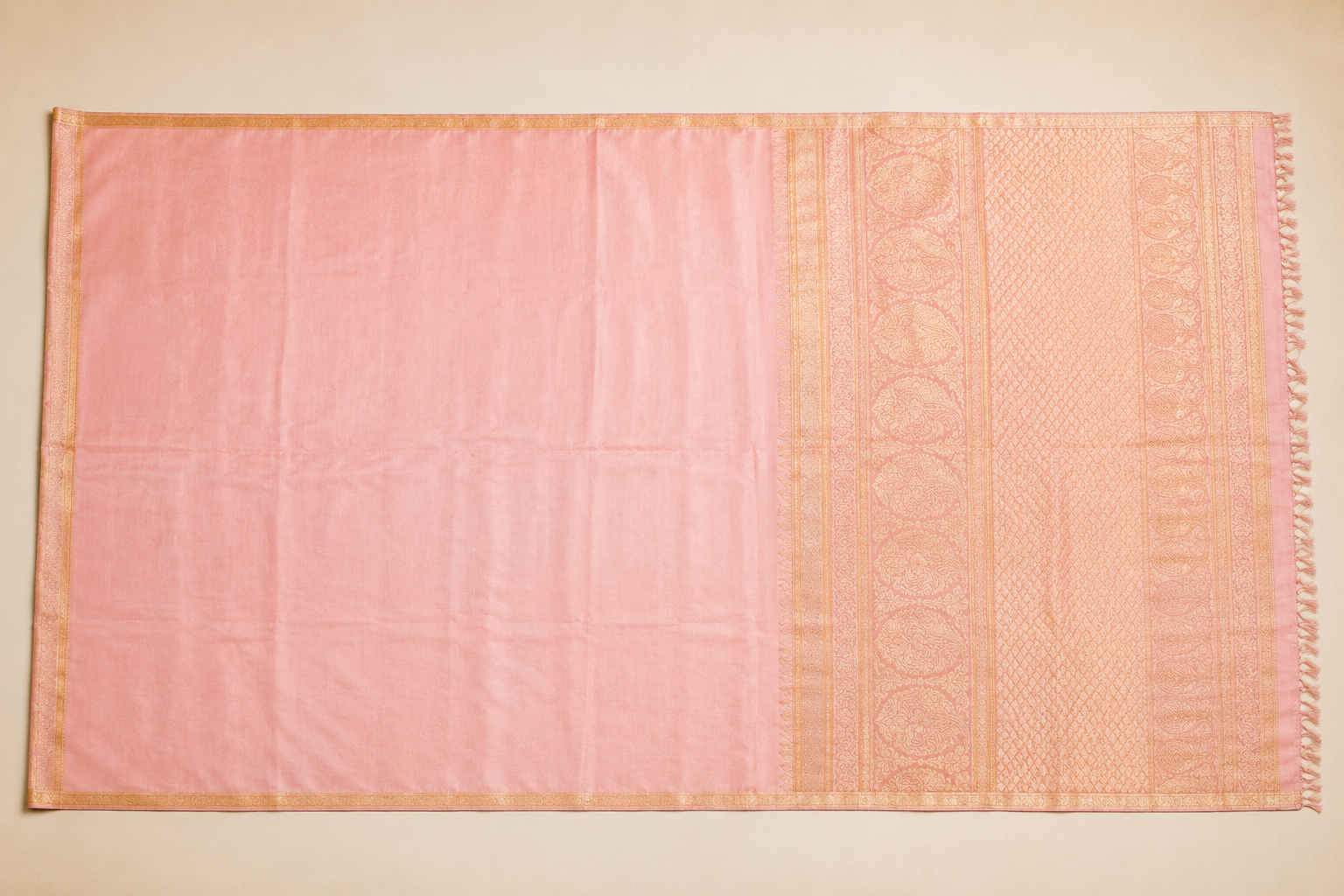
This makes a saree extraordinarily flexible. The same piece of fabric can be draped tightly or loosely, formally or casually, traditionally or experimentally. A saree adapts to the body that wears it, not the other way around. That quality — quiet, generous, intelligent — is part of why the garment has survived for so long.
The three parts every saree has
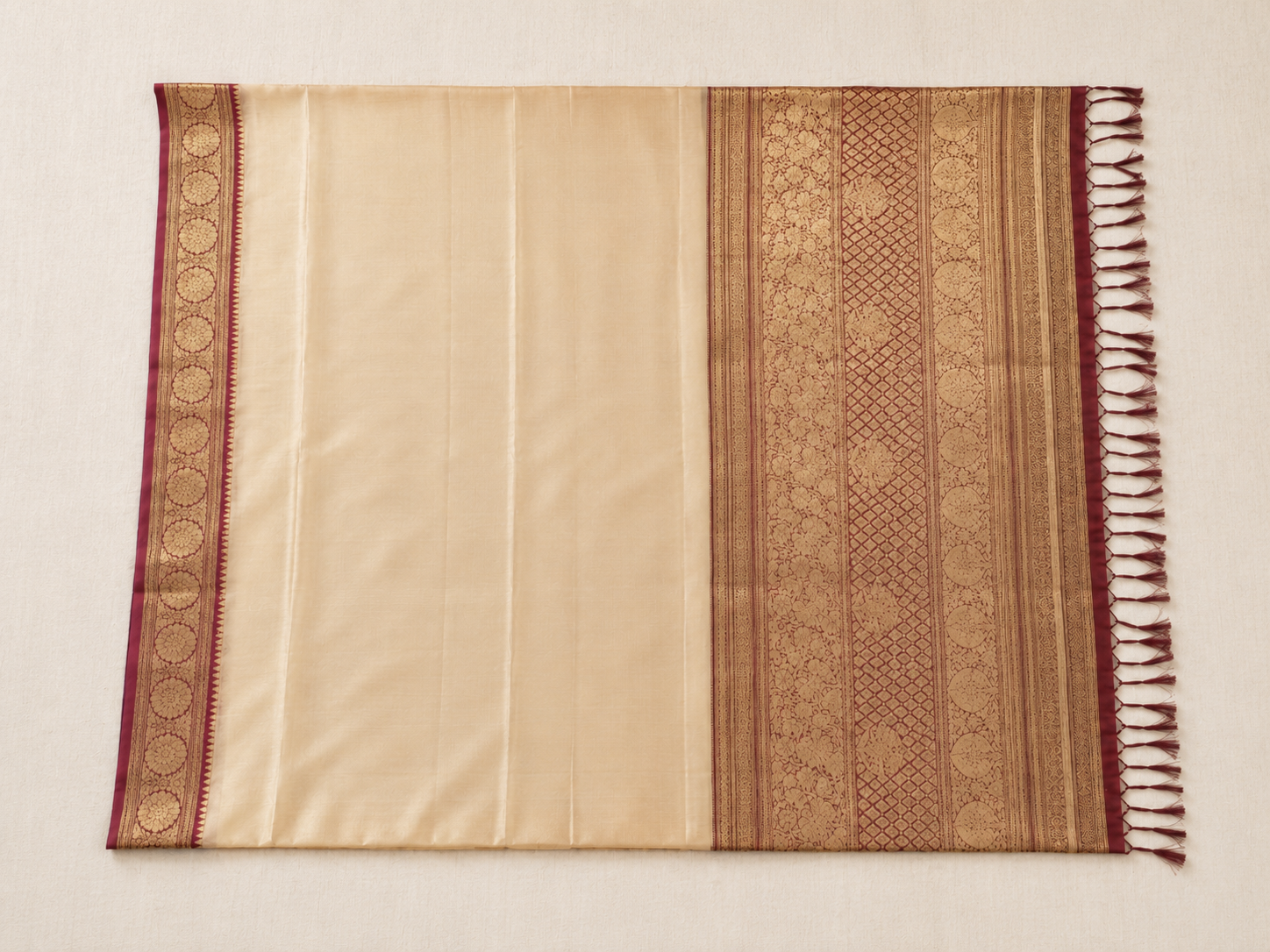
To understand what is a saree at the level of design, you need to know its three named zones. Although it looks like one continuous piece of fabric, a saree is best understood as three named parts. Learning these three words — body, pallu, and border — is the single most useful first step in understanding what is a saree at the level of design. These three zones are what every weaver, tailor, and saree wearer talks about when describing a piece.
The body — the bulk of the fabric
The body is exactly what it sounds like: the main field of the saree. It runs along most of the length of the fabric and forms what you see wrapped around the lower body and tucked at the waist. In some sarees the body is plain, letting one beautiful colour or a delicate weave carry the design. In others, the body is patterned all over — small repeating motifs, brocade work, or a printed design that covers the whole field.
The pallu — the decorative end
The pallu is the part most people notice first. It is the more decorated end of the saree, designed to drape over the shoulder and fall down the back or front. Pallus carry the most intricate work — heavy zari brocade in a Banarasi, temple-pattern borders in a Kanjivaram, fine kantha embroidery in a Bengali saree. When we say “this is a beautiful saree,” it is most often the pallu we are talking about.
The border — the edge that frames it
The border is the strip of pattern that runs along one long edge of the saree, sometimes both edges. In a traditional drape, the border is the visible line that frames the lower half of the saree and again traces the edge of the pallu over the shoulder. Border designs are often where regional identity is most visible — a wide gold zari border in Banarasi work, a contrasting temple border in Kanjivaram silks, a fine red line on a white Bengali tant.
Once you know to look for these three things, every saree starts to make sense. A “red saree with a gold border” is no longer a vague description — it is a specific garment whose body, pallu, and border each play a part.
What a saree is worn with
The next part of the answer to what is a saree, practically, lies in what it is worn with. A saree is rarely worn alone. Three small companion pieces complete the outfit, and understanding what they are makes a great deal of the saree world less mysterious.
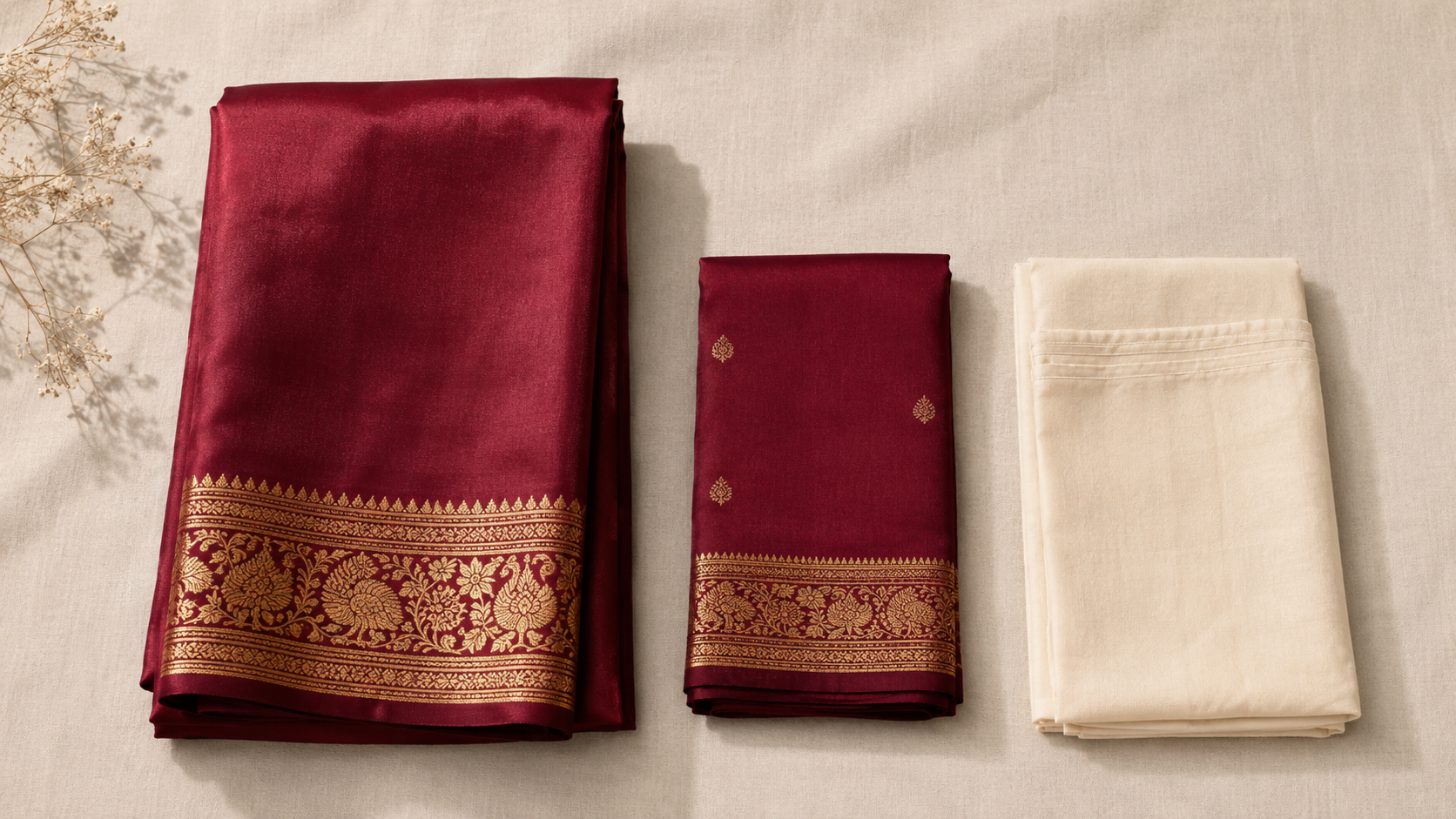
The first is the blouse — a short, fitted top worn under the saree. The blouse is the only stitched part of the outfit, and it has to be tailored to fit. When a saree is sold, it usually comes with a small extra piece of unstitched matching fabric — often around 80 to 100 centimetres long — called the blouse piece. The wearer takes this fabric to a tailor, who cuts and sews it into a blouse that fits. Our complete saree blouse design guide covers necklines, sleeve length, fabric, and finding a tailor in Europe.
The second is the petticoat — a simple cotton underskirt with a drawstring waist. It sits at the natural waistline and gives the saree something to be tucked into. Without a petticoat, the saree has nothing to hold its lower folds in place.
The third, optional but often used, is a small set of safety pins or saree pins. These hold the pleats in place and secure the pallu over the shoulder. Many experienced saree wearers manage without them. For a beginner, two or three pins make the whole drape feel much more secure.
How a saree is worn — the drape, simply explained
Once you understand what is a saree as cloth, the next question is how it becomes a garment. The act of putting on a saree is called draping. A drape is not one fixed method — it is a family of regional styles, each with its own logic. Our step-by-step Nivi drape guide walks through the seven simple steps for the most common drape. But it helps to know that the drape is what turns a flat piece of cloth into a garment, and that there is no single correct way to do it.
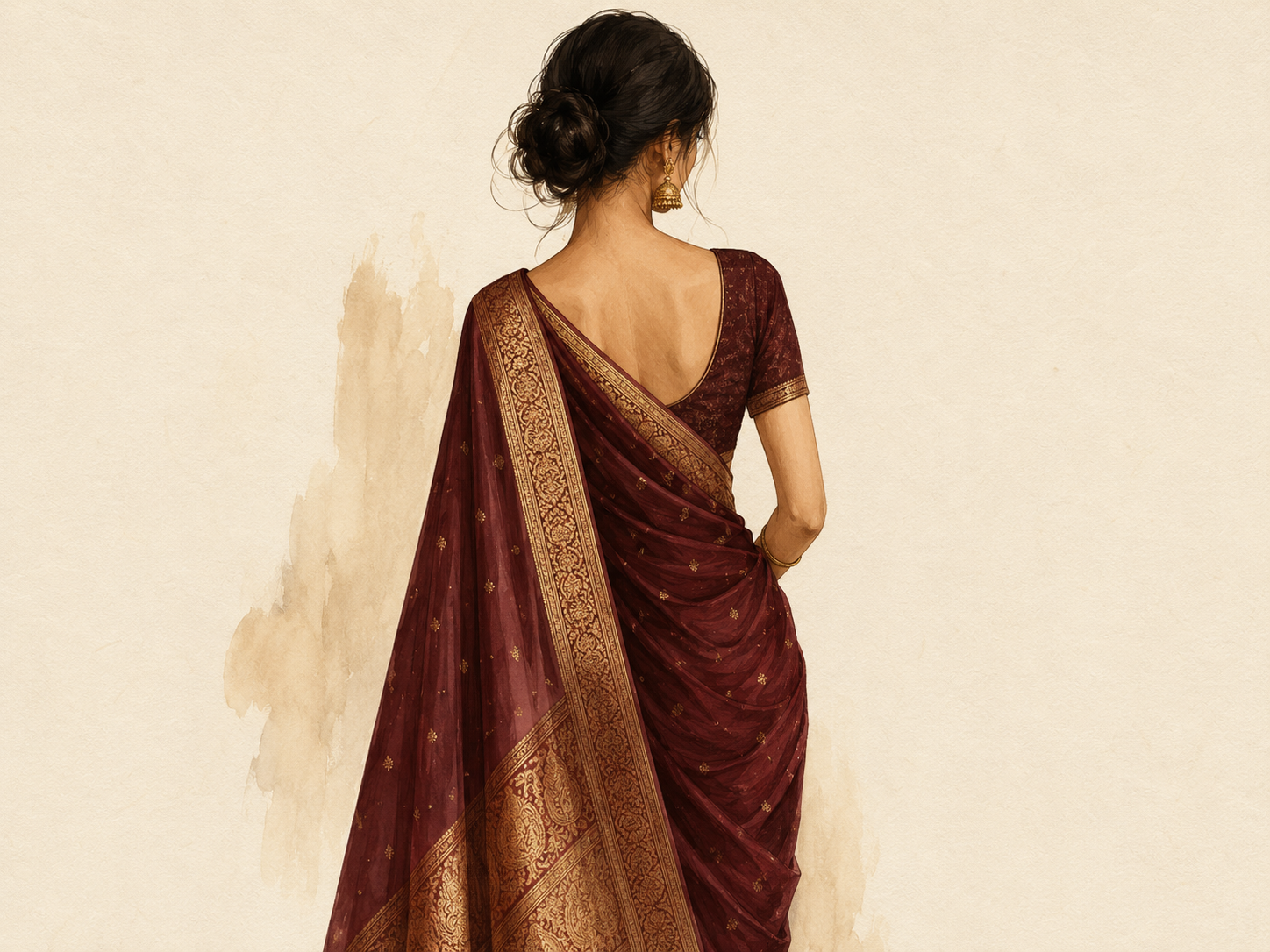
The most common drape, and the one most people picture when they think of a saree, is the Nivi drape from Andhra Pradesh in southern India. The saree is tucked at the waist, brought around the body once, pleated at the front, tucked in again, and then brought across the torso so that the pallu falls over the left shoulder. It is the drape worn for offices, weddings, films, and everyday occasions across much of modern India.
But the Nivi is only one drape among many. The Bengali drape from West Bengal pleats the pallu differently and brings it across both shoulders. The Maharashtrian Nauvari drape uses a longer nine-yard saree and pleats it between the legs in a way that more closely resembles a dhoti. There are drapes from Tamil Nadu, from Gujarat, from Coorg in the south. Some estimates suggest there are over a hundred regional drape styles still in use across India today.
For a beginner in Europe, the practical answer is: start with the Nivi. It is the drape most tutorials cover, the one tailors are most familiar with, and the one most pre-stitched ready-to-wear sarees follow. Once the Nivi feels comfortable, the other drapes open up. The drape is also part of what is a saree — the same cloth becomes a different garment in different hands. If draping feels too much for a particular occasion, our pre-stitched saree guide covers the ready-to-wear alternative.
A short history of the saree
To fully answer what is a saree, we must look at where it comes from. The saree is one of the oldest continuously worn garments in the world. Some historians trace its origins to the Indus Valley Civilisation, roughly 5,000 years ago, where figurines and seal impressions show women draped in long, single pieces of cloth. The word saree itself comes from the Sanskrit “sati,” meaning a strip of cloth.
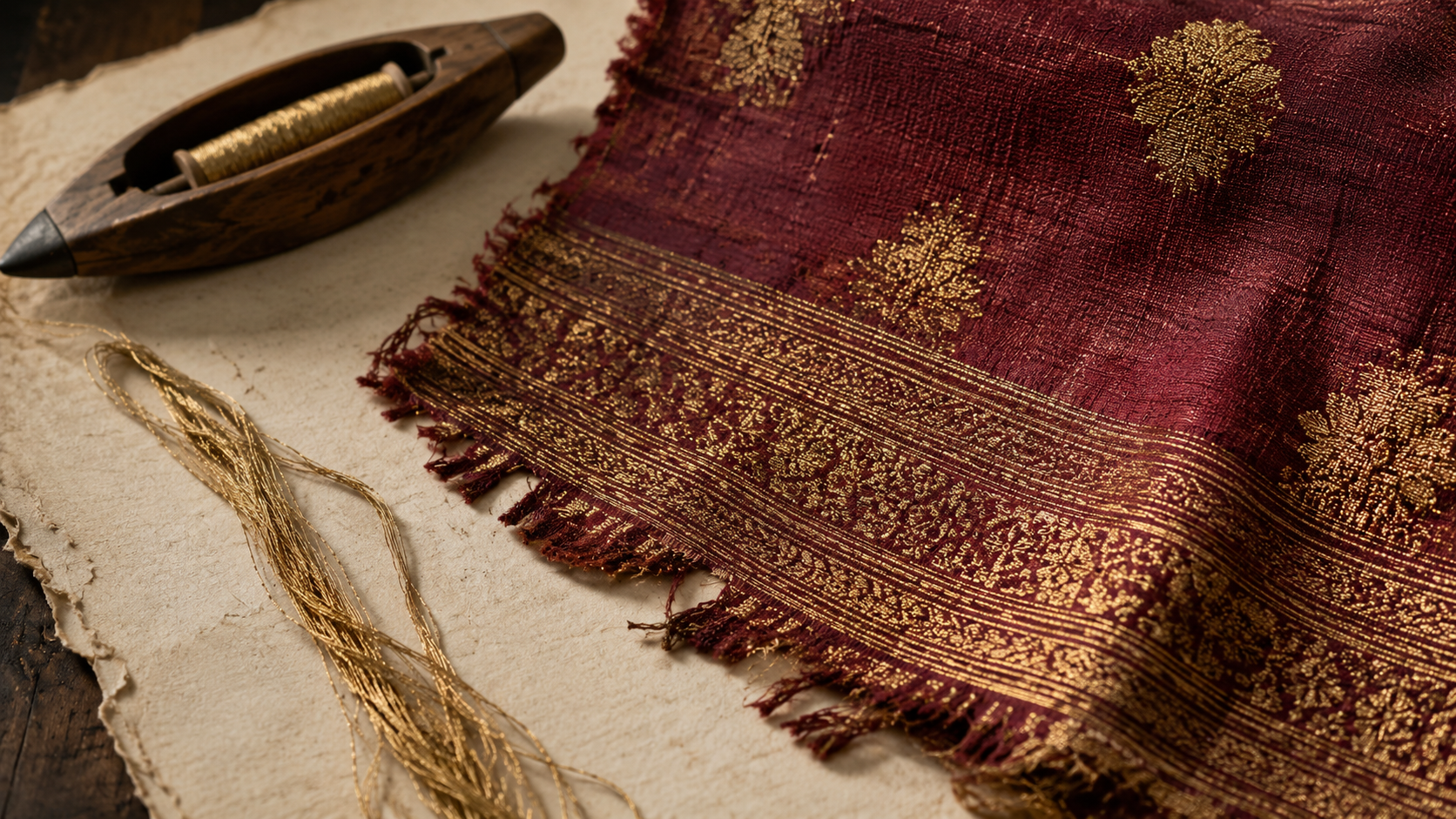
Through the centuries the saree absorbed influences without ever being replaced. Under the Mughal courts from the sixteenth century onward, intricate brocades, gold zari, and Persian motifs entered Indian weaving — the deeply ornamented Banarasi tradition takes much of its visual language from this period. Under British colonial rule, the saree quietly resisted: while many aspects of Indian dress were Westernised, the saree remained the daily garment of most women across the subcontinent.
The early twentieth century saw the rise of the modern Nivi drape, popularised in part by reformers and educators who wanted a version of the saree that worked easily with a blouse and a petticoat — practical for women entering universities and workplaces. The British Victoria and Albert Museum’s South Asia collection in London holds many fine examples of sarees from this transitional period.
In recent decades the saree has gone through a quieter resurgence — younger designers, weavers’ cooperatives, and a generation of women who left the saree behind for jeans have started returning to it. According to Vogue India, the saree today is being reimagined for modern life: lighter fabrics, easier drapes, ready-to-wear versions, and a growing global audience that includes Europe.
The main types of sarees you will hear about
The next layer of what is a saree is regional variety. One of the things that makes the saree world feel overwhelming at first is how many regional varieties exist. Each Indian state, sometimes each district, has its own weaving tradition. Listing all of them would take a book. But several names come up again and again, and knowing what each one is gives you a working map of the saree landscape. Each of these has its own dedicated guide in our growing fabric library.
Banarasi (Varanasi, Uttar Pradesh)
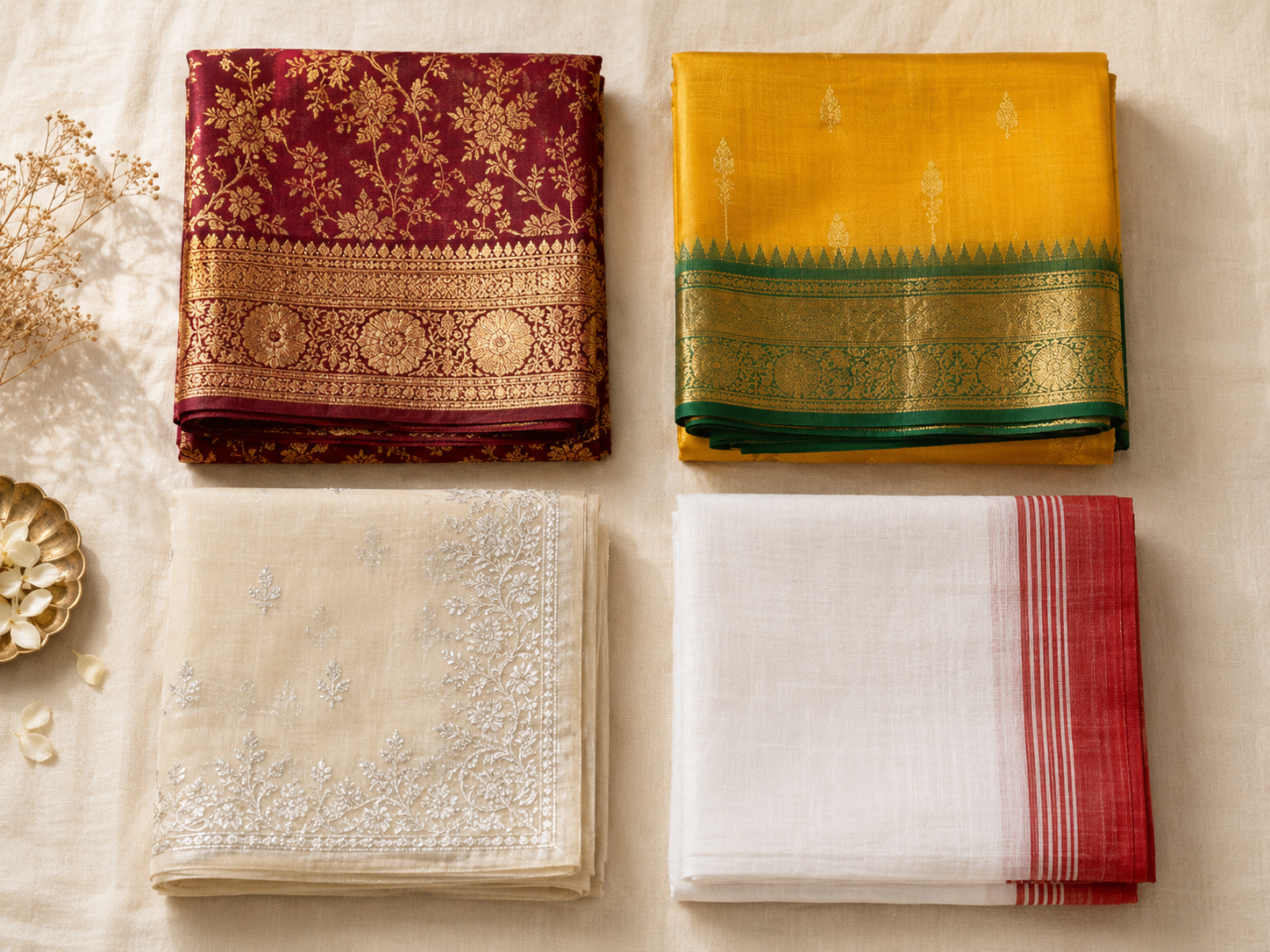
The Banarasi is the saree of weddings, formal occasions, and heirloom collections. Woven in the city of Varanasi (also called Banaras), it is known for deep silk, dense gold and silver zari brocade, and Mughal-influenced floral and geometric motifs. A traditional Banarasi can take weeks to weave on a handloom. Banarasi sarees received Geographical Indication (GI) status, which means only sarees actually woven in the Varanasi region can legally be called Banarasi. For the full Banarasi-vs-Kanjivaram silk decision, see our honest silk comparison.
Kanjivaram (Kanchipuram, Tamil Nadu)
The Kanjivaram (or Kanchipuram) saree is the southern counterpart to the Banarasi. Woven in the town of Kanchipuram in Tamil Nadu, these sarees use thick pure silk and bold contrasting borders — often a body and pallu in two completely different colours. The motifs tend to be inspired by temple architecture, sun and moon symbols, and South Indian heritage. Kanjivarams also carry GI protection. Our Banarasi vs Kanjivaram guide compares the two silk traditions side by side.
Chanderi (Madhya Pradesh)
The Chanderi saree comes from the town of Chanderi in Madhya Pradesh, in central India. Woven from a blend of silk and cotton, these sarees are famously light, almost translucent, with a soft sheen and delicate woven motifs. They suit warmer weather and feel less formal than a Banarasi or Kanjivaram — many modern wearers reach for a Chanderi for daytime events. Our Chanderi saree guide covers the regional weave tradition, the three variants, and choosing your first Chanderi.
Tussar silk (East India)
Tussar is a wild silk produced from the cocoons of forest-dwelling silkworms across Bhagalpur, Madhya Pradesh, Bengal, and Odisha. The fabric has a characteristic slubby texture, a natural golden-honey sheen, and a more sustainable production story than mulberry silk. Tussar is also one of the more European-climate-friendly silks. Our tussar silk saree guide covers the five regional variants, the ahimsa silk question, and the sustainability story behind wild silk.
Bengali Tant (West Bengal) and cotton sarees broadly
The Tant is the everyday saree of West Bengal — a crisp cotton weave, often in white or off-white with a coloured border. The Tant is light, breathable, easy to drape, and historically the saree of teachers, librarians, and the Bengali middle class. The red-bordered white Tant is iconic. Tant sits within the broader cotton saree family — Bengal cotton, Mangalagiri, Khadi, and more. Our cotton saree guide covers the full handloom cotton landscape.
Patola (Gujarat)
The Patola from Patan in Gujarat is one of the most labour-intensive sarees in the world. Woven using a double ikat technique — where both warp and weft threads are dyed in pattern before weaving — a single Patola can take months to complete. The geometric designs and saturated colours are unmistakable. Authentic Patan Patolas are rare and very expensive.
Modern fabric sarees — georgette, chiffon, organza, and ready-to-wear
Outside the traditional handloom world, a growing category of sarees uses lighter modern fabrics — georgette, organza, chiffon, crepe — often in solid colours or with subtle embroidery. These sarees are lighter, easier to drape, and increasingly available as pre-stitched ready-to-wear pieces that work like a long dress. For first-time wearers in Europe, ready-to-wear sarees are often the gentlest place to start. Each of these contemporary fabrics has its own dedicated guide: our georgette saree guide, chiffon saree guide, organza saree guide, and pre-stitched saree guide.
Each of these traditions deserves its own deep-dive, and most of them now have one. Knowing the names is enough to begin — they form a vocabulary you will hear over and over once you start exploring sarees. And they make clear that what is a saree depends on where in India you are asking.
What is a saree, beyond the fabric?
So far we have answered what is a saree at the level of cloth and craft. But the question runs deeper. The saree is also a culture, a livelihood, and a quiet act of continuity. It is tempting to think of the saree as just a beautiful garment. It is — but it is also much more than that. The saree sits at the centre of one of the largest craft economies in the world.
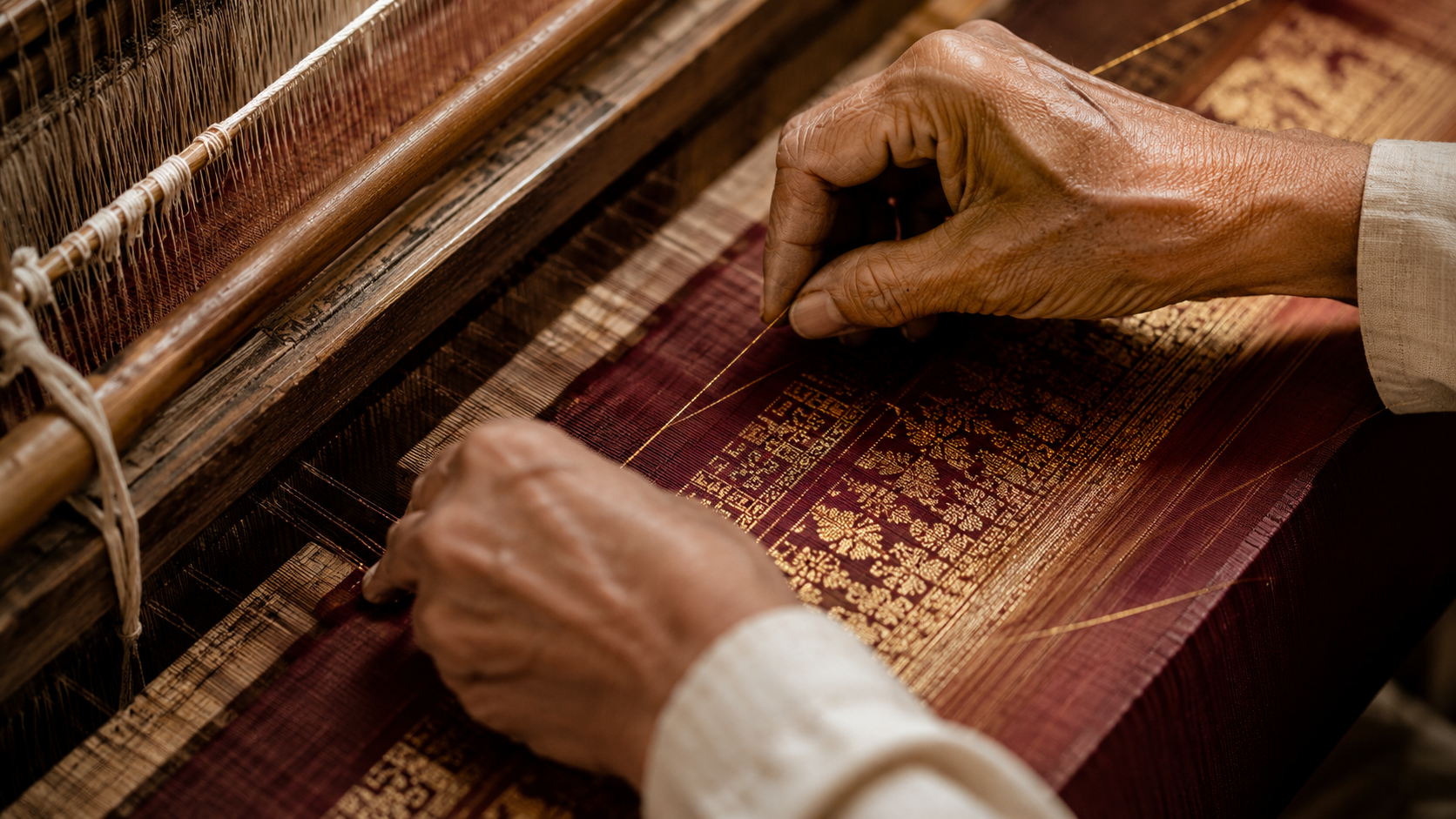
According to India’s Fourth Handloom Census, the country’s handloom sector supports millions of weavers and allied workers, the majority of whom are women working from home. A Banarasi silk saree is not made in a factory. It is made on a wooden pit loom by a single weaver — often the third or fourth generation of the same family to do the work — and depending on the design, it can take anywhere from a week to several months to complete.
This matters in two ways. First, it means that when you buy a handloom saree, you are paying for time and skill, not for branding. The price reflects real human work. Second, it means that the saree is a quietly sustainable garment. A well-made silk saree, looked after, can last decades. Many Indian families pass sarees from mother to daughter — heirloom pieces that have been worn at multiple weddings across two or three generations. In an era of fast fashion, this is a remarkable thing.
The saree also keeps regional craft traditions alive. The Banarasi tradition supports an entire ecosystem in Varanasi. The Kanjivaram tradition does the same in Tamil Nadu. The Patola tradition exists because a handful of families in Patan still know how to do the work. Each saree purchased from a verified handloom source helps these traditions survive. To answer what is a saree at this level: it is a livelihood for millions, and a living craft passed across generations.
Sarees in Europe — the honest reality
For European readers, the question of what is a saree comes with practical follow-ups. If you live in Germany, France, the Netherlands, or anywhere else in Europe, wearing a saree is harder than it should be. We have spent months listening to women across the continent describe the same difficulties, and the picture is consistent.
Finding the right blouse tailor is the single most common challenge. A saree blouse is a precise garment — it has to fit the chest, sleeves, and back exactly. Most European tailors have never made one. Our saree blouse design guide covers three practical approaches to getting a blouse made in Europe — local tailors with a template, online stitching services, and pre-stitched ready-to-wear options.
Sizing is another concern. Indian-sold sarees are usually one length and width, but the matching blouse piece needs to be tailored to European bodies that often differ in height, shoulder width, or chest measurement from the standard Indian patterns. Without an experienced tailor, the result can disappoint.
Climate matters too. Heavy Banarasi or Kanjivaram silks are wonderful for an Indian wedding in winter, but a German autumn or a Bavarian summer asks for different choices — lighter georgettes, breathable Chanderis, or layered drapes with a wool shawl. Our winter saree guide covers the full layering approach for cold European months, and our wedding saree Europe guide covers what to wear as a guest across the continent.
And finally, online photography in the saree market is famously misleading. Bright lighting, heavy filters, and stock-photo backgrounds make it difficult to know what you are actually buying. IndiaNiva exists in part to fix this — to photograph sarees honestly, ship them from Germany, and stand behind them with returns that work.
Frequently asked questions
What is a saree, in simple words?
What is a saree, in the simplest possible terms? A saree is a long, unstitched piece of fabric — usually 5.5 to 9 metres long — draped around the body to form a garment. It is one of the oldest continuously worn pieces of clothing in the world and is most associated with women in India and across South Asia. Unlike most modern clothing, a saree is not cut or sewn to fit; it is wrapped, pleated, and tucked into shape on the wearer.
How long is a saree?
A standard modern saree is between 5.5 and 6 metres long and about 1.1 metres wide. Some regional sarees are longer — the Maharashtrian Nauvari is around 9 metres (nine yards), and some traditional South Indian sarees reach 8 metres. The shorter modern length suits the Nivi drape and is the most common today.
What is a saree made of?
A saree can be made from many fabrics. Silk, cotton, and silk-cotton blends are the most traditional — Banarasi is silk, Kanjivaram is silk, Chanderi is silk-cotton, Tant is cotton. Modern sarees also use georgette, chiffon, organza, crepe, and synthetic blends. The fabric a saree is made of largely determines how it drapes, how formal it feels, and how it suits different climates. Our complete fabric library covers each: cotton, georgette, chanderi, organza, tussar silk, and chiffon.
Do I need to know how to drape a saree myself?
No, although learning is rewarding. Most modern wearers, even in India, learn the Nivi drape once and use it for years. Our step-by-step drape tutorial walks through every step. If you prefer not to drape, ready-to-wear sarees are pre-stitched and slip on like a long skirt with an attached pallu — see our pre-stitched saree guide for the ready-to-wear approach.
Are sarees only for weddings and festivals?
No. In India sarees are worn for everyday occasions — offices, universities, casual meetings — as well as for weddings, religious events, and festivals. The difference is in the fabric and ornamentation: a light cotton or georgette saree for daily wear, a heavy silk or zari brocade for celebration. The same garment family covers both ends of the spectrum. For wedding-specific guidance, our wedding saree Europe guide covers what to wear as a guest.
What is the difference between a saree and a lehenga?
A saree is a single piece of unstitched fabric. A lehenga is a three-piece outfit: a long pleated skirt (the lehenga itself), a blouse called a choli, and a separate scarf called a dupatta worn over the shoulder. Lehengas are often worn for weddings, particularly by brides and bridal-party members. Sarees and lehengas share an aesthetic world but are different garments.
Can someone non-Indian wear a saree respectfully?
Yes. Sarees have been welcomed onto people of every background for centuries. The standard most Indians ask for is simple: wear it with care, treat the garment as the craft it is, and learn a little about where your saree comes from. Avoid cheap, factory-printed imitations that misrepresent regional traditions. A well-chosen, well-worn saree is a quiet act of appreciation, not appropriation.
Are sarees comfortable in European weather?
It depends on the fabric. A heavy silk Banarasi in a Berlin summer would be uncomfortable; a lightweight Chanderi or georgette saree is perfectly wearable in warm weather. For European winters, sarees layer beautifully with shawls, woollen blouses, and structured outerwear. Choosing the right fabric for the season is more important than the saree itself. Our winter saree guide goes deeper on the climate question.
One more thing
A saree, in the end, is more than a garment. It is a craft, a quiet conversation between centuries, and a slow act of beauty that asks only for time and care. If you have read this far, the question of what is a saree should feel a little less unfamiliar — and that is a good place to begin. The answer to what is a saree is, ultimately, a long answer: a piece of cloth, a method of wearing, a regional craft, a livelihood, a culture. All of it true at once.
This guide is the foundation for a growing library. Once you have the basics, our five-piece saree wardrobe guide walks through how to build a working capsule. For fabrics, our complete library now covers cotton, Banarasi vs Kanjivaram silk, chanderi, georgette, chiffon, organza, tussar silk, and the pre-stitched format. For the act of wearing, our Nivi drape tutorial, blouse design guide, and winter saree guide cover the practical questions. And our wedding saree Europe guide covers what to wear as a guest.
Follow the journey
Be there from day one.
IndiaNiva launches its online shop soon. Until then, we are quietly building — visiting weavers, researching tailors, and writing what we learn. Two thoughtful emails a month. Nothing more.
Continue reading
- Your first saree wardrobe — five pieces that cover almost every occasion
- How to drape a saree — the step-by-step Nivi tutorial
- Saree blouse design — necklines, sleeves, fabric, and finding a tailor in Europe
- Banarasi vs Kanjivaram — an honest comparison of the two great silks
- Cotton saree guide — the foundational handloom fabric
- Georgette saree guide — flowing fabric for every occasion
- Chanderi saree guide — the silk-cotton weave of Madhya Pradesh
- Organza saree guide — the contemporary couture fabric
- Tussar silk saree guide — wild silk from East India
- Chiffon saree guide — the fluid evening fabric
- Pre-stitched saree guide — the modern ready-to-wear format
- How to wear a saree in winter — the layering principle for European cold
- Wedding saree Europe — what to wear as a guest in Europe
- About IndiaNiva — why we are building this, and for whom
This post draws on conversations with weavers, public cultural sources including UNESCO and the Victoria and Albert Museum, and IndiaNiva’s own brand research. Where specific figures appear, the source is linked. All information is correct at the time of writing.