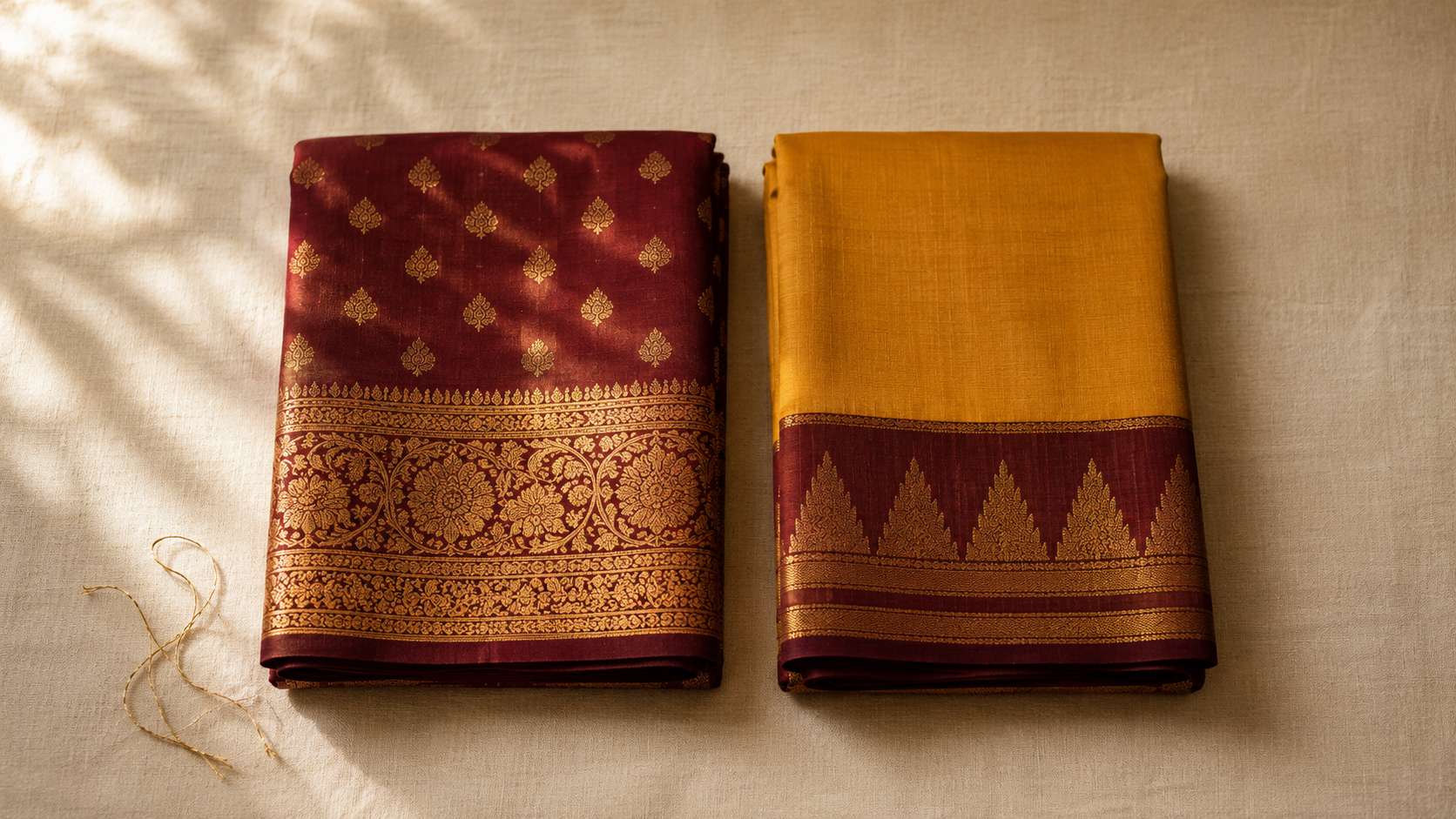
Banarasi vs Kanjivaram is the comparison every European reader asks about once the world of silk sarees opens up. Both are crown jewels of Indian handloom. Both are silk. Both carry GI protection. Both are worn at the most important occasions of a person’s life. And yet they are completely different sarees — different regions, weaves, motifs, weights, occasions, stories. This guide is our honest, founder-led comparison of Banarasi vs Kanjivaram, written for readers in Germany and across Europe who want to understand the difference before choosing a first silk saree.
In this guide
Banarasi vs Kanjivaram — the short answer
Before we go deep, here is the Banarasi vs Kanjivaram answer in one paragraph. A Banarasi is a silk saree woven in Varanasi in north India, defined by gold and silver zari brocade and Mughal-influenced floral motifs. A Kanjivaram is a silk saree woven in Kanchipuram in south India, defined by thick pure mulberry silk, bold contrasting borders, and temple-architecture motifs. The Banarasi is generally lighter and more ornate, most associated with north Indian weddings. The Kanjivaram is heavier, more structural, most associated with south Indian weddings and temple visits. Both are heirloom-grade sarees that last generations when cared for.
That is the surface answer to Banarasi vs Kanjivaram. The deeper Banarasi vs Kanjivaram answer takes the rest of this guide — and it matters, because the right choice depends on where you live, what occasion you have in mind, and what you want the saree to mean to you. (For the third great silk tradition — the wild silk of East India — see our tussar silk saree guide.)
A brief history of each weave
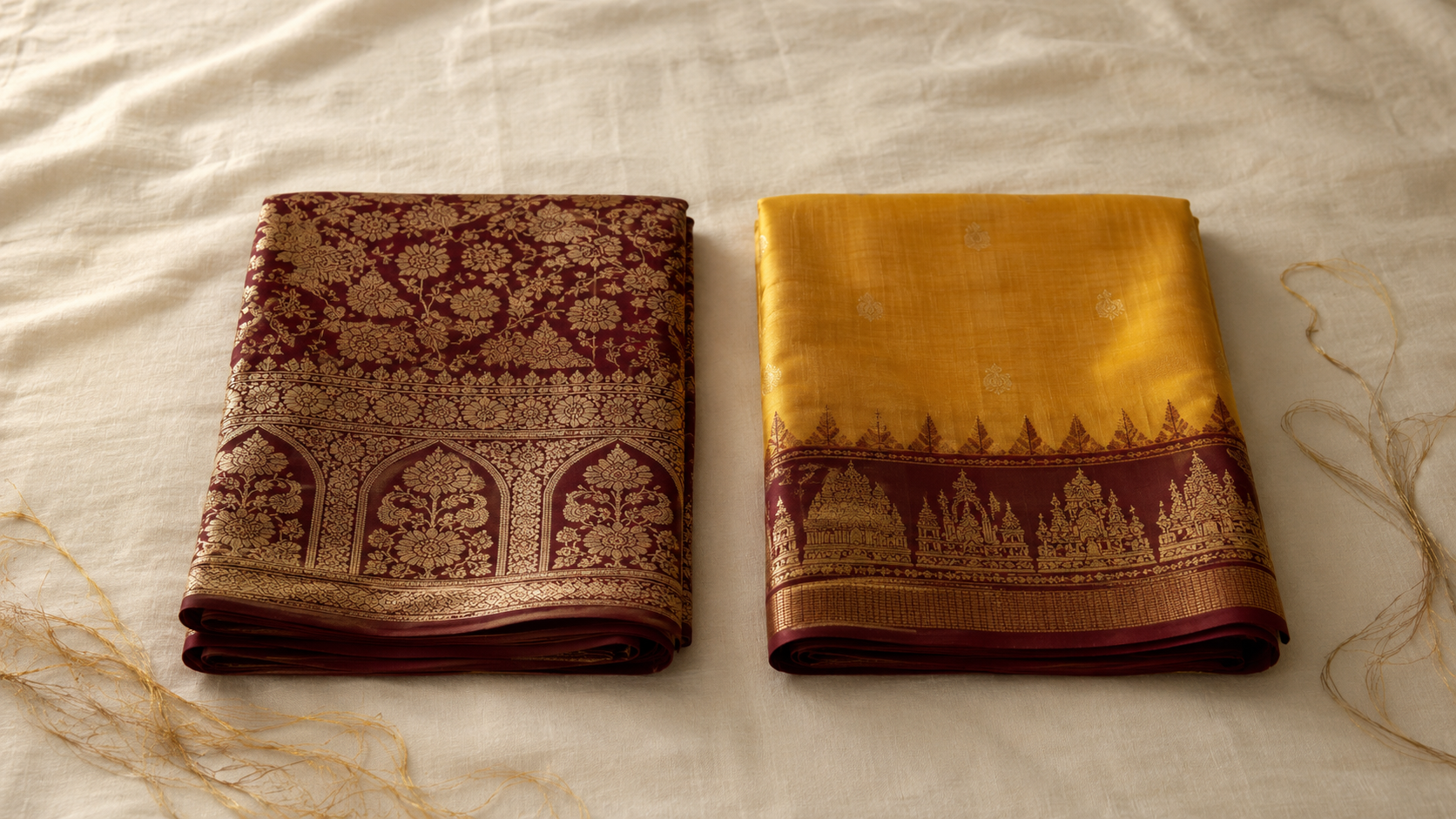
To make sense of Banarasi vs Kanjivaram, it helps to understand where each comes from. The Banarasi vs Kanjivaram story begins in two different regions of India, under two different sets of patrons. Their differences are not just decorative — the Banarasi vs Kanjivaram contrast reflects two distinct cultural worlds.
Banarasi — Mughal courts and the city of Varanasi
The Banarasi saree comes from Varanasi, also called Banaras — one of the oldest continuously inhabited cities in the world. The modern Banarasi tradition took shape under the Mughal courts from the sixteenth century, when Persian weavers and motifs entered Indian textile production. The result was a fusion: Indian silk yardage, Persian floral design, and the introduction of zari — gold and silver thread woven directly into the cloth.
By the time the British arrived, Banarasi silks were already prized across India and beyond. The Banarasi tradition survived colonial rule largely intact, and Banarasi sarees received Geographical Indication (GI) protection in 2009. Only sarees woven in the Varanasi region by registered weavers can legally be called Banarasi today. This matters for the Banarasi vs Kanjivaram authenticity question, which we return to later in the guide.
Kanjivaram — temple towns of Tamil Nadu
The Kanjivaram saree comes from Kanchipuram, a temple town in Tamil Nadu in south India. The Kanjivaram tradition is older than the modern Banarasi style and grew not in royal courts but in temple economies. Weavers in Kanchipuram, many descended from communities that migrated from Andhra Pradesh centuries ago, wove silk sarees for temple priests, deity garments, and temple-going families.
The motifs reflect that origin — sun and moon symbols, peacocks, and the architectural lines of South Indian temples appear in Kanjivaram pallus and borders. Kanjivaram sarees received GI protection in 2005, four years before Banarasi. Both protections are administered by the same Registry, which makes Banarasi vs Kanjivaram GI status legally symmetrical even though the crafts evolved separately.
The fabric — what each saree is actually made of
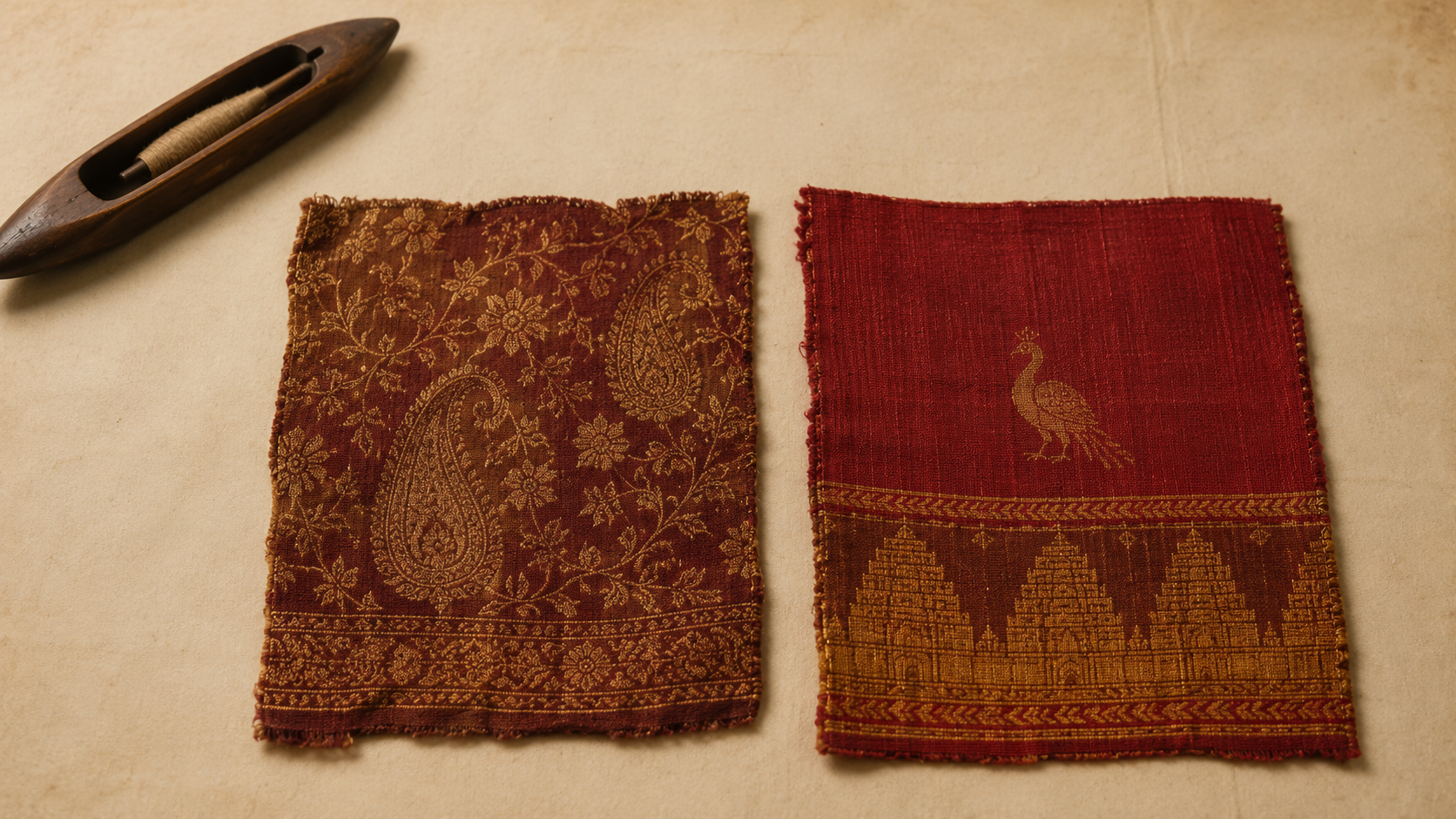
The Banarasi vs Kanjivaram question begins with the silk itself. Both sarees are made from real silk, but the type, the spinning, and the weaving are completely different. This single fabric distinction is the root of most Banarasi vs Kanjivaram differences readers notice — weight, drape, lustre, and how the saree feels in the hand.
Banarasi silk and the role of zari
A traditional Banarasi is woven from fine silk yarn — typically katan silk, a tightly twisted pure silk thread — together with zari brocade work. Zari is the gold or silver thread that creates the saree’s ornamental designs. In an authentic handloom Banarasi, the zari is real silver thread electroplated with gold and wrapped around a silk core. In machine-made Banarasis, the zari is plastic-coated copper or polyester.
The Banarasi technique sets it apart in the Banarasi vs Kanjivaram comparison: the design is created during weaving, not after. The patterns are woven into the cloth itself using a complex jacquard or pit-loom mechanism that selectively raises threads to form motifs. A single dense Banarasi can take a weaver six weeks to several months to complete.
Kanjivaram silk and the three-shuttle weave
A Kanjivaram is woven from a different silk — thicker, denser mulberry silk known locally as pattu. The yarn is dyed before weaving and is significantly heavier than Banarasi katan silk. This is the heart of the Banarasi vs Kanjivaram weight question: it explains why a Kanjivaram feels structural while a Banarasi feels fluid.
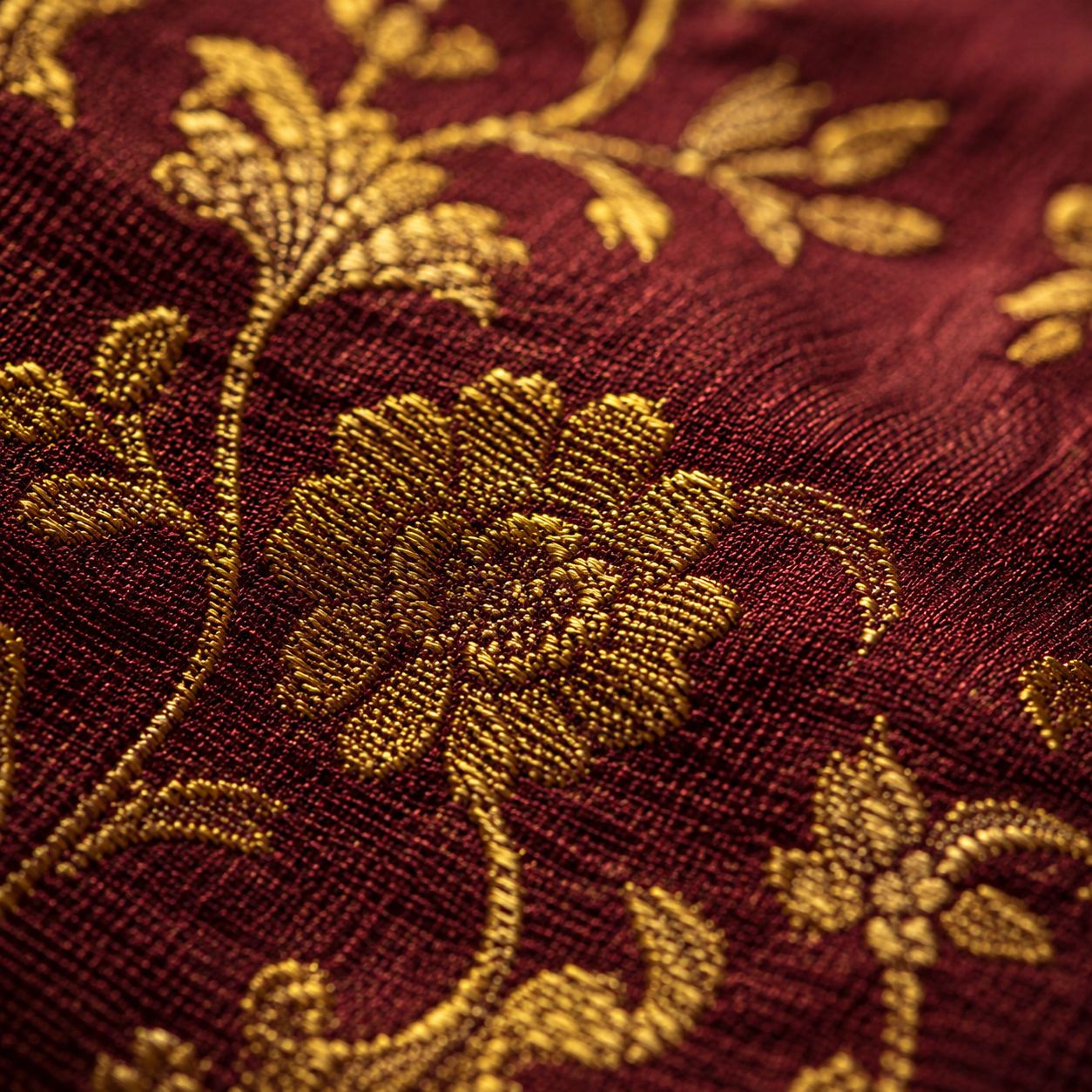
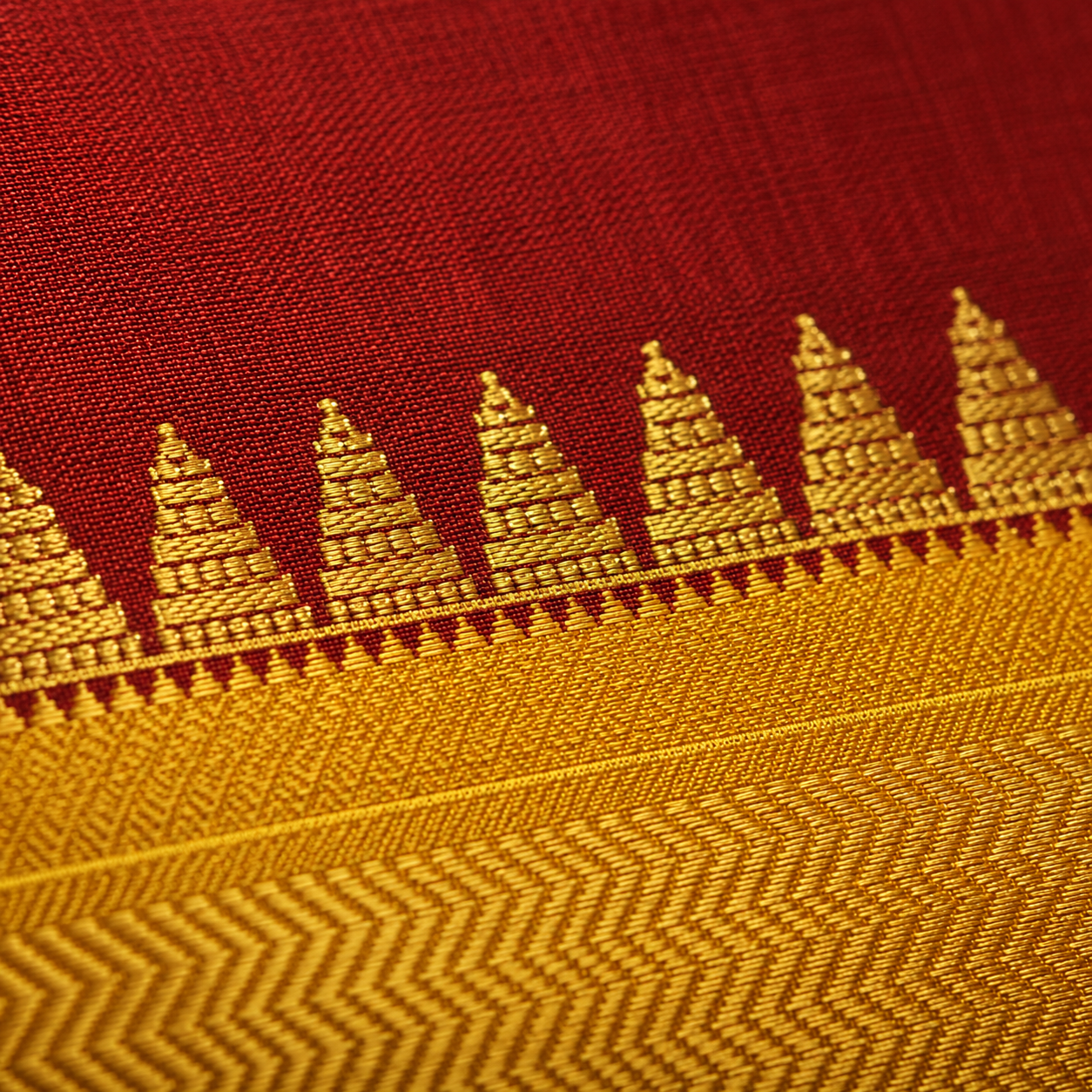
The defining technique of a Kanjivaram is the three-shuttle weave. Three silk threads are woven simultaneously — one for the body, one for the border, one for the pallu. The body and border are woven as two distinct pieces and interlocked at the join, often in a contrasting colour. This is why a real Kanjivaram can have a deep maroon body and a mustard or pista green border — the two colours are not printed or appliquéd; they are separate weaves joined by a technique called korvai.
Motifs and design language
The next dimension of Banarasi vs Kanjivaram is what each saree shows. Once you can read the motifs, you can usually identify a Banarasi vs Kanjivaram saree across a room without touching it. This is the most visible Banarasi vs Kanjivaram difference, and the one that most readers learn to spot first.
Banarasi motifs — florals, jaali, Mughal influence
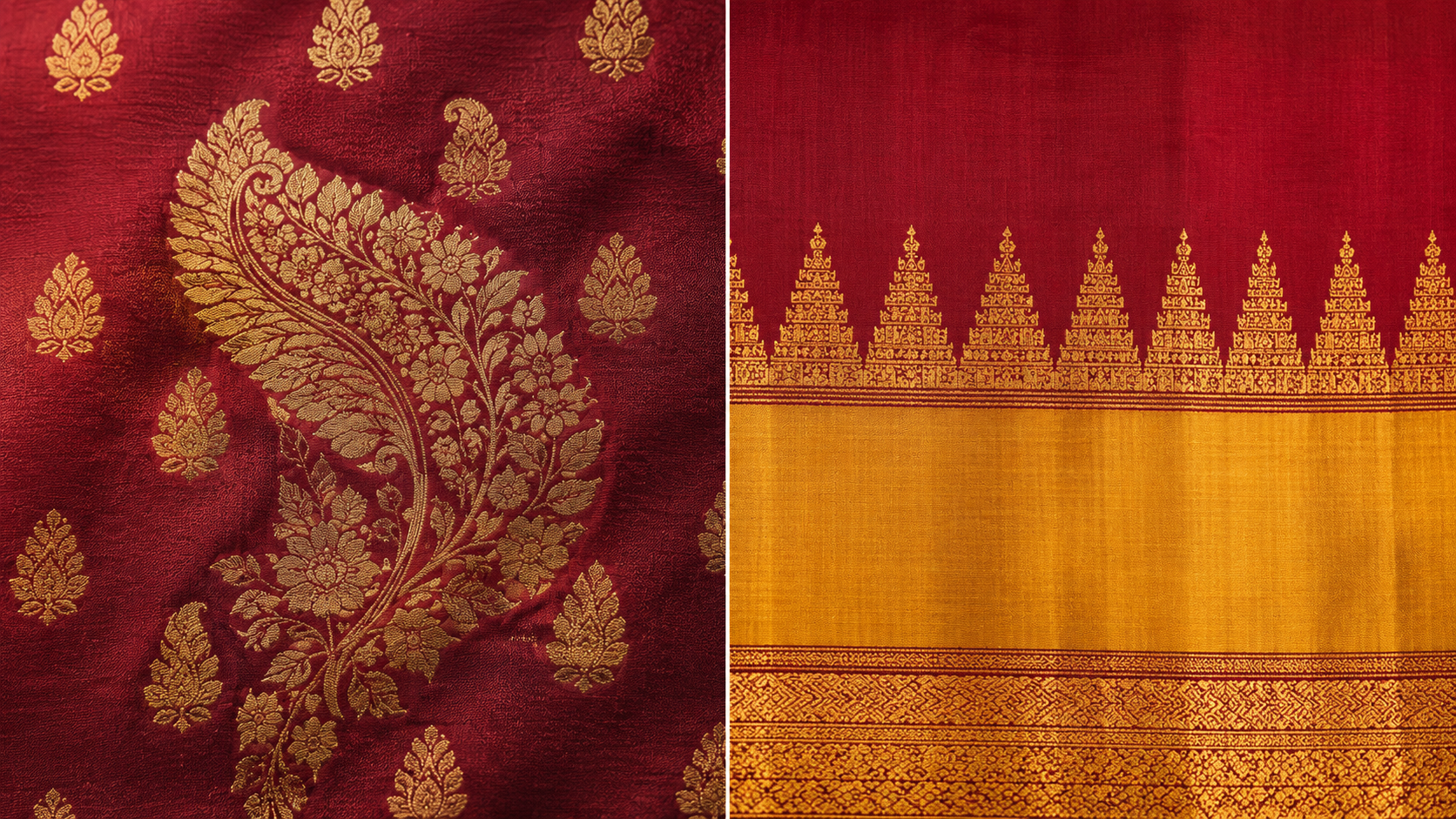
Banarasi sarees carry the visual language of Mughal-era textile design. The most common Banarasi motifs include the buta and buti — small repeating floral or paisley shapes scattered across the body. The pallu often features kalga and bel — larger curved leaf and vine patterns. Jaali work, named after the lattice screens in Mughal architecture, creates intricate net-like patterns inside the brocade. In the Banarasi vs Kanjivaram visual comparison, these motifs are unmistakably north Indian and unmistakably courtly.
The Banarasi colour palette tends toward deep, warm tones — maroons, wine reds, royal blues, forest greens, soft golds — set against the gleam of zari. A Banarasi at a wedding looks as though it is glowing from within. The Banarasi vs Kanjivaram colour story is one of the easiest ways to tell the two apart at first glance.
Kanjivaram motifs — temples, suns, contrasting borders
Kanjivaram motifs are bolder, larger, and more architectural. Temple borders — small triangular shapes echoing South Indian temple gopurams — are the most identifiable Kanjivaram feature. Sun and moon medallions appear in the pallu of many traditional Kanjivarams, along with peacocks, parrots, lions, and lotus motifs drawn directly from temple iconography.
The colour story of a Kanjivaram is also distinct. Where a Banarasi glows in soft warm tones, a Kanjivaram declares itself in high contrast: a deep red body with a parrot green border, a mustard pallu against an indigo blue body. The contrast is intentional, structural, tied to temple aesthetics. In any Banarasi vs Kanjivaram lineup at a wedding, you can almost always spot the Kanjivaram first — it is the saree with the loudest border.
Weight, drape, and how each one feels to wear
For European readers, weight matters more than it might seem on screen. The Banarasi vs Kanjivaram weight difference is significant, and it affects everything from how the saree drapes to how comfortable it is to wear for hours at a wedding reception. This is the Banarasi vs Kanjivaram factor that most often surprises first-time wearers in Munich, Berlin, or Paris.
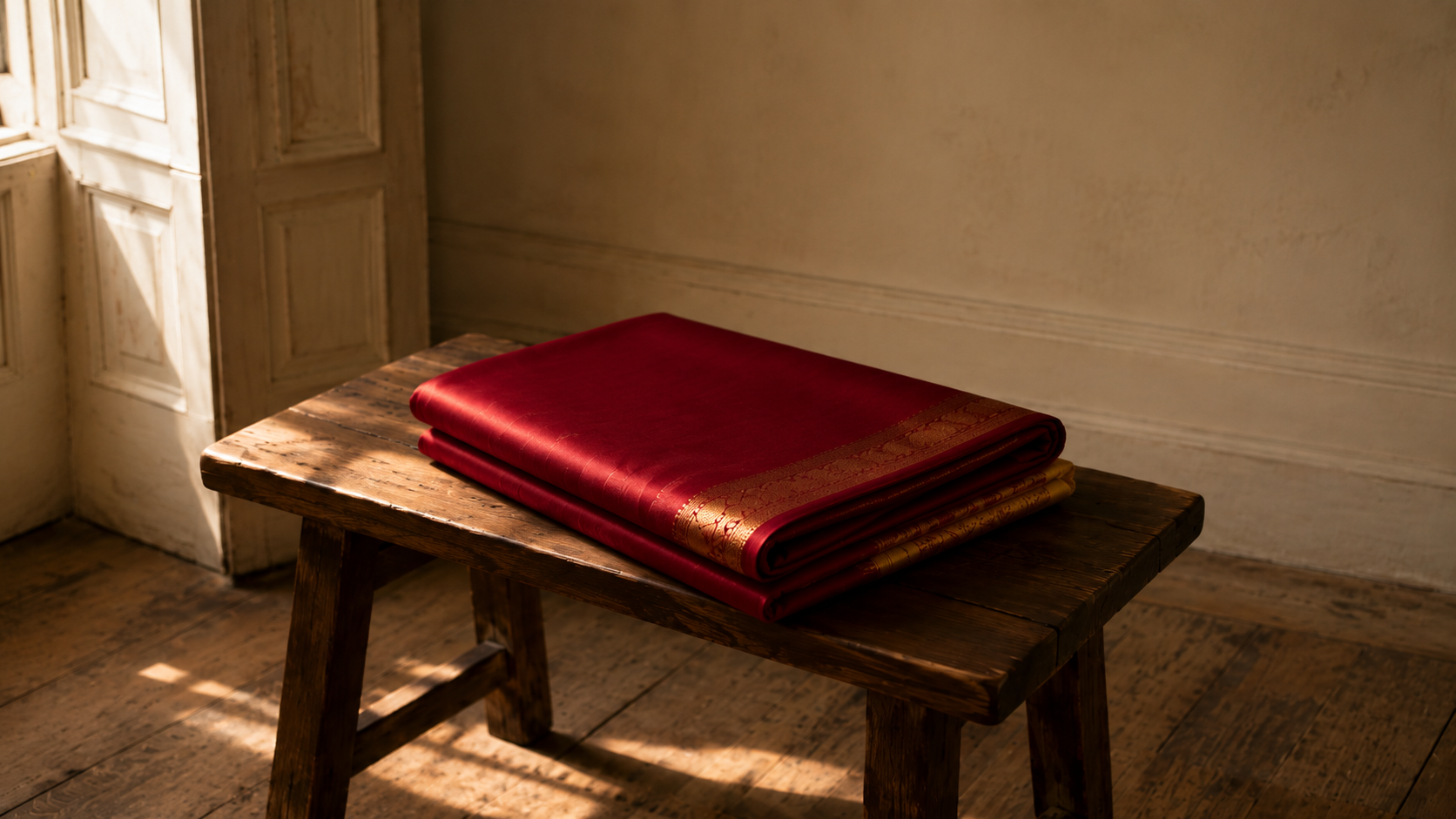
A handloom Banarasi weighs between 600 grams and 1.2 kilograms. A Kanjivaram weighs between 1.5 and 2.5 kilograms — more for heavily worked bridal pieces. That is a meaningful Banarasi vs Kanjivaram difference. When you drape a Kanjivaram, you feel its weight on your shoulder throughout the day. When you drape a Banarasi, the cloth moves with you.
This shapes the drape itself. A Banarasi falls in fluid folds — pleats lie naturally, pallu drapes softly. A Kanjivaram holds its shape more firmly — pleats stand crisp, pallu hangs with structural weight. Neither is better in the Banarasi vs Kanjivaram sense; they create different silhouettes. Banarasis flatter softer drapes. Kanjivarams flatter structured silhouettes. The Banarasi vs Kanjivaram drape choice is, in the end, a question of which silhouette feels more like you. Our step-by-step drape guide works for both, with small adjustments for the weight difference.
Occasions — when each saree is worn
Both Banarasi and Kanjivaram are formal sarees. Neither is everyday wear in modern India. The Banarasi vs Kanjivaram occasion question is mostly about regional tradition and the type of formality — the same Banarasi vs Kanjivaram decision often comes down to which family side you are dressing for. For European wedding occasions specifically, our wedding saree Europe guide covers what to wear as a guest.
Banarasi for north Indian weddings
The Banarasi is the heritage bridal saree of north India. A bride from a Punjabi, Uttar Pradesh, Bihar, or Rajasthani family will often wear a Banarasi at one of her wedding events — sometimes the bridal lehenga is paired with a Banarasi dupatta, sometimes the wedding itself is in a deep red Banarasi. The Banarasi is also a common gift from mothers to daughters at significant life moments, and a typical heirloom in north Indian families. In the Banarasi vs Kanjivaram tradition map, this is the north Indian heartland.
Beyond weddings, a Banarasi is worn at sangeet evenings, religious festivals like Diwali and Karva Chauth, and formal family gatherings. Lighter Banarasis suit office occasions or daytime events; heavier zari-rich pieces are reserved for evening celebration.
Kanjivaram for south Indian weddings and temple visits
The Kanjivaram is the heritage bridal saree of south India — the southern counterpart to the Banarasi in the Banarasi vs Kanjivaram regional split. A Tamil, Telugu, Kannada, or Malayali bride will most often wear a Kanjivaram on her wedding day. Frequently, the wedding-day Kanjivaram is gifted by her mother or grandmother and kept as the saree she will pass on to her own daughter.
Kanjivarams are also worn at temple ceremonies, Carnatic and Bharatanatyam performances, and formal family events across south India. The Kanjivaram has a more sacred resonance than the Banarasi — in the Banarasi vs Kanjivaram comparison, it is associated with temple worship and tradition, while the Banarasi is associated with court and celebration.
Price, authenticity, and the GI question
The most uncomfortable part of the Banarasi vs Kanjivaram conversation is authenticity. Both categories have significant fake-market problems. Machine-woven imitations are sold as handloom; polyester zari is sold as silver-gold zari; sarees woven in completely different regions are labelled Banarasi or Kanjivaram because the words command higher prices. The Banarasi vs Kanjivaram counterfeit problem is one of the saree world’s open secrets.
According to the Geographical Indications Registry of India, only sarees woven in the protected area by registered weavers can legally use the Banarasi or Kanjivaram name. Both crafts have authentication marks — the Silk Mark for pure silk content, the Handloom Mark for handloom origin, and category-specific GI tags. In practice, these marks are not always visible on the sarees sold to consumers, and Banarasi vs Kanjivaram verification depends largely on buying from a trusted source.
Price is the other Banarasi vs Kanjivaram signal. A genuine handloom Banarasi or Kanjivaram represents many weeks of skilled work. A real Kanjivaram with substantial pure silk content rarely sells under several hundred euros equivalent at source; a heritage bridal Kanjivaram can cost several thousand. A real handloom Banarasi with extensive zari work sits in a similar range. If a saree in either category is priced extremely low, something is being substituted somewhere — usually the silk, or the zari, or both.
According to Vogue India, the contemporary resurgence of handloom sarees has been driven partly by younger women seeking direct relationships with weavers and weaver cooperatives — bypassing the middle market where fakes are most common. The Banarasi vs Kanjivaram authenticity question is, in the end, a question of supply chain transparency.
Banarasi vs Kanjivaram — side by side
The Banarasi vs Kanjivaram differences gathered into one place:
| Aspect | Banarasi | Kanjivaram |
|---|---|---|
| Origin | Varanasi, Uttar Pradesh (north India) | Kanchipuram, Tamil Nadu (south India) |
| Silk type | Katan silk — fine, tightly twisted | Mulberry pattu silk — thick, dense |
| Weight | 600 g – 1.2 kg | 1.5 – 2.5 kg |
| Defining technique | Brocade weaving with zari | Three-shuttle korvai weave |
| Typical motifs | Florals, paisley (buta), jaali lattice | Temple borders, suns, peacocks |
| Colour story | Warm, harmonious tones with gold | High contrast body and border |
| Drape feel | Fluid, soft, flowing | Structural, crisp, holds shape |
| Typical occasion | North Indian weddings, sangeet, Diwali | South Indian weddings, temple events |
| GI protection | Granted 2009 | Granted 2005 |
| Heirloom potential | Generations, when cared for | Generations, when cared for |
Which one is right for you?
For a European reader new to silk sarees, the Banarasi vs Kanjivaram choice is rarely as simple as buying the more famous one. It depends on weight, climate, occasion, and the relationship you want to build with the saree over time. Here is how we would think through the Banarasi vs Kanjivaram decision for three common situations.
If this is your first silk saree
For first-time European wearers facing the Banarasi vs Kanjivaram choice, we would lean toward a Banarasi. The lighter weight makes it easier to drape, less tiring at a long evening event, and more forgiving on European summers when air conditioning is not always reliable. A medium-weight Banarasi in soft maroon, dusty pink, or muted gold is a piece you can grow into. Many of the women we have spoken to in Munich, Frankfurt, and Berlin who own one saree own a Banarasi. A third option worth considering for first-silk buyers is tussar silk — wild silk with a slubby texture, lighter weight than Kanjivaram, more European-climate-friendly, and a lower entry price. Our tussar silk saree guide covers the full case for tussar as a first silk. For wearers who want a non-silk first wedding-grade piece, our cotton saree guide covers the handloom cotton case.
If you are buying for a wedding
For weddings, the Banarasi vs Kanjivaram choice often follows the family’s region. If you are attending a south Indian wedding, a Kanjivaram is the most occasion-appropriate choice — though a heavy Banarasi will also work. If you are attending a north Indian wedding, a Banarasi is conventional, but a Kanjivaram will not feel out of place either. If you are the bride and one side of the family expects tradition, ask which they associate more strongly with bridal silk — the answer is usually obvious. Our wedding saree Europe guide covers the full guest-wear logic for European weddings.
If you want an heirloom piece
In the Banarasi vs Kanjivaram heirloom question, both qualify. Both can last fifty to a hundred years with careful storage — folded in soft cotton, refolded every few months, kept away from direct light. If you want a saree that will outlive you, either tradition will deliver. Choose based on which motif language speaks to you, which weight suits how you want to wear it, and which region you feel a personal connection to.
Frequently asked questions
In the Banarasi vs Kanjivaram comparison, which one is heavier?
Kanjivaram is significantly heavier. A typical Kanjivaram weighs 1.5 to 2.5 kilograms; a Banarasi typically weighs 600 grams to 1.2 kilograms. The difference comes from the silk itself — Kanjivaram uses thick mulberry pattu silk, while Banarasi uses finer katan silk. For long wearing events, especially in warm weather, this weight difference matters.
Banarasi vs Kanjivaram — which is better for a summer wedding?
A lighter-weight Banarasi tends to be more comfortable for summer wear — it is lighter and drapes more fluidly. A Kanjivaram in warm weather can feel substantial. That said, both are silk and both are formal — neither is genuinely a hot-weather fabric. For European summer weddings, choose the lightest piece you can find in whichever tradition you prefer, and consider a Chanderi, organza, or tussar silk saree if comfort is the top priority.
Can a Banarasi be machine-woven, or must it be handloom?
Both exist in the market. In the Banarasi vs Kanjivaram authenticity discussion, this is one of the most confusing points. The original Banarasi tradition is handloom, woven on a pit loom by a single weaver over several weeks. Power-loom Banarasi sarees are sold widely — they are faster, cheaper, and use synthetic zari instead of real silver-gold. The GI protection technically applies to the geographical area, not exclusively to handloom production, so a power-loom saree woven in Varanasi can still be called Banarasi. For an heirloom piece in the Banarasi vs Kanjivaram bracket, handloom is what you want; for everyday wear, power-loom is acceptable.
How long does a real Kanjivaram take to weave?
A traditional handloom Kanjivaram with substantial zari work takes between three weeks and three months on a pit loom, depending on the design complexity, the density of the zari, and the skill of the weaver. Very intricate bridal pieces can take longer. In the Banarasi vs Kanjivaram weaving time comparison, Kanjivaram timelines are similar to Banarasi for equivalent complexity. The three-shuttle korvai technique used for the body-border join is particularly slow because two separate weaves must be interlocked thread by thread.
In the Banarasi vs Kanjivaram price comparison, which costs more?
It varies by piece. At the heritage handloom end, both can cost several thousand euros equivalent. At the entry-handloom level, a simple Banarasi often sits slightly below an equivalent Kanjivaram because the silk content is lower by weight. Power-loom imitations of either can be found for very low prices, but they are not genuinely comparable to handloom pieces. We do not quote specific prices because our online shop is not yet open — until then, treat any quoted figures with caution and always ask the seller about silk content and weaving method.
Can men wear either Banarasi or Kanjivaram as a stole or dupatta?
Yes, in both cases. Banarasi stoles and dupattas are widely worn by men at north Indian weddings — typically over a kurta or sherwani, in deep red, gold, or maroon. Kanjivaram dupattas are less common as menswear but appear at south Indian weddings, sometimes as a temple offering or as a shawl over formal dress. The Banarasi vs Kanjivaram menswear question follows the same regional logic as the saree itself.
One more thing
Banarasi vs Kanjivaram is not a question with a single winner. Both are masterworks of Indian handloom — different in technique, different in region, different in feel, but equal in craft and equal in heritage. The honest answer to Banarasi vs Kanjivaram is that the right choice depends on the occasion, the wearer, the climate, and the personal story you want the saree to carry. If you live in Europe and you are starting your relationship with Indian silk sarees, give yourself permission to learn both. Touch them when you can. Read the weavers’ stories. Ask sellers where the saree was made and by whom.
This guide is one stop in a larger journey. To understand what a saree is at its essence, we have a dedicated guide. For the third great silk tradition, our tussar silk saree guide covers the wild silks of East India. For everyday fabrics that complement silks in a working wardrobe, our cotton saree guide, chanderi saree guide, georgette saree guide, chiffon saree guide, and organza saree guide are the place to start. And for the wardrobe context — how a silk saree fits into a five-piece European capsule — our first saree wardrobe guide walks through the framework.
Follow the journey
Be there from day one.
IndiaNiva is launching its online shop soon. Until then, we are quietly building — visiting weavers in Varanasi and Kanchipuram, researching tailors in Europe, and writing what we learn. Two thoughtful emails a month. Nothing more.
Continue reading
- What is a saree? An essential beginner’s guide — the foundation post in this series
- Tussar silk saree guide — the third great silk tradition (wild silk of East India)
- Cotton saree guide — the foundational handloom fabric
- Chanderi saree guide — the silk-cotton weave for dressier daytime
- Georgette saree guide — flowing fabric for every occasion
- Organza saree guide — sheer contemporary couture
- Chiffon saree guide — the fluid evening fabric
- Pre-stitched saree guide — the modern ready-to-wear format
- Your first saree wardrobe — building the five-piece capsule
- How to drape a saree — step-by-step Nivi tutorial
- Saree blouse design — pairing blouses with silk sarees
- How to wear a saree in winter — the European cold-weather guide
- Wedding saree Europe — what to wear as a guest
- About IndiaNiva — why we are building IndiaNiva from Munich
This Banarasi vs Kanjivaram guide draws on conversations with weavers, public records from the Geographical Indications Registry of India, the Victoria and Albert Museum’s South Asia collection, and IndiaNiva’s brand research. Where specific figures appear, the source is linked. All information is correct at the time of writing.