
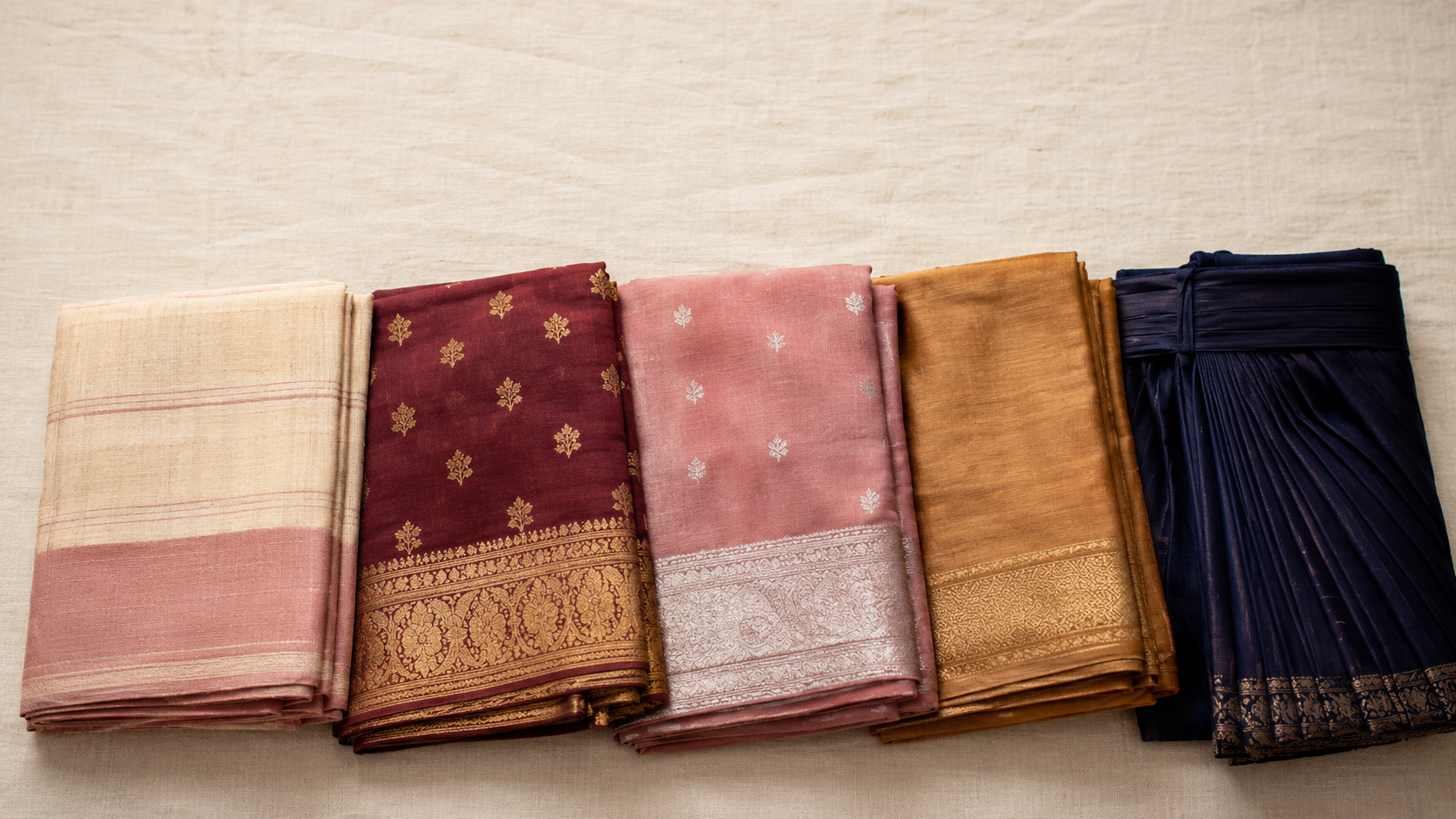
A saree wardrobe does not have to be large to be useful. Most Indian women who wear sarees regularly own dozens — built up over decades through gifts, weddings, inheritance, and accumulation. For a European reader starting from zero, that is intimidating and unnecessary. This guide proposes a smarter approach: five carefully chosen sarees that, together, cover almost every occasion you are likely to face in the next five years. This is what we recommend.
In this guide
Why a saree wardrobe should be a capsule, not a collection
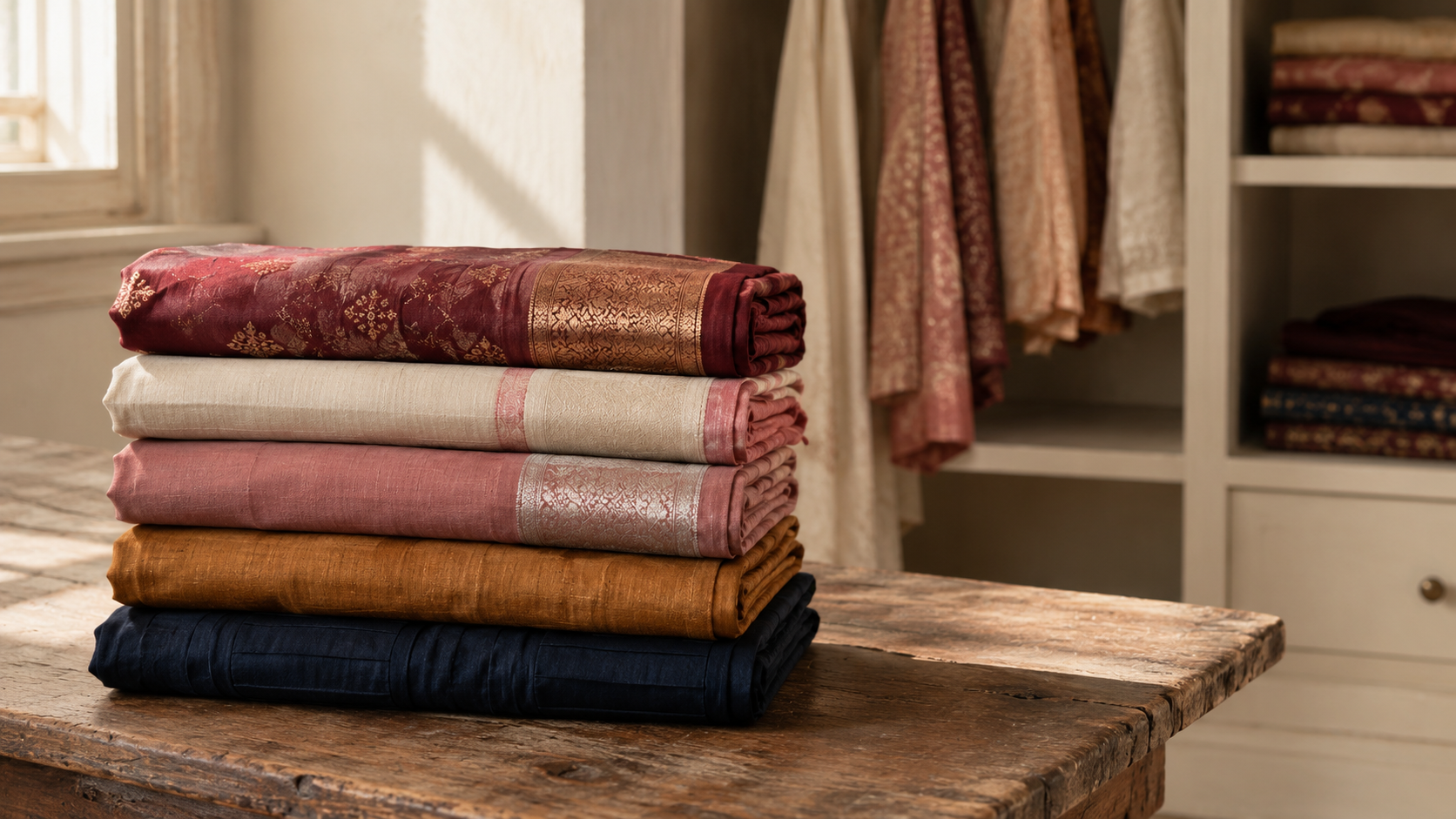
The idea of a capsule wardrobe — a small set of carefully chosen pieces that cover most occasions — was popularised in European fashion thinking in the 1970s. Applied to a saree wardrobe, the principle works even better. A saree is more versatile than a Western dress, easier to restyle, and longer-lasting. Five well-chosen sarees can do the work of twenty mediocre ones, and the cost of a five-piece saree wardrobe is lower than building a sprawling collection over time.
For European wearers especially, the capsule approach to a saree wardrobe makes sense. Storage space is limited. Travel back to India to buy new pieces is occasional. The occasions that call for a saree are fewer than they would be in Mumbai or Bengaluru, which means each piece in a European saree wardrobe must be flexible enough to serve several different roles. A capsule built with this constraint in mind serves European saree life far better than an accumulated collection of impulse purchases.
The five pieces we recommend are not a fixed prescription. They are a framework. The fabrics and colours should be adapted to the wearer’s region, occasions, and personal style. But the roles the five pieces play in a saree wardrobe should be preserved — each one solves a different problem.
The 5-piece saree wardrobe at a glance
Before we go into detail, here is the entire saree wardrobe capsule in one paragraph. One everyday cotton saree for daytime wear and drape practice. One formal silk saree (Banarasi or Kanjivaram) for weddings and major occasions. One lightweight day-to-evening saree (Chanderi or organza) for office events and daytime weddings. One wool or tussar saree for European winter. One pre-stitched ready-to-wear saree for last-minute occasions and busy mornings. Five pieces, four fabrics, every season covered — the working saree wardrobe in its most efficient form.
- Piece 1 — Everyday cotton saree (handloom). Full detail in our cotton saree guide.
- Piece 2 — Formal silk saree (Banarasi or Kanjivaram). See our silk comparison.
- Piece 3 — Lightweight day-to-evening (Chanderi or organza). See our chanderi guide and organza guide.
- Piece 4 — Wool or tussar saree for winter. See our tussar silk saree guide.
- Piece 5 — Pre-stitched ready-to-wear saree. See our pre-stitched saree guide.
Piece 1 — the everyday cotton saree
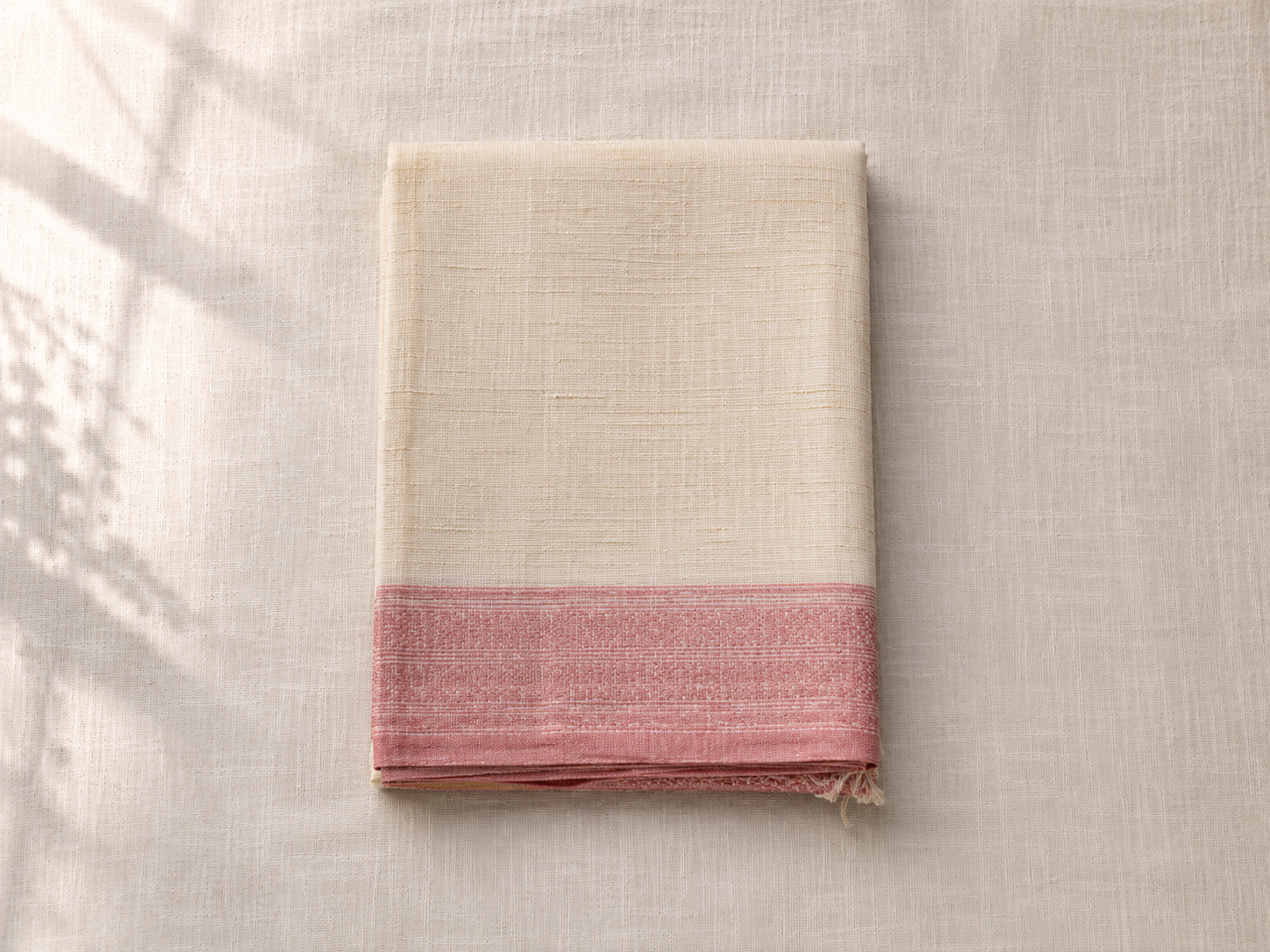
The first saree in any starter wardrobe should be a simple handloom cotton. Not silk, not heavy, not formal — a plain cotton saree in a neutral or earthy colour (cream, dusty pink, olive, soft maroon, deep navy) that you can wear without anxiety. The everyday cotton saree is where you learn to drape, where you build muscle memory, where mistakes are forgivable. It is the most-worn piece in most starter saree wardrobes.
What to look for: a handloom cotton saree around 5.5 metres long, with a simple woven border (not heavily embroidered), in a colour that pairs with multiple blouses. Bengal cotton, Khadi, and Mangalagiri cotton from Andhra Pradesh are three traditional handloom cottons that work beautifully for everyday wear. Each has a slightly different weight and weave, but all are forgiving for beginners. Our cotton saree guide covers the full handloom cotton landscape — regional variants, drape, care, and how to verify a genuine handloom.
For first-time draping practice, our step-by-step Nivi drape guide uses exactly this kind of saree as the recommended starter. The cotton’s weight and texture make the early drape attempts much easier than they would be with a heavier silk.
Piece 2 — the formal silk saree (Banarasi or Kanjivaram)
The second piece in a starter saree wardrobe is the investment piece — a formal silk saree for weddings, milestone celebrations, and the occasions that justify dressing properly. In any saree wardrobe, this is usually the largest single financial decision, and it rewards careful choice. The shortlist is almost always between a Banarasi and a Kanjivaram, the two great silk traditions of India.
For a European wearer choosing one formal silk saree, we tend to recommend a medium-weight Banarasi over a Kanjivaram for first-time owners. The Banarasi is lighter (600g–1.2kg vs 1.5–2.5kg for a Kanjivaram), drapes more fluidly, and is more forgiving in European indoor settings. A bridal-weight Kanjivaram can be tiring through a long evening reception with the winter layering we covered in our winter saree guide.
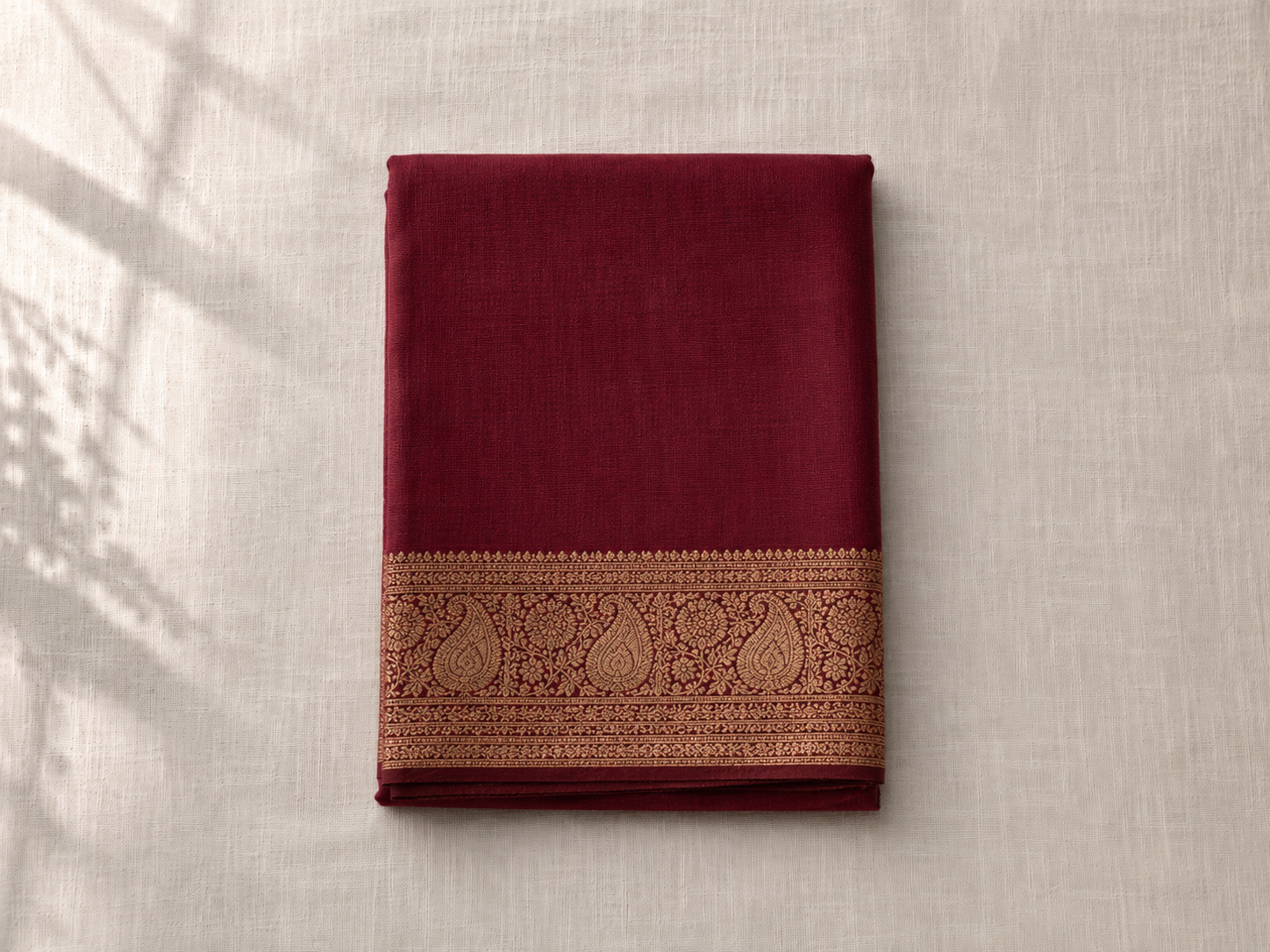
Colour matters more for this piece than for any other. A deep maroon, a wine red, a forest green, an ochre gold, or a midnight navy will carry you through almost every wedding you attend in Europe. Avoid pure white or very pale pastels — they require more frequent dry-cleaning and are harder to layer in winter. For the deeper Banarasi vs Kanjivaram decision, our honest comparison goes into the full detail.
Piece 3 — the lightweight day-to-evening saree (Chanderi or organza)
The third piece in the saree wardrobe is the bridge — something dressier than cotton but lighter than silk, suitable for daytime weddings, office events, festival evenings, and the wide middle ground between casual and formal. Two fabrics dominate this category: Chanderi and organza.
A Chanderi saree from Madhya Pradesh is a silk-cotton blend with a slight sheen and a distinctive woven texture. It drapes beautifully, layers well, and reads as quietly elegant. Our chanderi saree guide covers the regional weaving tradition, the three Chanderi variants, and choosing your first Chanderi in full. An organza saree is sheerer, more contemporary, and reads modern — it has become a signature fabric of contemporary Indian fashion in the past decade. Our organza saree guide covers the contemporary couture story, the four organza types, and the fragility considerations.
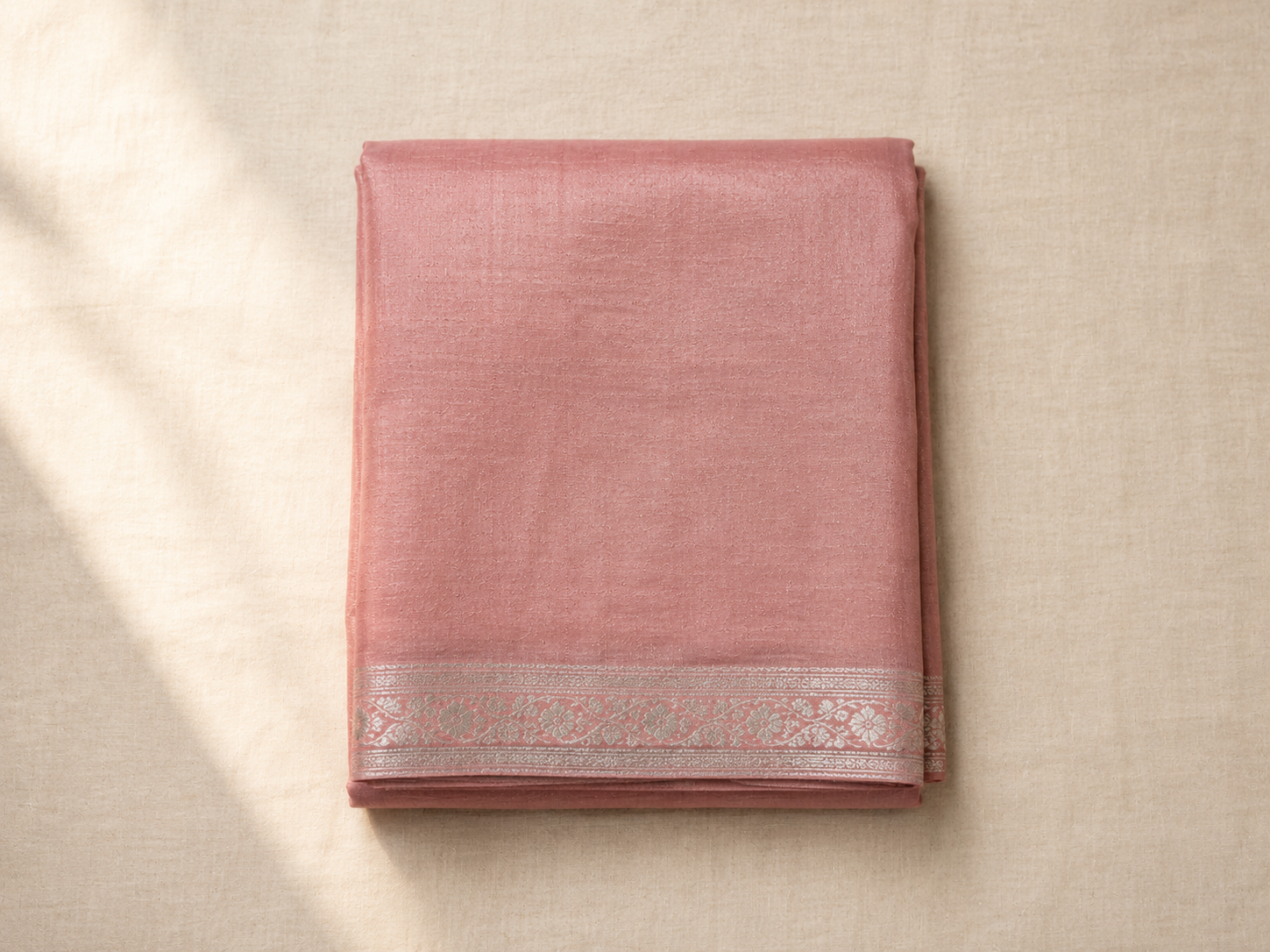
For Piece 3, colour can be softer than for Piece 2. Dusty pink, pista green, powder blue, pale gold, or soft lavender work beautifully. The lightweight nature of Chanderi and organza makes pastels practical here, because the fabric itself is the focal point.
Piece 4 — the wool or tussar saree for European winter
The fourth piece is the one most European saree wardrobes are missing: a fabric heavy enough for winter. A pure wool saree (pashmina, fine merino, or Kullu wool) or a tussar silk saree — both with significantly more weight than a standard mulberry silk — are the two traditional choices, and either belongs in a saree wardrobe that needs to function from October to March.
Wool sarees come from Kashmir, Kullu, and other Himalayan regions where Indian winters are genuinely cold. They are designed for cold weather and behave beautifully in European winter conditions. A pashmina saree in particular layers with European winter coats in a way no other saree does.
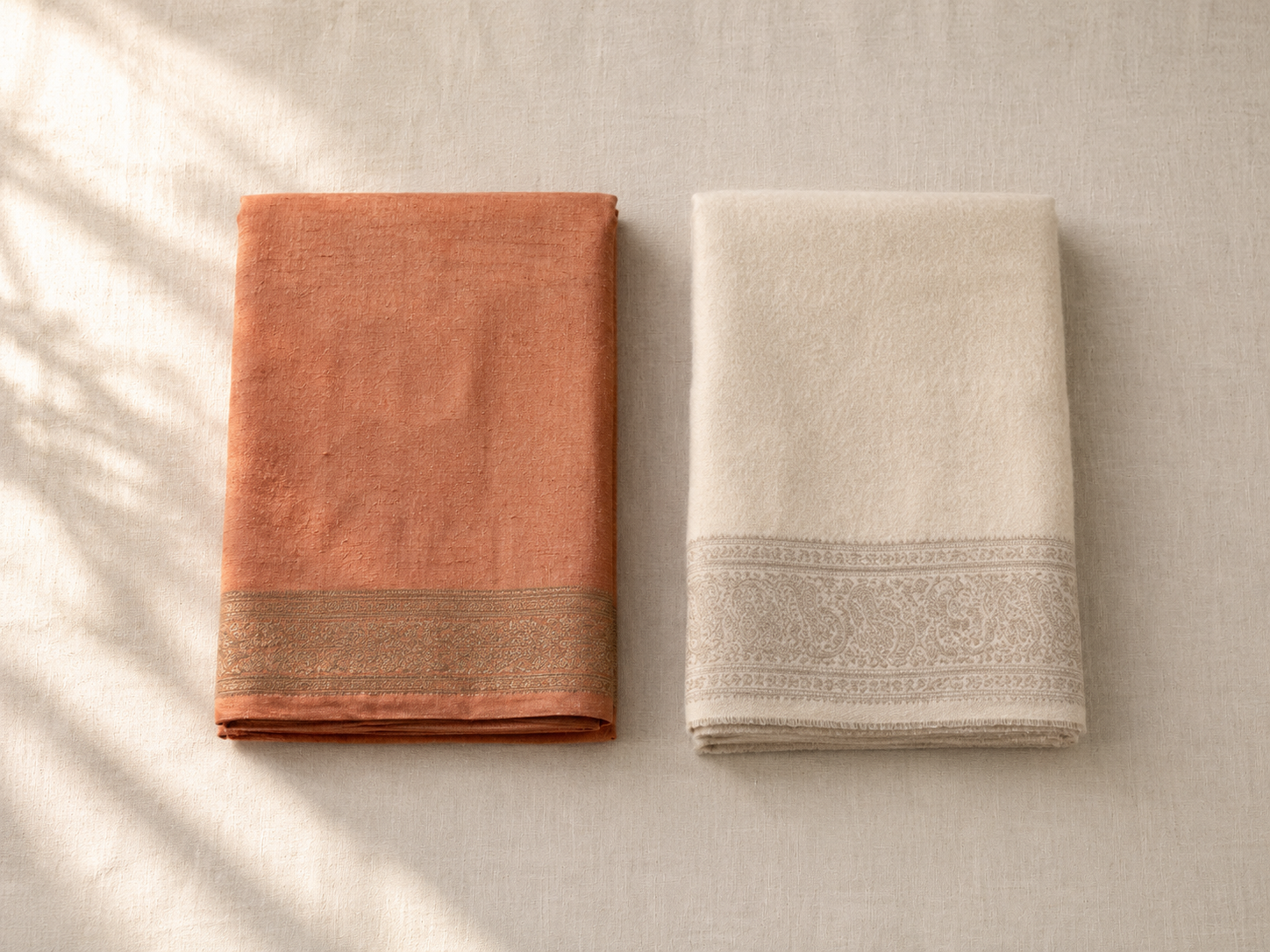
Tussar silk is the alternative — a thicker, naturally textured wild silk that holds warmth better than mulberry silk and reads richer in winter light. Our tussar silk saree guide covers the wild silk tradition, the five regional variants (Bhagalpuri, kosa, Madhya Pradesh, Bengal, Odisha), the sustainability story behind forest-foraged silk, and the ahimsa silk question. For a saree wardrobe that needs to function from October to March, Piece 4 may end up being the one you wear most often. Our winter saree guide covers the full layering principle that makes these fabrics work in European cold.
Piece 5 — the pre-stitched ready-to-wear saree
The fifth and final piece in the saree wardrobe is the most modern, the most often dismissed, and the most quietly useful: a pre-stitched ready-to-wear saree. A pre-stitched saree has the pleats and pallu already sewn into a skirt-like form. It puts on like a long fitted skirt, takes two or three minutes instead of twenty, and looks indistinguishable from a draped saree to anyone but the wearer. Our pre-stitched saree guide covers the three construction types (pre-pleated, drape-style, saree-gown), the honest cons of the format, and how to choose your first pre-stitched.
Traditionalists often dismiss pre-stitched sarees as not “real” sarees. We disagree. For a European saree wardrobe — where occasions are often during work weeks, getting ready time is short, and the wearer may still be learning to drape — the pre-stitched saree is a working garment. It belongs in the capsule.
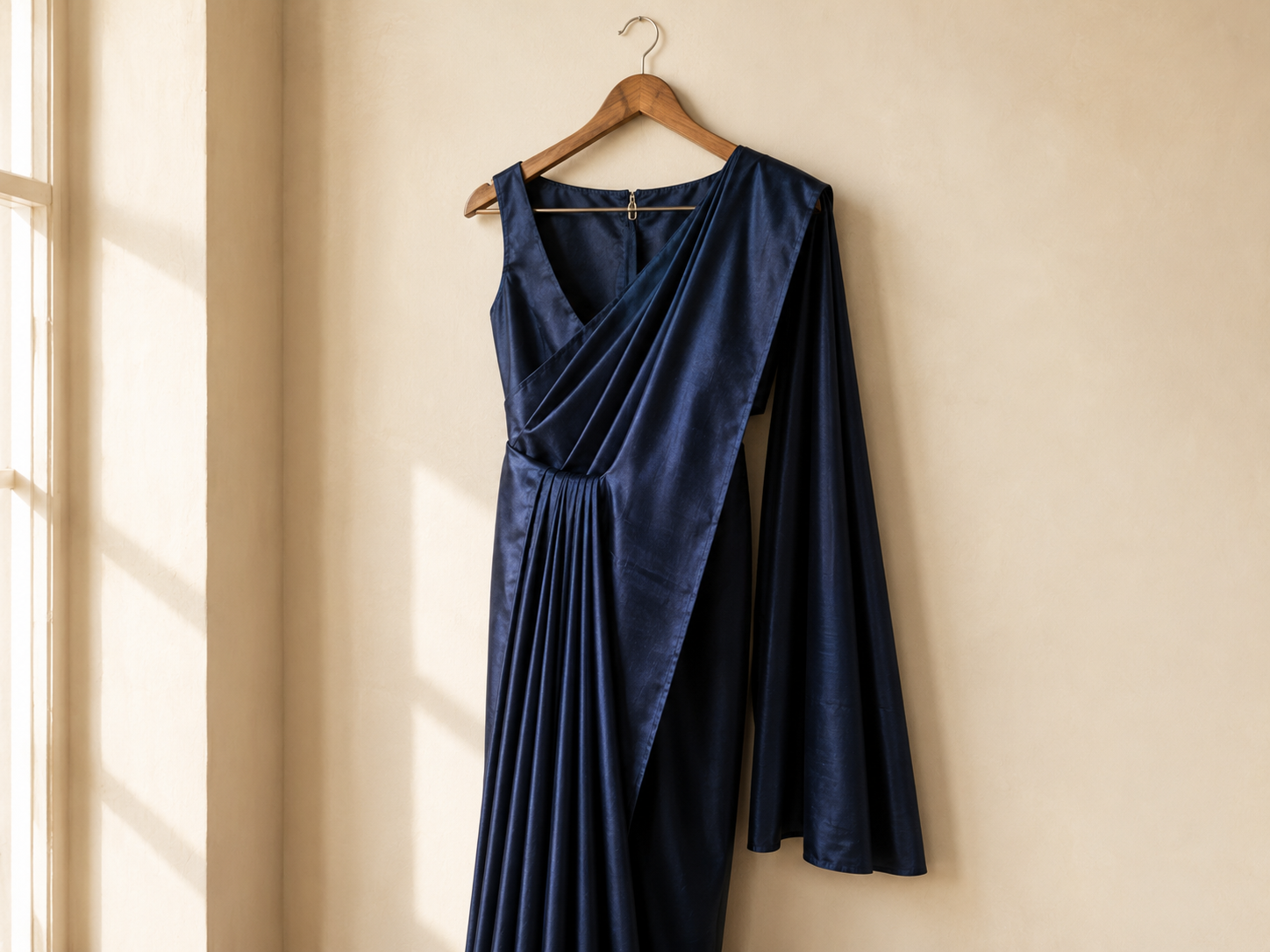
What to look for: a pre-stitched saree in a versatile silk-blend fabric (georgette, satin silk, or light pure silk) with a colour that bridges day and evening — deep navy, wine, emerald green, or a soft champagne. Avoid heavily embellished pre-stitched designs for the capsule piece; you want something that goes anywhere and reads quietly elegant. For the fabric question specifically, our georgette saree guide and chiffon saree guide cover the two most common pre-stitched fabrics.
Three saree blouses to pair with the capsule
Five sarees need pairing with blouses, but you do not need five blouses. Three well-chosen saree blouses, in compatible colours, will work with all five pieces in the saree wardrobe. This is where the capsule approach pays off — fewer, better-fitted blouses do more work than a cluttered drawer of mediocre ones.
The three blouses we recommend for a starter saree wardrobe: first, a short-sleeved boat-neck blouse in cream raw silk for daytime and lighter sarees. Second, a three-quarter-sleeved blouse in deep maroon or wine raw silk or brocade, for the formal silk saree and winter occasions. Third, a long-sleeved blouse in soft navy, black, or dark green velvet or brocade, for winter wear and the wool or tussar saree.
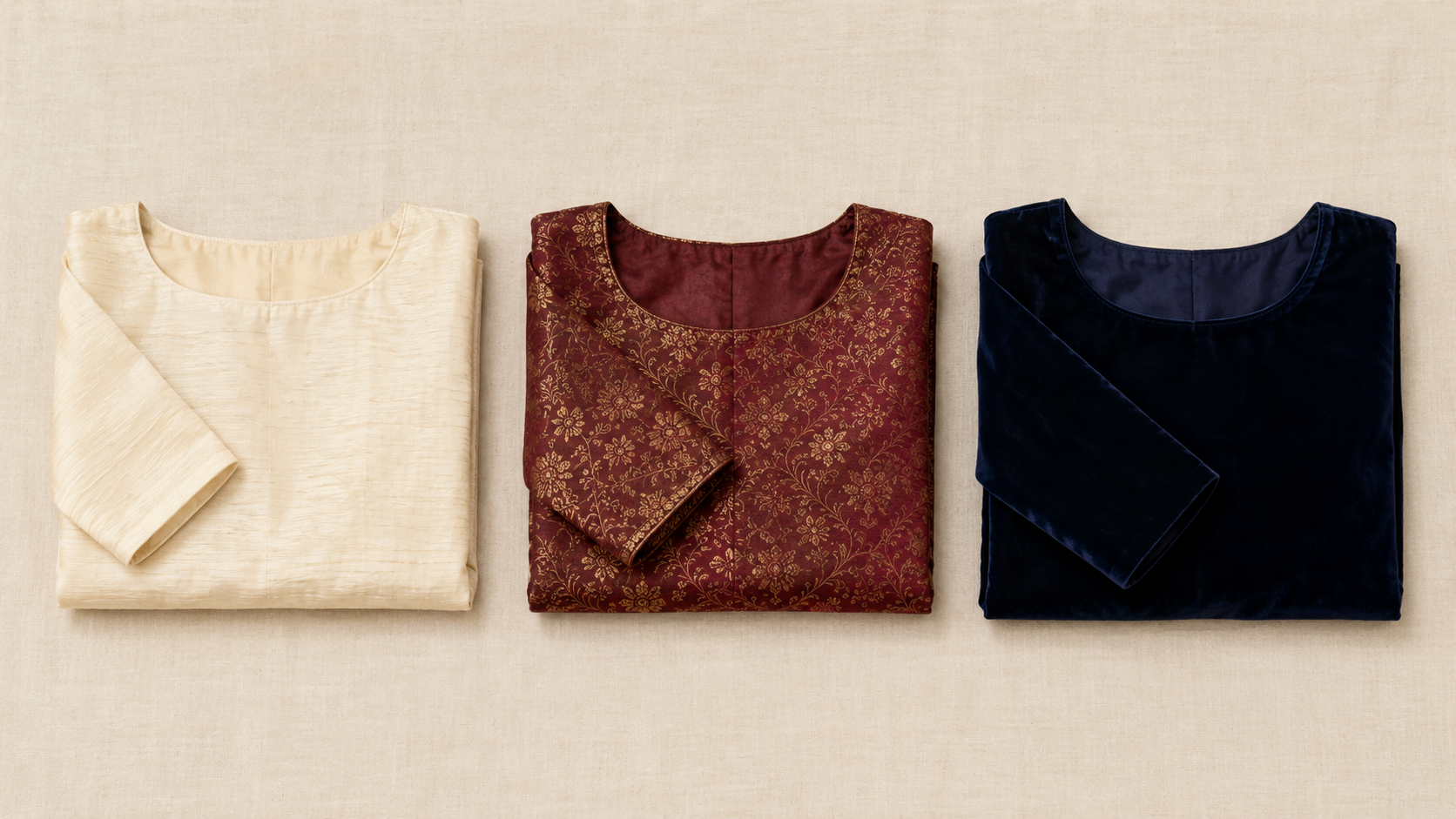
For the fit, neckline, and fabric decisions involved in each of these blouses, our complete saree blouse design guide walks through the four key decisions. The blouses are the single biggest fit decision in the saree wardrobe; the sarees are forgiving, the blouses are not.
How to store and care for a small saree wardrobe
A five-piece saree wardrobe is easy to store but rewards thoughtful storage. The principles that protect a silk saree from European indoor conditions — dry air from central heating, occasional moths, the temperature differential between cold winter days and warm interiors — apply equally to all pieces in the saree wardrobe. According to the Victoria and Albert Museum’s textile care guidance, the principles for museum textiles apply directly to heirloom sarees.
Store each saree folded in unbleached cotton or muslin, away from direct sunlight and not near a radiator. Refold every two to three months to prevent permanent crease lines. For silk sarees, dried neem leaves or natural cedarwood blocks repel moths without the chemical smell of mothballs. Hang pre-stitched sarees rather than folding — the constructed shape prefers a hanger.
The five-piece capsule fits comfortably in a small dedicated drawer or two shelves of a wardrobe. Resist the temptation to add a sixth or seventh piece in the first year; the discipline of the capsule pays off as you learn what you actually wear and what gathers dust.
A 12-month saree wardrobe build plan
For most European wearers, building a five-piece saree wardrobe in a single shopping trip is neither practical nor advisable. A more realistic approach: build the saree wardrobe over twelve months, starting with the pieces you will use most.
Months 1–3: Acquire Piece 1 (everyday cotton). The cheapest piece, the most forgiving, the one you will practise draping with. According to Vogue India, cotton sarees have been the foundation of saree-wearing for centuries — they remain the natural first piece for any new wearer.
Months 4–6: Acquire Piece 5 (pre-stitched ready-to-wear). This is the piece that will get you through the first few formal occasions while you are still learning to drape. The pre-stitched saree removes the time pressure that often derails first attempts.
Months 7–9: Acquire Piece 3 (Chanderi or organza). The most-occasion-flexible piece in the capsule — by month seven you will start being invited to events where this piece is the right answer.
Months 10–11: Acquire Piece 4 (wool or tussar) if winter is approaching, or save this for next year if you are heading into summer. The seasonal piece is best acquired close to its season.
Month 12 onward: Acquire Piece 2 (the formal silk Banarasi or Kanjivaram). This is the largest investment and benefits from waiting — by month twelve you know your draping confidence, your colour preferences, and the occasions you actually need formal silk for. A heritage silk saree at the end of the first year is a fitting milestone for completing the capsule.
Frequently asked questions
How much should I expect to spend on a 5-piece saree wardrobe?
Costs vary widely. A genuine handloom cotton saree (Piece 1) might cost the equivalent of 80 to 150 euros at source. A pre-stitched ready-to-wear saree (Piece 5) typically sits in the 100 to 250 euro range. A Chanderi or organza saree (Piece 3) ranges from 150 to 400 euros. A pure wool or tussar saree (Piece 4) costs 200 to 600 euros. A genuine handloom silk Banarasi or Kanjivaram (Piece 2) is the largest investment, ranging from 400 euros for entry-level handloom to several thousand for bridal-weight heritage pieces. A full five-piece saree wardrobe built carefully sits somewhere between 1,000 and 3,000 euros depending on the silks chosen.
Can I build a saree wardrobe without going to India?
Yes. Several India-based online saree retailers ship to Europe with international logistics. Returns and exchanges from Europe are harder than within India, so first orders are best kept small. Indian community shops in major European cities (London, Paris, Frankfurt, Hamburg) often carry a selection of everyday cottons and georgettes. Heritage handloom silks are more reliably sourced from India directly — either through a trusted family connection, an online specialist, or a single in-person trip.
What if I only want to own one saree?
If your saree wardrobe will be a single piece, choose Piece 3 (Chanderi or organza) over the others. It is the most flexible — it works at daytime weddings, evening parties, festivals, and formal dinners. A medium-weight Chanderi in a dusty rose, pista green, or soft champagne, paired with a well-cut cream silk blouse, will carry one-saree wearers through more occasions than any other single fabric.
How do I expand the saree wardrobe beyond five pieces?
Once the capsule is built, expansion follows your actual life. If you attend many south Indian weddings, add a second silk in a complementary colour to Piece 2. If your winters are long and saree occasions plentiful, add a second wool saree. If you travel often for festivals, add a second Chanderi in a contrasting colour. The expansion should be need-led, not impulse-led. Most European saree wearers we know hit a comfortable equilibrium around 8 to 12 pieces total. For evening events specifically, a chiffon saree is often the natural sixth piece — our chiffon saree guide covers the case.
What if I inherit sarees — do they fit into this capsule?
Inherited sarees are gifts to a saree wardrobe and should be treated as additions rather than capsule replacements. A heritage silk inherited from a grandmother often fills the role of Piece 2 (formal silk) automatically, in which case the saree wardrobe becomes four pieces to acquire instead of five. Inherited sarees may need cleaning, refolding, or minor repairs before their first wearing — a tailor experienced with silk can usually handle this.
Is a pre-stitched saree really worth its place in the capsule?
For European wearers, yes. The pre-stitched saree solves a specific problem — the time pressure of getting ready for an occasion when draping skills are still developing or when the morning is short. It also solves the travel problem: a pre-stitched saree packs flatter than a draped one, requires no separate petticoat, and arrives ready to wear at the destination. It is the most modern piece in the capsule and the least traditional, but it earns its place by solving real problems that traditionalists never had to solve. Our pre-stitched saree guide covers the full case.
One more thing
Five sarees is not a lot. For someone arriving from a saree-wearing family, where wardrobes hold thirty pieces accumulated over decades, the capsule may feel sparse. But for European wearers building a saree wardrobe from zero, five pieces is more than enough to feel dressed for any occasion the next five years will bring. The discipline of the capsule is also the freedom of it — fewer decisions, fewer pieces gathering dust, more time spent actually wearing the sarees you own.
For those building toward this capsule, our complete library of fabric guides supports each piece. The beginner’s guide to sarees covers the foundational vocabulary. Our cotton saree guide covers Piece 1; the Banarasi vs Kanjivaram comparison guides the silk decision for Piece 2; our chanderi and organza guides cover Piece 3; our tussar silk saree guide covers Piece 4; our pre-stitched saree guide covers Piece 5. The draping tutorial teaches the Nivi, the winter saree guide covers the cold-weather considerations, and the blouse design guide handles the three blouses that complete the capsule.
Follow the journey
Be there from day one.
IndiaNiva is launching its online shop soon. Until then we are building quietly — sourcing capsule-worthy sarees, researching tailors in Europe, and writing guides like this one. Two thoughtful emails a month. Nothing more.
Continue reading
- What is a saree? An essential beginner’s guide — the foundation before building a wardrobe
- Cotton saree guide — the everyday foundation (Piece 1)
- Banarasi vs Kanjivaram — the silk decision for Piece 2
- Chanderi saree guide — the dressy daytime fabric (Piece 3)
- Organza saree guide — the contemporary alternative (Piece 3)
- Tussar silk saree guide — the sustainable winter silk (Piece 4)
- Pre-stitched saree guide — the modern ready-to-wear (Piece 5)
- Georgette saree guide — flexible expansion fabric
- Chiffon saree guide — the evening expansion piece
- How to wear a saree in winter — the layering principle for Piece 4
- How to drape a saree — the step-by-step Nivi tutorial
- Saree blouse design — the three blouses that complete the capsule
This saree wardrobe guide draws on conversations with European saree wearers in Germany, France, and the Netherlands, and the Victoria and Albert Museum’s South Asia collection for historical context on saree wardrobes across generations. Where specific references appear, the source is linked. All information is correct at the time of writing.